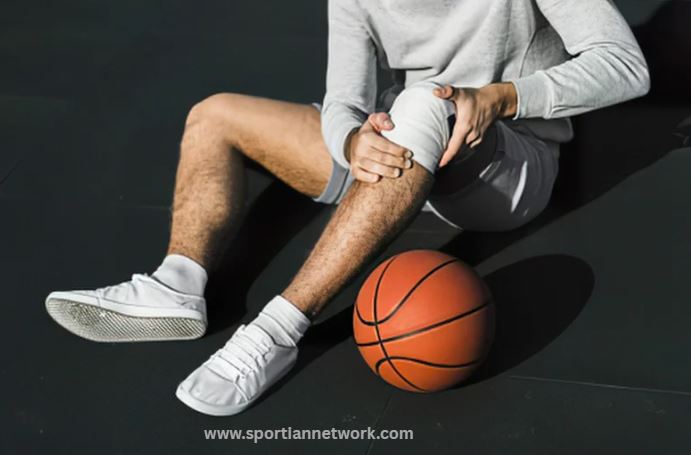
Jumper’s knee is the injury that ends seasons quietly. It does not happen in one dramatic moment. It builds over weeks of practice, drilling, and games until one morning the pain below the kneecap is impossible to ignore. Every basketball player who jumps and cuts repeatedly is at risk. Understanding what it actually is, why it develops, and how to fix it properly is the difference between a two-week setback and a six-month one.
This article is for informational purposes only and does not replace professional medical advice. If you are experiencing persistent knee pain, consult a qualified healthcare provider before returning to play.
What Jumper’s Knee Actually Is
The clinical name is patellar tendinopathy. The patellar tendon connects the kneecap to the tibia and transmits the force your quadriceps produce every time you jump, land, sprint, or cut. It is one of the most load-bearing tendons in the body and it takes an enormous amount of stress in basketball specifically because of the high volume of jumping combined with rapid direction changes on hard court surfaces.
Tendinopathy means the tendon tissue has been repeatedly stressed beyond its ability to recover. The collagen structure within the tendon degrades and becomes disorganised. This is not the same as a tendon tear and it is not a simple inflammation. The old term “tendinitis” implied inflammation was the primary problem, but current understanding is more nuanced. The tissue changes, becomes painful with load, and loses its ability to store and release energy efficiently. That is what slows players down and causes the familiar aching tenderness directly below the kneecap.
Why Basketball Players Get It More Than Most
Basketball involves more vertical loading per session than almost any other sport. A single game can involve hundreds of jump landings. Practice adds more. A player who trains twice daily, plays games on weekends, and skips dedicated recovery work is asking their patellar tendon to absorb forces it has never been properly prepared for.
The sport compounds this with hard court surfaces that return force quickly to the joints, repetitive sprint and stop mechanics that load the knee through deceleration, and a competitive culture where playing through minor pain is normalised long past the point where it is sensible.
Younger players are particularly vulnerable because their training volumes often increase faster than their tendons can adapt. Tendons are slower to strengthen than muscles, which means a teenager who builds quad strength rapidly through a strength training programme may have muscles pulling on a tendon that has not yet caught up structurally.
Recognising Jumper’s Knee: The Symptom Pattern
The pain is almost always located at the inferior pole of the patella, which is the bony point at the bottom of the kneecap. Press there with a finger and a player with patellar tendinopathy will feel sharp tenderness immediately.
In the early stages, the pain appears at the start of activity and then fades as the tendon warms up. This is one reason players ignore it. The session feels fine after the first ten minutes and the temptation is to believe the problem is resolving. It is not. The tendon is simply becoming less sensitive under load temporarily.
As the condition progresses, pain appears during activity as well as before it. At a more advanced stage, pain occurs during daily activities like walking down stairs or rising from a chair. A player who reaches that point has been training through a significant problem for too long.
The Load Management Reality
Patellar tendinopathy is a load problem. Too much repetitive tensile stress without adequate recovery is what causes it and load management is what fixes it. This is not the same as rest. Complete rest actually makes tendon tissue more fragile and slower to recover. The goal is modified loading that keeps the tendon stimulated without driving further degradation.
Understanding how to monitor training stress objectively helps enormously here. Session RPE tools give players and coaches a practical way to track cumulative load across a week, which is important because jumper’s knee typically develops when weekly spikes in training volume are too large relative to what the athlete has been doing in previous weeks.
During active management of the condition, the volume of jumping and sprinting needs to be reduced temporarily while targeted tendon loading is introduced. Continuing to train at full volume while adding a few exercises underneath that work is not load management. It is wishful thinking.
The Eccentric and Heavy Slow Resistance Protocol
The most well-supported treatment approach for patellar tendinopathy in athletes is a progressive loading programme that uses eccentric and heavy slow resistance exercise to stimulate tendon tissue remodelling.
Isometric Loading for Pain Relief
In the acute phase when pain is significant, isometric exercises are the starting point. A wall sit held for 45 seconds produces a strong analgesic effect on tendon pain in many patients and allows loading without the reactive flare that dynamic exercises can cause early on.
The mechanism is not fully understood but the pain relief from isometric loading is well-documented and clinically useful. A player who needs to compete during early recovery can use isometric loading before games to temporarily reduce pain. This does not treat the underlying problem but it is a safer short-term strategy than anti-inflammatories before performance.
Eccentric Single-Leg Decline Squat
The eccentric decline squat became the gold standard for patellar tendinopathy rehabilitation after research in the early 2000s showed far better outcomes compared to standard physiotherapy. The exercise is performed on a 25-degree decline board, which increases the load on the patellar tendon specifically compared to a flat surface squat.
The player lowers slowly on the affected leg over three to five seconds, then uses both legs to return to the start position. The eccentric phase is the therapeutic component. Three sets of 15 repetitions twice daily was the original protocol. As pain allows, weight is added via a backpack or weight vest.
This exercise is uncomfortable. The pain experienced during the exercise should sit between three and five out of ten. Going above that is too much. Zero pain is a sign the load is insufficient to drive adaptation.
Heavy Slow Resistance
As the tendon responds and pain reduces, heavy slow resistance training replaces or supplements the eccentric work. Leg press, squat, and leg extension performed at a slow tempo with heavier loads develops the structural integrity of the tendon more completely than eccentric work alone. Research comparing the two approaches has shown comparable outcomes, and most current rehabilitation programmes combine both.
Single leg training is a key component of return-to-sport work because basketball involves so many unilateral landings and pushoffs. A player whose injured leg cannot match the strength output of their healthy leg is not ready to return, regardless of how the pain feels in straight-line movement.
Hamstring and Posterior Chain: The Missing Element
Most patellar tendinopathy programmes focus exclusively on quadriceps loading because the patellar tendon connects to the quad. This is correct but incomplete. The posterior chain, particularly the hamstrings and glutes, plays a critical role in decelerating the knee joint during landing. A player with weak hamstrings and glutes absorbs more landing force through the quadriceps and patellar tendon than one whose posterior chain is properly developed.
Nordic curls build the eccentric hamstring strength that slows knee extension on landing and reduces the reactive load on the patellar tendon. They are one of the most underprescribed exercises in basketball rehab and prevention. A player returning from jumper’s knee without addressing their hamstring strength is leaving a significant vulnerability in place.
The broader case for posterior chain training as a foundation for knee health is well established. A player who squats and deadlifts seriously is building the posterior chain that protects the front of the knee, not just the muscles that load it.
Plyometric Reintroduction
Returning to jumping before the tendon is ready is the most common cause of relapse. The plyometric reintroduction phase should be gradual and criteria-based rather than time-based. A player should not return to full jumping volume simply because four weeks have passed. They should return because specific strength and performance benchmarks have been met.
A general progression looks like this: double-leg box landings, then single-leg box landings, then low-height jumping with long recovery, then progressive jump volume with monitored symptoms, then sport-specific jump patterns at game intensity.
The plyometrics done right guide covers the progressions and volume management principles that apply directly to this reintroduction phase. Rushing this stage is where most players end up back at square one.
Shoe Choice and Court Surface
Not all of this is training-related. The basketball shoes a player uses affect how much force the knee absorbs on every landing. A shoe with inadequate cushioning or a worn midsole transmits more ground reaction force to the joints above it. Players who spend significant time on their feet should replace training shoes every 500 to 700 hours of use regardless of how the upper looks.
The basketball shoes guide covers the specific features that matter for knee health, including midsole cushioning, heel height, and outsole rigidity. Footwear is not a substitute for proper rehabilitation, but it is a modifiable variable that affects total load on the patellar tendon across a season.
Court surface matters too. Outdoor concrete surfaces return force to the joint more aggressively than sprung hardwood indoor courts. Players who train primarily outdoors are exposing their tendons to harder loading conditions and should account for that in their overall training volume.
Ankle Mobility and Its Effect on the Knee
Restricted ankle dorsiflexion forces the knee to compensate during squat and landing patterns, which alters the angle of force through the patellar tendon and increases localised stress at the inferior pole. This is not a theoretical relationship. Players with limited ankle mobility consistently show altered knee mechanics under load.
The basketball-specific ankle mobility routine addresses the restrictions that are most common in basketball players and most directly linked to knee loading patterns. Ankle mobility work done consistently as part of a warm-up routine costs five minutes and reduces the mechanical stress on the patellar tendon during every jump and landing that follows.
Warm-Up Before Play
A targeted warm-up before every session and game reduces the reactive sensitivity of the patellar tendon to load. This means isometric holds as described above, progressive lower body activation, and ankle mobility work before any jumping begins. The warm-up science is clear that tissue that has been progressively loaded before maximal demands are placed on it performs better and sustains less cumulative stress.
The dynamic warm-up routine for athletes provides the full-body structure within which these basketball-specific additions fit. Players who arrive and immediately begin full-speed shooting drills or game play without warm-up are increasing their patellar tendon stress from the very first repetition of the session.
Recovery Between Sessions
Patellar tendinopathy is a recovery failure as much as a loading failure. The tendon can handle significant load if it is allowed to recover adequately between sessions. Double session days, back-to-back game schedules, and insufficient sleep all compromise the recovery window that tendon tissue needs to remodel.
Recovery between training sessions covers the practical steps that accelerate tissue repair, including sleep quality, nutrition timing, and soft tissue work. Sleep quality specifically has a direct effect on tissue repair and players who are chronically under-sleeping are compromising their tendon recovery regardless of how well they manage their training load.
When to See a Clinician
Self-managed rehabilitation is appropriate for mild to moderate patellar tendinopathy in athletes who understand load management principles. It is not appropriate for players whose pain is worsening despite reduced load, whose pain is present during rest, who have had a sudden increase in symptoms after a jump or landing, or who have swelling or structural changes around the tendon that were not there before.
A sports physiotherapist or sports medicine physician can confirm the diagnosis with imaging if needed, rule out other causes of anterior knee pain including patellofemoral syndrome, which is covered in the runner’s knee guide, and provide a supervised rehabilitation programme for more severe presentations. The ACL injury guide is also worth reading for any player who experiences sudden, high-force knee events, as ACL tear prevention requires a different approach entirely from tendinopathy management.