Most people watching spring training from the stands see the same drills, the same sun-soaked fields, the same leisurely-looking warmups. What they miss is that two completely different conditioning programmes are running in parallel the entire time.
Pitchers and position players share the same clubhouse. They do not share the same training plan. The physical demands of each role are different enough that treating them the same way produces worse results for both and raises injury risk for pitchers specifically.
This article breaks down what each group does, why the programmes diverge, and what any serious baseball athlete can take from how the pros structure their spring build.
Why Spring Training Conditioning Exists
Baseball has a 162-game regular season. Athletes go from months of relatively lower activity in the off-season to daily competition across six months. Without a structured transition, the jump in workload would destroy joints, tendons, and arms inside the first month.
Spring training is the bridge. It runs roughly six weeks, mid-February through late March for most MLB clubs. The goal is not peak fitness. The goal is controlled, progressive ramp-up to game readiness without accumulating the kind of stress that causes early-season injuries.
Periodisation principles apply here the same way they apply to any sport. The body needs sequential loading phases. Jump too fast and tissue fails. Build too slowly and you arrive at Opening Day underprepared.
How Pitcher Conditioning Differs
The pitcher’s arm is the most injury-prone structure in professional sport. Ulnar collateral ligament tears, rotator cuff strains, and flexor-pronator injuries have ended more careers than any other category of baseball injury. Spring training for pitchers is designed entirely around protecting and gradually loading that arm.
The Throwing Programme Is the Conditioning Programme
For pitchers, the arm build is the central axis of everything else. It starts with short-toss at low intensity in week one. Distance and effort increase week by week, measured in pitch counts, intensity percentages, and number of high-effort throws rather than just mound appearances.
The formal structure is called an arm care or throwing programme. Pitchers do not simply throw until they feel ready. Coaches track cumulative stress across each day and week. A starter who throws 25 pitches in a live batting practice session on Wednesday does not throw bullpen work two days later. Recovery between efforts is non-negotiable.
Shoulder health is the non-negotiable foundation underneath all of this. Rotator cuff strength, scapular stability, and posterior shoulder capacity are trained year-round and maintained actively throughout spring. Pitchers who skip shoulder maintenance work during the off-season arrive to spring with tissue that is not ready to absorb the demands of a six-week ramp.
Band Work and Shoulder Prep
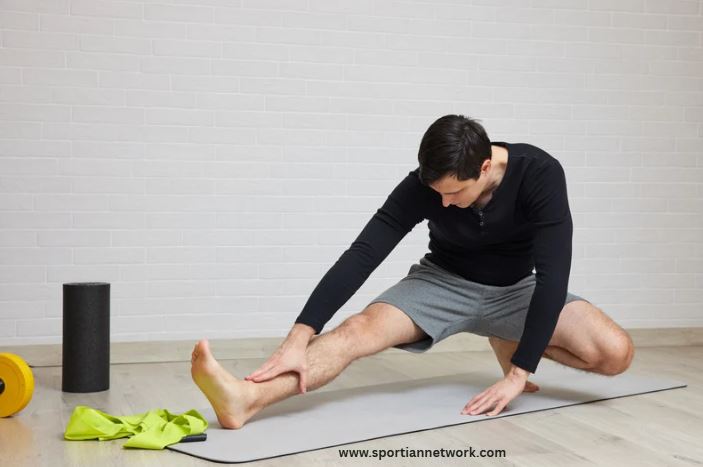
Before every session involving throwing, pitchers run through a structured shoulder activation sequence. Bands, light dumbbells, and bodyweight movements target the rotator cuff musculature and prime the scapular stabilisers before any arm stress is applied.
Band warm-up work for the shoulder is not optional for pitchers. It is the first non-negotiable in every training day. Athletes who skip it are asking the rotator cuff to absorb throwing load on cold, uninitiated tissue.
Lower Body and Core
Pitching generates force from the ground up. Leg drive off the rubber, hip rotation, and trunk stiffness determine how much arm the pitcher needs to use to reach full velocity. A mechanically efficient pitcher with strong legs and a stable core puts less stress on the elbow and shoulder than one who throws arm-dominant.
Spring conditioning for pitchers includes hip hinge work, single-leg exercises for stability and force transfer, and rotational core training. The posterior chain work supports the deceleration demands of pitching. A throwing arm decelerates from 100mph to zero in milliseconds after ball release. The muscles responsible for that braking action run from the posterior shoulder down through the hip and glute on the landing leg.
Posterior chain training built properly through the off-season means pitchers arrive at spring with the structural foundation to absorb that deceleration repeatedly across a full season.
What Pitchers Do Not Do in Spring
Heavy lower body training early in spring camp is typically avoided for starting pitchers. A starter who squatted heavy the day before a bullpen session arrives with fatigued legs and compromised mechanics. Strength work for pitchers in spring is maintenance-focused rather than gain-focused. The off-season is when pitchers chase strength improvements. Spring is when they protect what they built.
How Position Player Conditioning Differs
Position players do not have a single joint that carries the workload of an entire game. Their conditioning needs are broader. Speed, lateral movement, reactive agility, rotational power, and the stamina to play nine innings daily for six months are all in scope.
Volume and Running Work
Position players run significantly more than pitchers in early spring camp. Conditioning work for outfielders, infielders, and catchers includes base running mechanics, first-step quickness drills, lateral movement patterns, and increasing sprint distances across the first two weeks.
The goal is to rebuild the anaerobic conditioning that dissipates across an off-season. Baseball is not an aerobic sport in the traditional sense. Sprints are short, explosive, and repeated across several hours of game time. The conditioning model reflects that. Long slow running is largely absent from position player programmes at the professional level. Short accelerations, reactive change of direction, and repeated sprint capacity take priority.
Rotational Power Development
Hitting is a rotational skill. The physical quality underpinning it is rotational power, the ability to generate force through the transverse plane at high speed. Spring conditioning for hitters includes medicine ball work, rotational core exercises, and hip mobility maintenance alongside the technical batting practice that makes up most of their visible spring workload.
Romanian deadlifts and hip hinge variations build the posterior chain that drives hip rotation in the swing. Hitters with strong glutes and hamstrings generate more bat speed than those who rely on arms and upper body. Spring conditioning reinforces that connection between lower body strength and swing output.
Hamstring Health Is a Shared Priority
Hamstring injuries are one of the most common and most disruptive injuries in baseball. Outfielders accelerate hard from a standing start repeatedly. Baserunners sprint at near-maximum effort with no prior warm-up. The hamstring complex absorbs enormous load across a full season.
Both hamstring injury prevention work and hamstring strain rehab protocols are relevant here. In spring, healthy players use exercises like Nordic curls and eccentric hamstring loading to bulletproof the muscle-tendon junction before game speed demands begin. This is one area where position players and pitchers share a conditioning priority.
Catchers Are a Special Case
Catchers do not fit neatly into either category. They throw repeatedly like pitchers, absorb impact through the knees like no other position, and need the reactive agility of a middle infielder. Their spring conditioning typically includes dedicated knee resilience work, hip mobility, and a specific throwing arm programme that mirrors the pitcher model.
Catchers also suffer from the cumulative load of squatting hundreds of times per game across a season. Ankle dorsiflexion, hip mobility, and quad strength all receive specific attention in a well-run spring camp.
The Shared Foundations
Despite the differences, pitchers and position players share several conditioning priorities during spring camp.
Load management is applied across both groups. Coaches track RPE, pitch counts, sprint volumes, and total training stress to ensure no athlete exceeds what the body can recover from in 24 to 48 hours. Spring training is not a competition. Every decision is subordinate to arriving at Opening Day healthy.
Nutrition timing matters significantly during a six-week camp where athletes train twice daily in warm climates. Muscle tissue rebuilding, hydration replacement, and fuelling between sessions determine how well each athlete absorbs the training load across the full camp.
Warm-up science is taken seriously at the professional level in a way it often is not at amateur and collegiate levels. A full dynamic warm-up precedes every session. The belief that static stretching alone prepares an athlete for explosive movement has been abandoned at every serious programme.
What Amateur and College Baseball Athletes Can Apply
The principles governing professional spring conditioning translate directly to amateur and college programmes, even when the resources do not.
Progressive arm loading is the most critical carry-over. No pitcher at any level should go from throwing casually in the off-season to full-effort throwing without building across several weeks. The tissues in the medial elbow and shoulder do not care what level you play. They respond to load the same way.
Position players should prioritise hamstring health and rotational power work in their pre-season preparation rather than spending the bulk of time on batting practice alone. Physical conditioning determines how much you can train throughout the season. An athlete who arrives at opening day with a hamstring injury cannot play. An athlete who arrives strong, mobile, and conditioned can play every day.
Building an off-season training programme that transitions properly into a spring build is the structural decision that underpins everything else. The six weeks of spring conditioning do not stand alone. They are the final phase of a year-round athletic development cycle.