Hudl Sportscode is one of the most recognizable names in sports video analysis. Professional teams across the NFL, Premier League, NBA, and Olympic programs have used it for years. That reputation carries weight. But reputation alone does not justify a software decision, especially at Sportscode’s price point.
This review covers what Sportscode actually does well, where it falls short, who it is built for, and whether the investment makes sense for your program in 2026.
What Is Hudl Sportscode?
Hudl Sportscode is a professional-grade video analysis platform designed for coaches and performance analysts. It allows teams to capture, tag, code, and review game and training footage with a level of speed and precision that general video editing tools cannot match.
The software originated as Sportscode Elite before Hudl acquired it and integrated it into their broader ecosystem. Today it sits at the top of Hudl’s product tier, positioned above Hudl Focus and Hudl Studio as the tool built specifically for analysts and high-performance coaching environments.
The core function is live coding. Analysts can tag events in real time during a game or training session. Every tag creates a clip. Those clips are instantly sortable, searchable, and shareable. A coach can pull every transition sequence from a match, every set piece, every defensive breakdown, within seconds of the final whistle.
That speed is the product’s central value proposition.
Interface and Usability
Sportscode has a reputation for a steep learning curve. That reputation is earned.
The interface is powerful. It is not intuitive. First-time users face a significant investment of time before the software becomes efficient rather than frustrating. The coding window, timeline, matrix setup, and capture preferences all require deliberate learning. A new analyst coming from a simpler tool like Nacsport or Hudl’s own lighter products will need two to four weeks of consistent use before workflows feel natural.
Once that learning curve is cleared, the interface becomes genuinely fast. Experienced analysts describe Sportscode as the most efficient live coding environment available. The keyboard shortcut system is extensive and customizable. A well-designed code window with trained muscle memory produces tags faster than almost any competing platform.
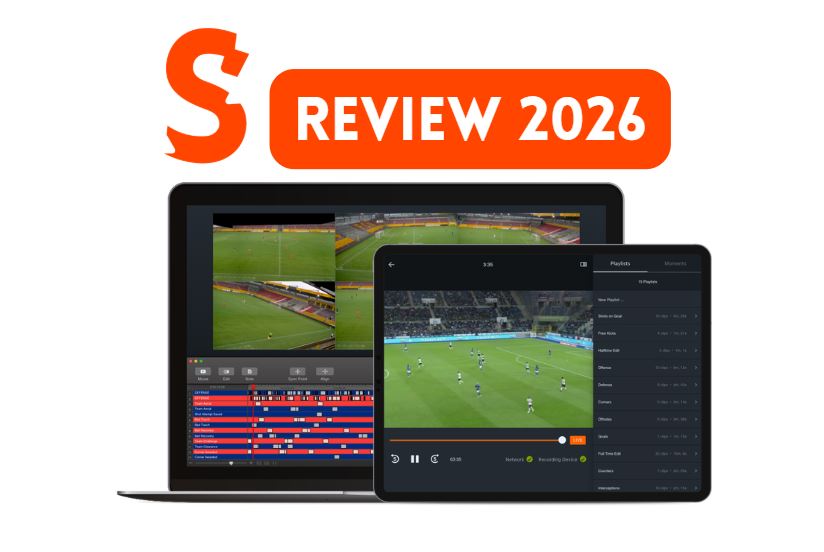
The matrix system, where coding buttons are arranged in a customizable grid linked to specific labels and data fields, is Sportscode’s signature feature. Each button can be color-coded, linked to multiple data fields simultaneously, and configured to start and end clips automatically based on predefined timing windows. This allows complex multi-variable coding at real-time pace.
For context, the sports analytics tools overview on Sportian Network covers how different platforms serve different analytical needs. Sportscode sits at the most analyst-centric end of that spectrum.
Interface score: 3.5 out of 5. Powerful when mastered. Demanding to learn.
Live Coding Performance
This is where Sportscode earns its professional reputation.
Live coding at match pace is the hardest technical challenge in sports video analysis. Events happen fast. Sequences overlap. A system that lags, crashes, or requires multi-step inputs loses data permanently. There is no rewinding a live game.
Sportscode handles live coding with exceptional stability. The software runs on local processing rather than cloud dependency, which means performance does not degrade with internet quality during live sessions. Tags register immediately. The timeline updates in real time without buffering.
The capture integration is similarly robust. Sportscode captures directly from video sources including cameras, HDMI inputs, and broadcast feeds simultaneously. Multiple camera angles can be captured and synced, allowing analysts to cut between angles on the same coded clip sequence. For sports where spatial context across multiple angles matters, rugby lineouts, basketball offensive sets, soccer pressing triggers, this multi-angle capability is genuinely valuable.
Compared to the Nacsport platform reviewed previously on Sportian Network, Sportscode’s live coding is faster and more stable under high event-frequency sports. Nacsport’s interface is more accessible for smaller programs. Sportscode’s ceiling is higher for experienced analysts working at elite level.
Live coding score: 5 out of 5. Best in class.
Video Clipping and Playlist Management
Post-session, Sportscode’s clip management is where the analysis workflow lives.
Tagged clips are automatically organized into categories defined during the coding session. Pulling a playlist of all high press sequences from a training week takes seconds. Filtering by opponent, player, date range, or outcome is intuitive once the matrix is properly configured.
The timeline view gives analysts a complete visual picture of a session. Event density, sequence patterns, and temporal spacing are all visible at a glance. This is particularly useful for physical performance analysis where the distribution of high-intensity events across a session matters as much as the events themselves. The connection to wearable injury prevention data is obvious here. Sportscode’s timeline alongside GPS load data creates a combined picture of what was happening tactically when physical demands peaked.
Clip export is clean and fast. Presentations for players, coaching staff, and opposition analysis can be assembled within Sportscode and exported as video packages without leaving the platform. The built-in drawing tools allow annotation on paused frames. Telestration options for live drawing during video playback are functional if not as polished as some dedicated presentation tools.
One limitation worth noting. Sportscode’s playlist management becomes more complex when working across very large libraries spanning multiple seasons. Search functionality across archived footage is less intuitive than within a single session. Teams with extensive historical databases sometimes supplement Sportscode with dedicated archival tools.
Clip management score: 4.5 out of 5.
Hudl Integration and Ecosystem
Sportscode’s acquisition by Hudl was a double-edged development.
The benefit is ecosystem integration. Teams already using Hudl Focus cameras for automatic game capture, Hudl Assist for outsourced coding, or Hudl’s athlete-facing highlight tools can connect those systems to Sportscode. Footage captured by Hudl’s camera systems flows directly into Sportscode’s workspace. This reduces the friction of footage management significantly for programs operating within the Hudl ecosystem.
The Hudl integration also enables direct sharing with athletes through the Hudl platform. Coaches can push clips from Sportscode analysis to individual players’ Hudl accounts. Players review their clips on mobile. This athlete feedback loop, from analyst coding to player review, happens within a single connected system.
The limitation is dependency. Sportscode’s deepest features work best when the surrounding infrastructure is also Hudl. Teams using competing camera systems, different athlete platforms, or non-Hudl workflows find some of the integration value disappears. The software still performs at a high level as a standalone tool. But the ecosystem pitch becomes less compelling outside of a full Hudl setup.
The AI-powered coaching apps landscape has also pushed Hudl to develop AI features within Sportscode. Automatic tagging through computer vision is available for specific sports and events. Shot detection in basketball, ball possession sequences in soccer, and set piece identification in rugby are all partially automated. The accuracy is useful but not yet reliable enough to replace human coding for high-stakes analysis. It functions best as a first-pass filter that a human analyst then reviews and refines.
Ecosystem and integration score: 4 out of 5.
Collaboration and Team Features
Sportscode handles multi-user environments with a dedicated server architecture. The Sportscode Hub acts as a central server that multiple analyst and coaching workstations connect to. Footage and coding databases are shared in real time across the network. An analyst coding on one machine updates the database immediately for a coach reviewing on another.
This networked architecture is standard in professional sports environments where dedicated performance departments have multiple staff working simultaneously. Head coach, assistant coaches, fitness staff, and analysts all access the same footage library from their own workstations.
For smaller programs without dedicated server infrastructure, this setup adds complexity and cost. Cloud collaboration features have improved in recent years but still lag behind cloud-native platforms for teams that need simple, accessible multi-device workflows.
Sharing outside the immediate staff network works through Hudl’s platform as described. For scouting workflows requiring external collaboration with other clubs, the sharing options are functional but require the receiving party to have appropriate Hudl account access.
Collaboration score: 3.5 out of 5. Excellent for large departments. Overkill for small programs.
Pricing and Value
Sportscode sits at the premium end of the sports analysis software market. Exact pricing is not publicly listed and requires direct contact with Hudl’s sales team. Based on market reporting and industry knowledge, annual licensing for Sportscode typically ranges from several thousand to tens of thousands of dollars depending on team size, feature tier, and whether server infrastructure is included.
This pricing structure means Sportscode is realistically positioned for professional clubs, national federations, Division I college programs, and well-funded semi-professional environments. A youth club, a small college program, or an independent analyst working with limited budget will find better value in alternatives.
The value proposition for programs that can afford it is genuine. The time saved by experienced analysts using Sportscode’s live coding speed over a full season is significant. The quality of opposition analysis, player development feedback, and tactical preparation enabled by the platform contributes directly to competitive outcomes. Professional clubs treat it as operational infrastructure, not discretionary spending.
For programs sitting between grassroots and professional level, the decision comes down to whether a dedicated analyst role exists and whether that analyst has the experience to use Sportscode at the level that justifies its cost. The software’s ceiling is very high. Reaching it requires significant investment in both the tool and the human using it.
Value score: 3.5 out of 5. Justified at professional level. Hard to justify below it.
Sport Coverage and Versatility
Sportscode covers a wide range of sports. Soccer, rugby, basketball, American football, ice hockey, Australian rules football, handball, volleyball, cricket, and athletics are all supported with sport-specific templates and coding frameworks.
The platform is not equally optimized across all sports. Its deepest feature sets and most refined pre-built templates are in soccer and rugby, reflecting the sports where professional adoption has been highest and longest. Basketball and American football coverage has improved significantly with NFL and NBA adoption. Niche sports may require more custom matrix building from scratch.
The customization capability means any sport with a video component can theoretically be analyzed through Sportscode. The effort required varies. A well-developed sport gets you started immediately with professional-grade templates. A less-common sport requires more build time before the system reflects your specific analytical needs.
Sportscode’s versatility across team sports makes it the most directly comparable tool in the sport analytics space to what the top sports analytics platforms article covers as a broader category. Where other platforms specialize narrowly, Sportscode attempts to serve the full spectrum of team sports at professional depth.
Sport coverage score: 4 out of 5.
Performance Under Pressure: The Real Test
Software review articles often focus on features. The more revealing test is how a platform behaves when conditions are not ideal.
Sportscode’s local processing architecture makes it resilient to the connectivity issues that cloud-dependent platforms suffer during live events. A stadium with poor wifi, a training ground without reliable broadband, an international trip with limited connectivity: none of these compromise Sportscode’s core live coding function because the critical processing happens on the local machine.
The platform’s stability under extended use is well-documented in professional environments. Analysts report consistent performance across marathon sessions that would challenge lighter software. Memory management is efficient enough that analysts do not need to restart mid-session to maintain performance.
The flip side is hardware dependency. Sportscode’s performance scales with the machine it runs on. Running it on underpowered hardware produces a different experience from running it on a well-specced analysis laptop or desktop. Teams investing in Sportscode should budget for appropriate hardware alongside the software license.
The mental performance demand on analysts under live coding conditions is real. An analyst coding a fast-paced basketball game or a high-press soccer team is making rapid categorization decisions under time pressure for 90 to 120 minutes continuously. Software that adds friction to that process through lag, crashes, or unintuitive shortcuts compounds analyst fatigue. Sportscode reduces that friction more than most platforms at its performance ceiling.
Who Should Use Hudl Sportscode
Sportscode makes the most sense for specific program types and roles.
Professional and semi-professional clubs with dedicated analysts who live in the software daily. The learning curve is only a problem if usage is infrequent. Daily users master the shortcuts and the platform becomes genuinely fast.
National federation and Olympic program environments where multi-sport, multi-analyst infrastructure is standard and the Hudl ecosystem is already deployed.
Division I and high-level college programs with analyst staff and a culture of video analysis embedded in coaching practice.
Programs transitioning from lighter tools who have outgrown the ceiling of their current platform and need deeper live coding capability and more sophisticated clip management.
Sportscode is harder to justify for part-time analysts, small clubs with limited video budgets, youth programs, or organizations where coaching staff are expected to both coach and analyse without dedicated analyst support.
Final Verdict
Overall: 4 out of 5
Hudl Sportscode is the closest thing to an industry standard in professional sports video analysis. Its live coding speed and stability are best in class. The matrix customization system enables coding complexity that competing platforms cannot match. The Hudl ecosystem integration creates genuine workflow efficiency for programs already invested in that infrastructure.
The limitations are real. The learning curve is steep. The pricing is premium. The collaborative architecture favors large departments over small programs. And outside the Hudl ecosystem, some of the platform’s most convenient features lose their value.
For the right program, with the right analyst, and the right budget, Sportscode is the best available tool. It earns four stars because it delivers on its professional promise at the level it was designed for. The missing star reflects the accessibility gap that keeps it out of reach for programs that could genuinely benefit from its capabilities but cannot justify the investment.
If you are a professional analyst or performance director evaluating video analysis platforms, Sportscode belongs at the top of your shortlist. If you are a smaller program looking for an accessible entry point into video analysis, the Nacsport review on Sportian Network covers a platform better matched to that context.
| Feature | Score |
|---|---|
| Interface and Usability | 3.5 / 5 |
| Live Coding Performance | 5 / 5 |
| Clip Management | 4.5 / 5 |
| Ecosystem and Integration | 4 / 5 |
| Collaboration | 3.5 / 5 |
| Value for Money | 3.5 / 5 |
| Sport Coverage | 4 / 5 |
| Overall | 4 / 5 |