
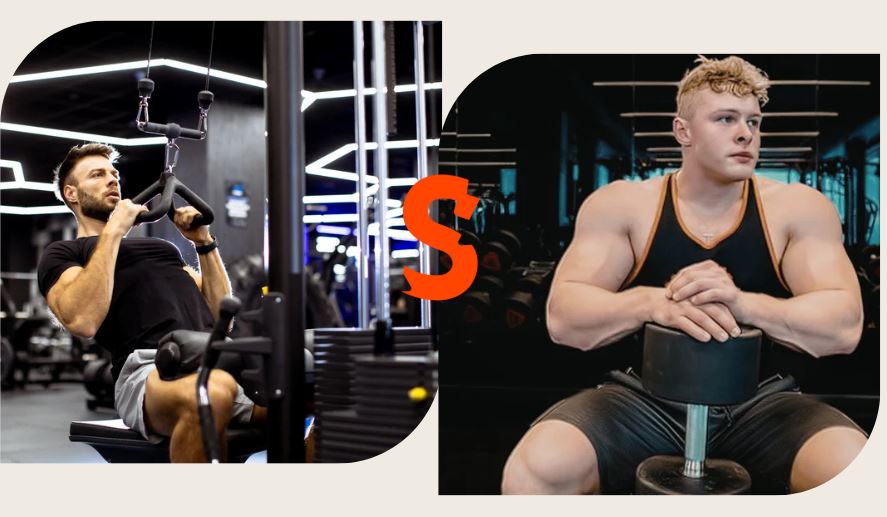
The cable vs free weight debate has been running in gyms for decades, and it produces more heat than light because most people frame it as an either-or choice. It is not. Both tools are valuable. The question worth answering is which one serves your specific goal better in a given context, and understanding that distinction is what separates athletes who programme intelligently from those who just pick up whatever is closest.
The Core Mechanical Difference
Free weights (barbells, dumbbells, kettlebells) move through a path determined by gravity and your body position. Resistance always pulls straight down. Your muscles must not only produce force but also control the implement through three-dimensional space. That demand for stabilisation is a feature, not a bug.
Cable machines apply resistance through a cable attached to a weight stack via a pulley system. The pulley changes the direction of force, meaning you can load a muscle from almost any angle regardless of where gravity points. Resistance stays relatively constant throughout the range of motion rather than varying with limb position.
That single mechanical difference has downstream consequences for everything: which muscles are most challenged, how joints are loaded, how much stabiliser demand is created, and how much the movement transfers to sport.
Where Free Weights Win
Maximum Strength Development
When the goal is absolute strength, the ability to produce maximum force, free weights with a barbell are unmatched. The squat, deadlift, bench press, and overhead press have a century of evidence behind them as the most effective tools for building raw force output. The unstable, three-dimensional nature of the barbell demands that your entire system learns to produce force as a coordinated unit rather than in isolation.
For any athlete whose sport demands moving heavy loads or producing high force quickly (sprinters, throwers, combat athletes, field sport players), free weight compound movements form the core of a well-built programme. The posterior chain training that underpins most athletic power development is built primarily on free weight movements: the deadlift, Romanian deadlift, hip thrust, and squat variations.
Sporting Transfer
Free weights train the body to produce force while managing an unstable load in space. That is much closer to what actually happens in sport than most cable exercises. When a rugby player scrums, a wrestler shoots for a takedown, or a baseball player rotates through a swing, the body must coordinate force across multiple joints simultaneously against an unpredictable external demand. Barbell and dumbbell training builds that capacity in a way cable machines largely do not.
The hip hinge mechanics that underpin explosive athletic movement (the jump, the sprint, the throw) are best trained with free weights because the hinge pattern under load through space is more specific to those demands than any cable variant.
Grip and Stabiliser Development
Holding a barbell or dumbbell builds grip strength, wrist stability, and forearm endurance as a byproduct of every session. These qualities matter across almost every sport. Grip strength is one of the best predictors of overall strength and athletic longevity, and free weight training develops it passively while cable handles largely bypass that demand.
Home and Minimal Equipment Training
Free weights require less infrastructure. A barbell, a rack, and a set of plates take up a fraction of the space and cost of a functional trainer. Anyone building a serious home setup on a real budget, the kind covered in the home gym under $300 guide, will get more return from free weights than from any cable alternative at that price point.
Where Cable Machines Win
Constant Tension Through Full Range
With a barbell curl, the resistance at the top of the movement is significantly lower than at the midpoint because your forearm is nearly parallel to the floor and the lever arm is short. With a cable curl, tension remains relatively consistent through the full range. For hypertrophy (muscle growth), constant tension through lengthened and shortened positions produces a strong stimulus. The science of muscle hypertrophy points clearly to mechanical tension and metabolic stress as the primary drivers of growth, and cables deliver both efficiently.
This matters most for isolation work on smaller muscle groups: biceps, triceps, rear deltoid, rotator cuff muscles, and the muscles of the mid and lower back that are difficult to load effectively with free weights alone.
Angle Specificity
Cables allow you to position the resistance vector precisely. You can load the chest from a low-to-high angle, a horizontal angle, or a high-to-low angle, something dumbbells and barbells cannot replicate without dramatically changing your body position. This is particularly useful for athletes who need to train specific movement patterns that free weights do not match well, such as the rotational demands of throwing and swinging sports.
For shoulder health and rehabilitation, the ability to load the rotator cuff from almost any angle makes cables extremely valuable. The exercises that form a proper rotator cuff strengthening programme are largely cable-based for exactly this reason: the angle specificity allows precise loading of the external rotators without the joint stress that barbell pressing creates.
Training Around Injuries
When a joint is compromised, free weight movements often become too painful or risky because the body must stabilise the implement on top of producing force. Cables allow the load to be reduced, the angle to be adjusted, and the range of motion to be controlled in ways that barbells and dumbbells do not permit. An athlete with a shoulder injury can often continue training the surrounding musculature with cables long before they can safely return to overhead pressing with a barbell.
Core Training in Multiple Planes
Free weight core exercises (planks, loaded carries, deadlifts) predominantly challenge the core in resisting extension and lateral flexion. Cables add the capacity to train rotational core strength with consistent resistance through the full rotational range. Pallof press variations, cable woodchops, and rotational rows develop anti-rotation and rotational strength that transfers directly to throwing, swinging, and striking sports. This is where cable machines genuinely outperform free weights for sport-specific core development, as the core training for athletes framework makes clear.
Beginners Learning Movement Patterns
A beginner learning to row, press, or perform a tricep extension on a cable faces a lower coordination demand than the same person trying to control a dumbbell through space. Cables guide the movement slightly, which can help establish the neuromuscular pattern before the load and stabilisation demands of free weights are added. This is not a long-term reason to stay on cables, but it is a legitimate use case for athletes early in their training.
The Goal-by-Goal Guide
Goal: Maximum Strength
Free weights win clearly. Barbell squat, deadlift, bench press, and overhead press are the foundation. Cables play a supporting role for accessory work only.
Goal: Muscle Hypertrophy
Both tools are effective. Use free weight compounds as the primary stimulus and cables as a finishing tool to add volume, constant tension, and angle-specific work for lagging muscle groups. The combination outperforms either tool alone for most athletes serious about body composition.
Goal: Sport Performance
Free weights form the majority of the programme, particularly compound movements that mirror the force demands of the sport. Cables serve a specific role in rotational power development and targeted isolation for injury prevention. The 10 most important strength exercises for athletes leans heavily on free weights for exactly this reason.
Goal: Injury Prevention and Prehab
Cables win here. The ability to load vulnerable joints from precise angles at controlled intensities makes cables the preferred tool for shoulder health, rotator cuff work, hip abductor training, and any programme designed to strengthen tissue around an unstable or previously injured joint.
Goal: Rehabilitation
Cables win again, for the same reasons plus the added benefit of easier load management and range of motion control during the early stages of return to training.
Goal: Home Training
Free weights win on cost and space efficiency. A functional trainer capable of replicating full cable training costs several hundred dollars at minimum and requires significant floor space. A barbell and plates deliver more raw training stimulus per dollar than any cable alternative. If budget allows and space permits, a compact cable attachment that mounts to a power rack, covered in the home gym under $1000 guide, gives you both options without a full functional trainer footprint.
The Most Common Mistake: Choosing One and Ignoring the Other
Athletes who only use free weights tend to neglect rotational strength, develop muscular imbalances from always training in gravity-dependent planes, and accumulate joint stress in the shoulders and elbows without the targeted accessory work that cables enable. Athletes who only use cables tend to develop less raw strength, poorer stabiliser function, and weaker grip, and their training transfers poorly to the actual demands of sport.
The real reason most athletes plateau in strength training often comes down to a failure to use the right tool for the specific adaptation they need. Trying to build maximum squat strength with cables is the wrong tool for the job. Trying to build rotator cuff health with a barbell overhead press when you have impingement is also the wrong tool for the job. Knowing which is which is the skill.
A well-designed programme for a serious athlete uses free weights as the primary strength and power stimulus, cables as the primary accessory and injury prevention stimulus, and structures them within a coherent periodisation framework that adjusts the ratio based on the phase of training and the demands of the competitive calendar.
The Practical Split Most Athletes Should Use
In a typical strength session, free weight compound movements (squat or deadlift variation, a pressing movement, a pulling movement) should account for 60 to 70 percent of total training volume. Cable work fills the remaining 30 to 40 percent, targeting specific muscle groups, adding rotational training, and addressing any joint health priorities identified by the athlete or coach.
That ratio shifts during injury management phases, where cable work may temporarily dominate. It also shifts during peaking phases for strength sports, where free weight specificity becomes the priority and accessories are reduced.
The single-leg training question follows a similar logic: dumbbell split squats and Bulgarian split squats deliver more stabilisation demand than cable single-leg work, making them the better primary tool, while cables suit targeted accessory movements where the unilateral loading angle matters more than the stabilisation challenge.
Neither tool is better. They solve different problems. The athlete who understands that is the one who builds a complete, durable, high-performing body.