Shin guards are one of those pieces of kit most athletes buy once without thinking too hard, then wonder why they feel wrong, slip constantly, or fail to protect when it actually matters. The problem is almost never the price point. It is buying the wrong type for the wrong sport.
Shin guards for soccer and shin guards for Muay Thai share a name and roughly similar anatomy. Beyond that they are different tools built for different jobs. A field hockey guard has almost nothing in common with a taekwondo shin pad beyond the body part it covers. Getting this right before you spend money saves pain, wasted kit, and in some cases a broken leg.
This guide covers every major sport that requires shin protection, what to look for in each, and how to make the right call in 2026.
What Shin Guards Actually Do
The tibia, the main shin bone, sits directly beneath the skin with minimal soft tissue protection. A direct strike, kick, or collision to the tibia without protection causes intense pain, bone bruising, and in high-impact contact scenarios a genuine fracture risk.
Shin guards work by distributing the impact energy across a harder outer shell and dissipating it through a foam backing before it reaches the bone. The shell spreads the load over a wider surface area. The foam absorbs the remainder. Neither element works well without the other.
What shin guards do not do is eliminate all risk. A hard direct kick in Muay Thai or a two-footed tackle in soccer still transmits force through a guard. The goal is meaningful reduction in injury severity, not invincibility.
They also protect against abrasion, the slow skin damage from repeated sliding tackles, mat friction, or contact with boots and equipment that accumulates over a season.
Soccer Shin Guards
Soccer is the sport most people associate with shin guards, and the variety available reflects how seriously the sport takes lower limb protection. Tackles arrive from every angle, studs make contact with shins regularly, and the tibia absorbs impact in ways that would sideline players for weeks without protection.
Types of soccer shin guard
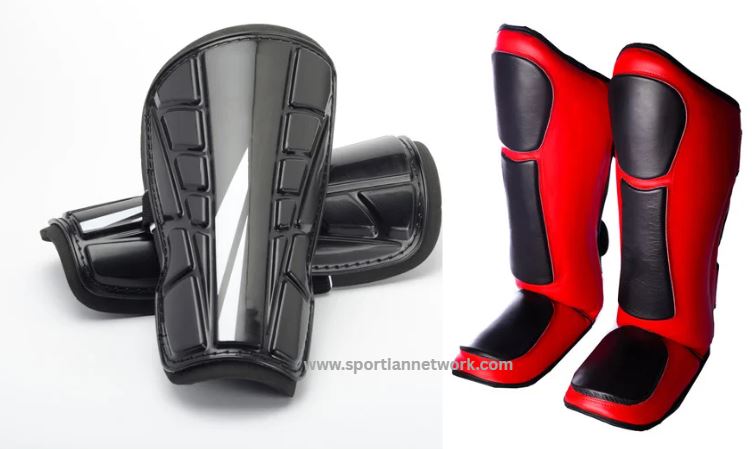
Slip-in guards are the most common at adult level. They are a single hard shell with a foam backing, no ankle support, held in place by the compression of a sock pulled over the top. Lightweight, low-profile, and preferred by most senior players who value freedom of movement over maximum protection.
Ankle guards add a stirrup that wraps under the foot and soft ankle padding on either side of the malleolus. More common in youth and amateur play where ankle protection matters more than the minimal extra weight. Some players find the ankle stirrup restricts movement; others appreciate the added stability.
Sleeve guards come with an integrated compression sleeve rather than a separate sock arrangement. The guard clips or slots into a pocket in the sleeve. Stays in position better than slip-ins but adds a layer of compression around the calf that some players find uncomfortable in heat.
Fit for soccer
The guard should cover from roughly two finger-widths above the ankle to two finger-widths below the knee. Gaps above or below the covered zone leave real estate exposed to studs and tackles. Width matters too. A narrow guard that does not cover the full face of the tibia leaves the medial and lateral edges unprotected.
For youth players, the strength training for teenagers guide is worth reading alongside this one. Young athletes in contact sport benefit from both proper protective equipment and the structural strength that makes lower limbs more resilient under impact.
Pair your guard choice with the right soccer cleats for the surface you play on. Protection works as a system. The right cleat reduces the slip and fall scenarios that produce the most severe shin impacts. The guard handles what the cleat cannot prevent.
What to prioritise in 2026
Low weight and secure fit. Modern shells use polypropylene and carbon fibre composites that are harder than older plastic constructions without adding bulk. If a guard shifts during play, no material quality compensates for it moving out of position under a tackle.
Muay Thai and Kickboxing Shin Guards
Muay Thai shin guards bear almost no resemblance to soccer guards functionally. In Muay Thai you both receive and deliver kicks with the shin. The guard needs to protect your own tibia from incoming strikes, protect your training partner from the full force of your kicks, and stay in position during clinch work, sweeps, and throws.
Construction differences
Muay Thai guards are thick, curved foam constructions with a hard shell or dense leather exterior. They wrap around the shin and the top of the foot, covering the instep. Velcro straps at the back hold them in place. The foam volume is significantly greater than any soccer guard because it needs to absorb and redistribute the force of a full-power roundhouse kick in both directions.
Genuine leather guards last significantly longer and compress more predictably than synthetic alternatives. For serious training, leather is worth the price difference.
Sizing for Muay Thai
Muay Thai guards are sized by weight class or body weight rather than height. A heavier, more powerful kicker needs a denser, longer guard to protect both themselves and their training partner. Under-sized guards in heavy sparring cause bruising and stress reactions in the shin bone over time. Those stress reactions can develop into stress fractures if ignored.
Shin splints share some of the same underlying pathology as repetitive shin impact stress. Athletes who train Muay Thai without adequate guard protection are accelerating the bone stress that produces that kind of overuse injury.
For beginners versus experienced fighters
Beginners benefit from larger, more protective guards that reduce the deterrent effect of painful shin conditioning. For experienced fighters whose shins have adapted to impact, lighter guards that allow more sensitivity in sparring are often preferred.
The Muay Thai beginners guide covers what to expect in your first months of training. Equipment choices are part of that conversation. Arriving to your first sessions with a guard that actually fits prevents the discouraging early soreness that sends many beginners to the door.
Field Hockey Shin Guards
Field hockey shin guards sit between soccer and Muay Thai in terms of bulk and coverage. The ball is hard and travels fast. A mis-hit shot or a drag-flick from a penalty corner delivers significant impact to an unprotected shin.
Field hockey guards tend to be longer than soccer guards, often covering more of the lower leg, and include more pronounced ankle protection. Many designs also include instep protection because the foot and ankle receive direct ball contact regularly.
Key considerations
Fit inside a sock without bunching. Field hockey involves significant running and direction changes. A guard that shifts inside the sock causes distraction and compromises protection during play. Look for designs with anatomical shaping that conforms to the leg rather than sitting flat against it.
Ice Hockey and Roller Hockey Shin Guards
Ice hockey shin guards are full protective systems rather than simple shin shields. They cover from the knee cap to the skate boot, incorporating knee cap protection, shin protection, and calf coverage in one integrated piece. They are worn under the hockey sock and held in place by elastic straps or tape at the knee and ankle.
What separates quality levels
Entry-level guards use basic foam. Mid-level and high-level guards incorporate harder knee caps, denser shin foam, and lighter composite shells that absorb high-puck impact without adding significant bulk. For competitive play at high school level and above, mid-grade protection at minimum is appropriate.
Mobility matters. A guard that limits knee flexion impairs skating mechanics. Try hockey guards with skates on where possible. The combination of boot, guard, and sock layers affects fit significantly more than the guard alone.
Taekwondo and Martial Arts Shin Guards
Taekwondo shin guards are lightweight, flexible, and designed for fast footwork rather than heavy impact absorption. Most designs are foam-based with a thin shell, secured with elastic straps or velcro behind the calf.
The contact rules of the competition format determine what guard you need. Olympic-style taekwondo uses electronic scoring systems with approved protectors. Point-based or continuous contact formats may use different approval standards. Always verify the guard meets the specific governing body requirements for your event.
For BJJ and grappling athletes who add striking work, the complete beginners guide to Brazilian Jiu-Jitsu covers the overall equipment picture. Shin guards for grappling cross-training are lighter and lower-profile than Muay Thai guards to avoid restricting ground movement.
How to Choose Across All Sports: Universal Rules
Certification and standards
Governing bodies in most sports publish approved equipment lists or minimum protection standards. FIFA, World Taekwondo, and sport-specific organisations specify what counts as compliant protection. A guard that does not meet the standard for your sport may not be allowed in competition regardless of its actual quality.
Retention and fit
A guard that moves is a guard that fails. Every sport creates movement patterns that test retention. Soccer players slide tackle. Muay Thai fighters clinch and sweep. Field hockey players sprint and turn. Test fit actively before committing. Slip, squat, sprint in place, and simulate the movements of your sport while wearing the guard before deciding.
Kinesio tape is sometimes used to secure guards that shift under game conditions. It is a practical workaround but not a substitute for proper fit. If you are regularly taping a guard in place it is the wrong size or design.
Weight versus protection trade-off
As with most athletic equipment, weight and protection exist in tension. More protection typically means more material, more bulk, and more weight. The right balance depends on the sport. A professional footballer choosing a 60g carbon shell slip-in is making a rational choice for their context. A youth hockey player in the same guard is not.
Match the protection level to the actual contact demands of your sport and level of play. Amateur recreational soccer in a Sunday league needs less protection than academy-level youth training where physical development and long-term bone health matter more than cutting grams.
Replacing worn guards
Foam compresses permanently over time. A guard that has absorbed two or three seasons of hard contact no longer distributes impact the way it did when new. Inspect the foam layer regularly for permanent compression, cracks in the shell, and worn velcro that no longer holds position. Replace guards showing those signs regardless of how much life they appear to have left.
This applies the same way to all protective equipment. The wetsuit buying guide and tennis racket guide both emphasise knowing when equipment has passed its useful life. Shin guards are no different.