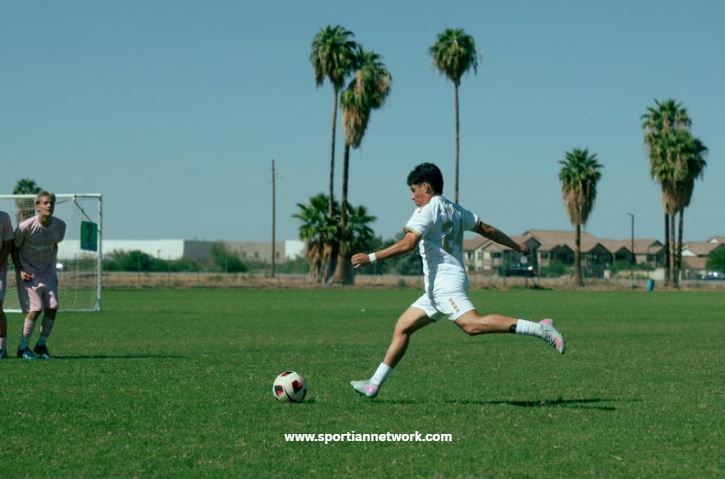

Nimedes is a neuromuscular inhibition detection tool used in sprinting biomechanics to identify stride asymmetry. It measures the difference in muscle activation timing, ground contact duration, and propulsive force output between the left and right leg during maximum velocity sprinting. When those differences exceed a threshold the system flags as significant, the athlete has a detectable neuromuscular asymmetry that is costing them speed and increasing their injury risk simultaneously.
Every sprinter has some degree of asymmetry. Perfect bilateral symmetry does not exist in human movement. However, there is a difference between minor natural variation and a functionally significant inhibition pattern that compounds across hundreds of strides per session. Nimedes distinguishes between the two. It identifies asymmetries large enough to affect performance and flag injury risk, while filtering out the minor variation that is simply part of normal human locomotion.
The detection happens through a combination of force plate data, high-speed video analysis, and surface electromyography. Together these inputs produce a neuromuscular inhibition score for each leg across four sprinting phases. When one leg scores significantly lower than the other in any phase, the nimedes system identifies the inhibited side, the phase where inhibition occurs, and the likely muscle group responsible.
Why Stride Asymmetry Matters More Than Most Coaches Realize
A sprinter running 100 meters takes approximately 44 to 48 strides. Each stride involves a ground contact phase and a flight phase. During ground contact, the leg must absorb force, stabilize the joint, and then produce propulsive force to drive the body forward. That sequence must happen in roughly 80 to 100 milliseconds at maximum velocity.
When one leg produces less propulsive force than the other, the body compensates. The stronger leg works harder to maintain velocity. The stride length on the inhibited side shortens. The ground contact time on the inhibited side lengthens because the leg needs more time to generate the force it cannot produce quickly enough. Over 44 strides, these small differences accumulate into a measurable performance gap.
More critically, the compensation patterns that develop around stride asymmetry are precisely the mechanisms that produce overuse injuries. The stronger leg accumulates disproportionate load. The hip flexors on the inhibited side work harder to compensate for reduced propulsive power. The lumbar spine rotates asymmetrically to help the weaker side contribute. All of these compensations are invisible to the naked eye during a sprint. Nimedes makes them measurable.
Speed training fundamentals emphasize bilateral development for exactly this reason. Asymmetry limits the ceiling of speed development because the inhibited side always acts as a brake on the stronger side’s output. Nimedes identifies where that brake is operating so training can address it precisely.
The Four Sprint Phases Nimedes Measures
Nimedes evaluates neuromuscular function across four distinct phases of the sprinting stride. Each phase has specific muscle activation requirements and its own inhibition signature.
Phase 1: Initial ground contact. This is the moment the foot strikes the ground during maximum velocity sprinting. At this instant, the quadriceps and hip extensors must be pre-activated before contact to stiffen the leg and prevent collapse. If pre-activation is delayed or insufficient on one side, the leg buckles slightly on contact and energy leaks out of the system rather than being stored and returned.
Nimedes detects this through EMG timing analysis comparing the pre-activation window on both sides. A difference of more than 12 milliseconds between sides in the pre-activation window is flagged as a significant inhibition pattern.
Phase 2: Loading and force absorption. Once the foot contacts the ground, the entire lower limb chain absorbs the impact force. The ankle, knee, and hip flex slightly in a controlled eccentric sequence that stores elastic energy in the tendons and muscles. On the inhibited side, this eccentric absorption is typically shorter and stiffer, meaning less elastic energy is stored for the subsequent propulsion phase.
Plyometric training develops the elastic energy storage capacity that phase 2 demands. Athletes with a strong plyometric base show more symmetrical loading patterns in nimedes phase 2 analysis because their tendons and muscles have been specifically trained to absorb and return force efficiently on both sides.
Phase 3: Propulsion and push-off. This is the active drive phase where the hip extensors, quadriceps, and calf generate the force that accelerates the body forward. Asymmetry in phase 3 is the most directly performance-relevant finding nimedes produces. A significant propulsive force deficit on one side means that leg is contributing less to forward velocity than the other on every single stride.
The posterior chain is the primary driver of phase 3 output. The gluteus maximus generates hip extension power. The hamstrings contribute to both late swing deceleration and early stance force production. A weak or inhibited posterior chain on one side produces a characteristic nimedes signature in phase 3 that is distinct from the phase 1 pre-activation pattern.
Phase 4: Swing phase mechanics. The swing phase is the period when the foot is off the ground and the leg cycles forward for the next stride. Asymmetry here involves hip flexor activation timing, knee drive height, and the deceleration of the swing limb before contact. A shorter swing on one side produces a shorter stride length on that side, which is one of the most common performance-limiting asymmetries nimedes identifies.
Common Causes of Neuromuscular Inhibition in Sprinters
Nimedes identifies asymmetry precisely. However, understanding what causes the inhibition is essential for correcting it through training rather than just monitoring it with technology.
Previous injury. The most common cause of neuromuscular inhibition in sprinters is a prior lower limb injury that was not fully rehabilitated. A hamstring strain from two seasons ago that the athlete ran through without proper rehab leaves residual inhibition patterns that persist long after the structural tissue has healed. The nervous system learned to protect the injured area and never fully unlearned that protection.
Hamstring strain rehab that addresses neuromuscular inhibition specifically rather than just structural healing produces significantly better nimedes scores at return to sprint because it targets the protective inhibition pattern directly rather than assuming it resolves with time.
Bilateral strength imbalance. When one leg is significantly stronger than the other, the nervous system develops different activation patterns for each side over time. The stronger leg recruits motor units confidently and quickly. The weaker leg recruits more cautiously and slowly. That difference in recruitment confidence is exactly what nimedes measures as inhibition.
Single-leg training is the most direct correction for strength-based asymmetry. By loading each leg independently, single-leg work forces the weaker side to develop its own strength rather than being rescued by the dominant side during bilateral lifts. Within six to eight weeks of targeted single-leg work, nimedes scores on the weaker side typically improve measurably.
Postural and alignment asymmetries. Leg length discrepancies, hip rotation asymmetries, and chronic postural patterns all create loading differences between sides that the nervous system adapts to over time. A sprinter who sits with a consistently rotated pelvis develops asymmetrical hip flexor and glute activation patterns that show up clearly in nimedes phase 1 and phase 4 analysis.
Overtraining on the dominant side. Many coaches design sprint workouts that appear bilateral but actually load the dominant side more heavily due to the athlete’s tendency to favor it during acceleration and maximum velocity work. Over months of training, the dominant side becomes more neurologically efficient while the non-dominant side falls behind. Nimedes catches this drift early before it becomes a significant performance or injury issue.
How Nimedes Data Changes Sprint Training
The value of nimedes is not in the detection alone. It is in how the detection changes what the coach programs in response. A nimedes report without a training intervention is just an interesting measurement. A nimedes report that drives specific programming changes is the tool operating as designed.
Phase 1 inhibition finding. If nimedes identifies delayed pre-activation on the left side at ground contact, the correction focuses on reactive strength training for the left leg. Depth jumps onto a single leg, reactive isometric holds, and contrast training between heavy leg press and immediate single-leg bounds all target the pre-activation timing deficit specifically.
Phase 2 loading asymmetry. If the loading pattern is asymmetrical, eccentric strength work for the inhibited side is the priority. Nordic curls performed unilaterally, single-leg Romanian deadlifts with a slow eccentric, and drop landings on the inhibited leg alone all address the elastic energy absorption deficit.
Phase 3 propulsive deficit. If one leg is generating significantly less propulsive force, maximum strength work for the posterior chain on that side is the correction. Glute training focused on the inhibited side through single-leg hip thrusts, Bulgarian split squats, and single-leg cable pull-throughs directly targets the phase 3 output gap.
Phase 4 swing asymmetry. If the swing phase is shorter on one side, hip flexor activation training and knee drive drills for the inhibited side address the deficit. A-skip variations, high knee drills performed unilaterally, and resisted hip flexion exercises all improve swing phase symmetry.
Hip hinge mechanics training supports all four phase corrections because the hip is the primary power generator in every sprint phase. Asymmetrical hip function is the root cause of most nimedes findings regardless of which phase the measurement captures the inhibition.
Nimedes Testing Protocol
A standard nimedes assessment runs over two sessions separated by 48 hours of rest. This separation ensures that acute fatigue does not influence the measurements and that the patterns detected represent the athlete’s genuine baseline neuromuscular function.
Session 1: Warm-up and familiarization sprints. The athlete performs a structured warm-up followed by three submaximal sprints at 70%, 80%, and 90% effort. These are not measured. They prepare the neuromuscular system for maximum velocity work and allow the athlete to settle into their natural sprint mechanics without the influence of novelty.
Session 2: Maximum velocity measurement sprints. Three maximum effort sprints of 30 to 40 meters are performed with full recovery between efforts. The middle 10 to 15 meters of each sprint, where maximum velocity is achieved, are the measurement window. Force plate data, EMG, and video are captured simultaneously across this window.
The three sprint measurements are averaged to produce the final nimedes score for each phase on each leg. A single sprint result is too variable to act on reliably. Three sprint average eliminates outliers and produces a stable baseline.
Session RPE monitoring alongside nimedes testing ensures the athlete is genuinely producing maximum effort rather than a controlled effort that underrepresents their true activation patterns. A nimedes test performed at 85% effort produces different phase data than a genuine maximum effort. The RPE record confirms test validity.
Nimedes in Team Sport Sprint Analysis
Nimedes was originally developed for track athletes where the sprint is the primary competition movement. However, it has become increasingly relevant in team sports where sprinting occurs repeatedly within a larger tactical context.
A soccer player who sprints asymmetrically across 90 minutes accumulates far more asymmetrical load than a track athlete running a single 100-meter race. The cumulative load on the dominant leg across a full season of asymmetrical team sport sprinting is enormous. Nimedes quarterly assessments for team sport athletes catch inhibition patterns that develop gradually rather than appearing suddenly after an acute injury.
ACL prevention programs benefit directly from nimedes integration because ACL tears in team sports frequently occur during sprinting and cutting movements where stride asymmetry has created compensatory loading patterns on the knee. Identifying and correcting those patterns before a catastrophic load event is exactly the preventive application nimedes was designed for.
The 6-week speed and agility program provides the ideal off-season window for running a nimedes baseline assessment, implementing a six-week correction protocol targeting the identified asymmetries, and retesting at the end to confirm improvement before the pre-season begins.
Improving Your 40-Yard Dash Through Nimedes Findings
For American football athletes, the 40-yard dash is the primary sprint performance benchmark. Nimedes findings translate directly into 40-yard dash improvements because the phases measured by the tool correspond exactly to the three components of the 40: the start, the acceleration phase, and the maximum velocity phase.
Phase 1 inhibition findings improve start reaction and initial drive mechanics when corrected. Phase 3 propulsive deficits correction improves the acceleration phase where propulsive force output is highest. Phase 4 swing asymmetry correction improves top-end mechanics in the final 10 yards where stride length and frequency determine the finishing time.
Improving your 40-yard dash time by 0.2 to 0.4 seconds is exactly the performance gain that targeted nimedes-based correction can produce in an athlete with significant pre-existing asymmetry. The improvement comes not from adding new athletic capacity but from removing the inhibition that was limiting the capacity already present.
Explosive speed development built on a symmetrical neuromuscular foundation produces faster and more durable speed gains than speed work built on top of undetected asymmetry. Nimedes provides the foundation assessment. The training does the rest.
Test, Detect, Correct, Retest
Nimedes is not a one-time measurement. It is a monitoring tool that belongs in a regular assessment cycle. Test at the start of the off-season to establish a baseline. Implement the correction protocol based on findings. Retest at six weeks to confirm improvement. Retest again at the start of the competitive season to ensure the gains have transferred into competition-ready sprint mechanics.
Athletes who integrate nimedes into their annual assessment cycle consistently run more symmetrically, sustain fewer overuse injuries, and respond better to sprint training because the inhibitions limiting their adaptation have been identified and removed.
The fastest version of you is the symmetrical version. Nimedes finds the gap between where you are and where that version starts.