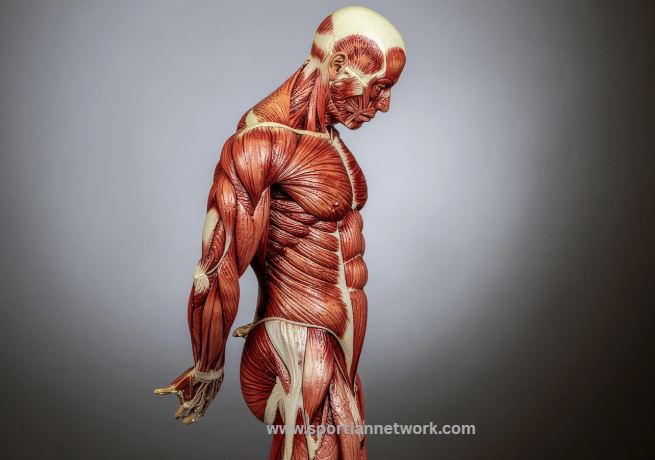
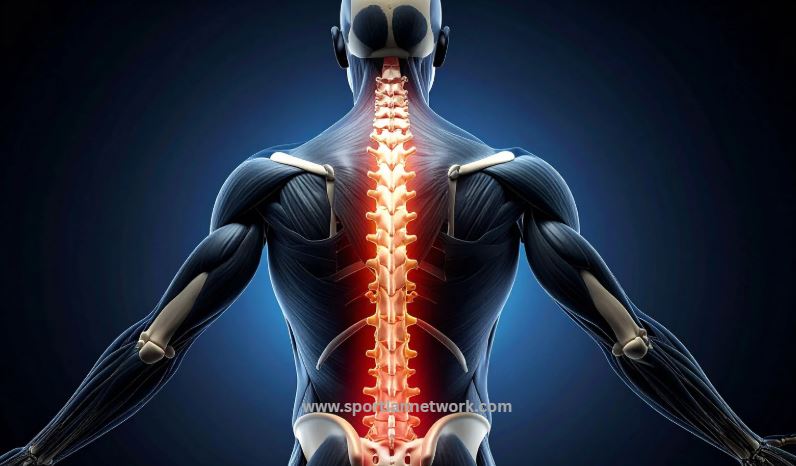
Most athletes who come in with shoulder pain get their shoulder assessed. Their thoracic spine never gets checked. That is a significant oversight, because a stiff mid-back is one of the most common root causes of shoulder impingement, poor overhead mechanics, restricted pressing strength, and upper back pain in athletes across every sport. The shoulder joint cannot function through its full range when the platform it sits on is immobile. Fix the T-spine and the shoulder problem often resolves without touching the shoulder directly.
This is for informational purposes only. For medical advice or diagnosis, consult a professional.
What the Thoracic Spine Is and What It Is Supposed to Do
The thoracic spine is the middle section of the spine, running from the base of the neck down to the lower back. It consists of twelve vertebrae, T1 through T12, each attached to a pair of ribs. By design, the thoracic spine is built for rotation and extension. It is the segment of the spine where the body rotates when you swing a bat, throw a ball, or paddle a kayak.
The problem is that the thoracic spine stiffens more readily and more quietly than any other spinal region. Sitting, desk work, driving, and the repetitive forward-loaded posture that most modern life demands all push the thoracic spine into flexion and keep it there. Over months and years the soft tissues adapt to that flexed position and the vertebral joints lose their natural extension and rotation range. The athlete does not feel it directly in the mid-back. They feel it in the shoulders, the neck, and eventually in the lower back.
How T-Spine Restriction Affects Shoulder Function
The shoulder complex is built to move through an enormous range. Full overhead reach requires not just movement at the glenohumeral joint where the arm meets the shoulder socket, but also upward rotation of the scapula, elevation of the clavicle, and critically, extension of the thoracic spine. These movements are interdependent. When one fails, the others compensate.
When the T-spine cannot extend adequately, the shoulder blade cannot upwardly rotate as far as it needs to during arm elevation. The scapula gets stuck in a downwardly rotated and anteriorly tilted position, which narrows the subacromial space through which the rotator cuff tendons pass. The athlete then tries to force overhead range by hiking the shoulder toward the ear, shrugging through the movement, or excessively extending through the lumbar spine instead. All three compensations increase injury risk. All three disappear when the T-spine regains its extension mobility.
The rotator cuff exercises that build shoulder stability depend on the scapula being positioned correctly to function. Doing rotator cuff work without addressing thoracic restriction is like trying to build a wall on a crooked foundation. The exercises help but the underlying position problem limits how far they can take you.
The Overhead Press and the T-Spine
Every athlete who presses overhead is asking their thoracic spine to extend so the ribcage can open and the shoulder can move into full elevation without lumbar compensation. A stiff T-spine forces the lumbar spine to extend excessively as a substitute. Most coaches and athletes call this overarching. The lower back takes the movement the thoracic spine could not provide. Done repeatedly under load, this pattern produces lower back discomfort in pressing athletes who have no apparent lower back problem during any other activity.
When T-spine mobility improves, the overhead press changes. The bar path straightens. The arch reduces. The shoulder feels less compressed at the top. The connection is mechanical and predictable. It is also why upper body strength programmes that include thoracic work as a warm-up staple produce athletes who press more comfortably over a longer career than those who skip it.
The Squat and the T-Spine
The thoracic spine position affects squatting as directly as it affects pressing. A forward lean in the squat is often attributed to tight hip flexors or weak glutes, and those factors can contribute. But a stiff T-spine that cannot extend adequately forces the torso to collapse forward as the athlete descends, because the spine cannot maintain an upright position through the movement. The result is a more horizontal torso angle, more load shifted to the lower back, and a squat that looks technically poor regardless of how strong the hips are.
Athletes who fix their T-spine mobility frequently report that their squat form improves without any change to their squat technique coaching. The squat form guide covers the common technical errors in depth, but any athlete who has been corrected on forward lean repeatedly without lasting improvement should address T-spine mobility before adjusting their foot position or squat stance.
The Deadlift and Thoracic Position
The upper back must maintain extension under load during the deadlift. A thoracic spine that rounds under load transfers shear force to the thoracic vertebrae and the surrounding soft tissue in a pattern that leads to chronic mid-back discomfort over time. More immediately, thoracic rounding during the deadlift shifts the centre of mass forward, makes the bar path inefficient, and reduces the mechanical advantage of the lats. The deadlift form checklist identifies upper back rounding as one of the most common and consequential form errors in athletes at all training levels.
Thoracic mobility work done consistently before lifting sessions reduces the tendency to round under load because the tissues are prepared and the range is available. The athlete is not fighting their own stiffness while simultaneously trying to produce maximum force.
Rotation Sports: Golf, Baseball, Tennis, Combat
Thoracic rotation is the physical foundation of every rotational sport movement. A golf swing, a baseball pitch, a tennis forehand, a wrestling clinch, a Muay Thai rotation into a body kick: all of these generate power by rotating the thoracic spine against the resistance of the hips and lower body. The power does not come from the arms. It comes from the separation between upper and lower body during rotation, and the speed at which the thoracic spine uncoils.
An athlete whose T-spine has lost 30 degrees of rotation to chronic stiffness is generating rotational power from a smaller range with tighter soft tissue. They are hitting, throwing, and striking with less rotational speed and more arm-dominant mechanics. Golf fitness depends on thoracic rotation more than any other physical quality. Every sport that involves twisting or rotating through the trunk depends on the same thing.
How to Assess Your Own T-Spine Mobility
Two simple tests reveal the state of your thoracic mobility before you invest time in specific exercises.
Seated Rotation Test
Sit on a chair with your feet flat and thighs parallel to the floor. Cross your arms over your chest. Rotate your upper body as far as possible to each side without moving your hips or lower back. A well-functioning thoracic spine should allow roughly 40 to 50 degrees of rotation to each side. Less than 30 degrees, or a notable asymmetry between sides, indicates meaningful restriction.
Wall Angel Test
Stand with your back flat against a wall, feet about 15cm from the baseboard. Press your lower back and upper back into the wall. Now raise your arms to shoulder height with elbows bent at 90 degrees, backs of the hands against the wall. Slowly slide your arms upward toward overhead while keeping the backs of your hands and forearms in contact with the wall throughout. An athlete with good T-spine extension and shoulder mobility can complete this movement cleanly. Loss of wall contact at the hands or forearms, compensatory lower back arching, or inability to reach past 90 degrees without losing position all indicate restriction.
The Most Effective T-Spine Mobility Exercises
These exercises address the specific movement restrictions that matter most for athletes. They work best done before training sessions rather than as standalone mobility work.
Thoracic Extension Over a Foam Roller
Place a foam roller perpendicular to your spine at mid-back level. Support your head with your hands. Let your upper back drape over the roller into extension. Breathe out and allow gravity to do the work. Spend 30 to 60 seconds at each spinal segment, moving the roller up and down the thoracic spine in small increments. This is the most accessible T-spine mobility tool available and the most commonly used for good reason.
The foam rolling comparison guide covers the broader applications of foam rolling in recovery, but the thoracic extension application is specifically about restoring joint mobility rather than releasing soft tissue tension. The distinction matters because the technique differs slightly: instead of rolling quickly to reduce muscle soreness, you pause and breathe at each stiff segment to allow the joint capsule and surrounding connective tissue to respond to the sustained load.
Cat-Camel into Thoracic Rotation
Begin on all fours. Move through a full cat-camel cycle twice to warm the spine generally. Then from a neutral spine position, place one hand behind your head and rotate your elbow toward the ceiling while following it with your eyes. Return to neutral and repeat on the same side for ten repetitions before switching. This exercise isolates thoracic rotation cleanly because the quadruped position locks out the lumbar spine and prevents it from substituting for the movement the T-spine is supposed to produce.
Open Book Stretch
Lie on your side with your hips stacked and knees bent at 90 degrees. Extend both arms in front of you at shoulder height. Keeping your hips and knees stacked together, take your top arm and slowly rotate it across your body and toward the floor behind you, following with your eyes and head. Hold for two to three seconds at the end of available range, then return. Ten repetitions per side. The open book is particularly useful for athletes whose T-spine restriction is asymmetrical, which is common in athletes who rotate predominantly in one direction.
Thoracic Extension in the Doorframe
Stand in a doorframe and interlace your fingers behind your head. Position the doorframe at the level of your mid-thoracic spine. Gently press your mid-back into the frame as you extend backward, using the door as a fulcrum. Breathe out as you extend. This provides a more targeted extension stimulus than the foam roller because the contact point is narrower and the athlete controls the exact level.
Quadruped T-Spine Rotation with Reach
From a quadruped position with a neutral spine, place one hand behind your head. Rotate down so your elbow points toward the floor beneath your body, then reverse the motion to rotate your elbow as far toward the ceiling as possible. Follow with your head and eyes throughout. The floor-to-ceiling range achieved in this exercise gives a clear daily measure of how rotation is changing as mobility work accumulates.
Programming T-Spine Work Into Training
T-spine mobility responds well to daily low-load input rather than infrequent high-volume sessions. Five to ten minutes before every upper body training session is more effective than a thirty-minute dedicated mobility session once a week. The tissues need repeated stimulus to reorganise and the new range needs to be reinforced regularly before it becomes the default available position.
The warm-up science is clear that mobility work done in a warm-up context immediately before training produces more durable changes than the same work done in isolation, because the nervous system is primed and the tissue is then immediately loaded in the new range. An athlete who foam rolls their T-spine, completes a few open book stretches and cat-camel rotations, and then immediately performs overhead pressing is reinforcing the new range in a loaded context. That combination is what produces lasting change.
The dynamic warm-up routine provides the full-body activation structure within which T-spine work fits naturally before upper body sessions. Three to four T-spine exercises requiring six to eight minutes total is enough when done consistently.
Who Needs This Most
Swimmers who develop shoulder impingement with high training volumes are almost always restricted through the T-spine, as the repeated overhead stroke pattern in a flexed position accelerates the stiffening. The connection between T-spine position and swimmer’s shoulder is well-established in sports medicine and consistently underaddressed in training programmes.
Grapplers and combat athletes who spend significant training time in forward-flexed positions during clinchwork, shooting for takedowns, and ground wrestling accumulate thoracic restriction faster than most other athletes. Wrestling training and Brazilian jiu-jitsu place the thoracic spine under sustained flexion load that requires deliberate extension and rotation work to counterbalance.
Athletes who sit at a desk for significant portions of their day and then train in the evening are attempting to produce high-quality shoulder and rotational movement from a thoracic spine that has been loaded into flexion for eight hours. They need T-spine mobility work more than almost any other athlete population, because their non-training hours are actively working against the range they are trying to build.
The broader case for prioritising mobility alongside strength is made in detail at why mobility work is the missing piece in most athletic training programs. The T-spine is the clearest single example of how a mobility deficit in one region produces pain and performance loss in an entirely different region, and why addressing the source rather than the symptom is what produces lasting results.