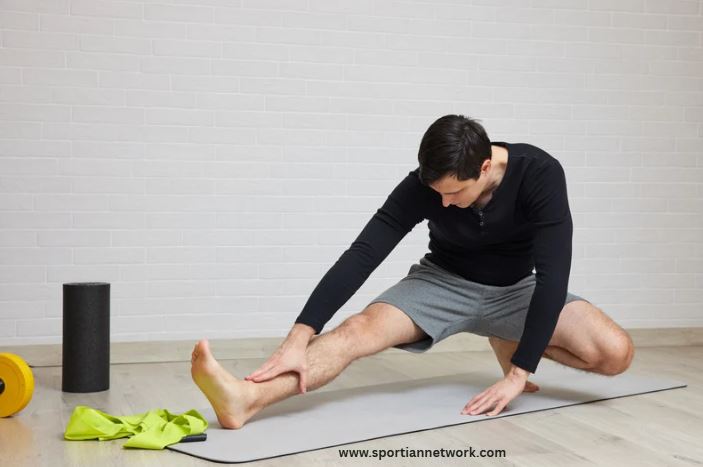
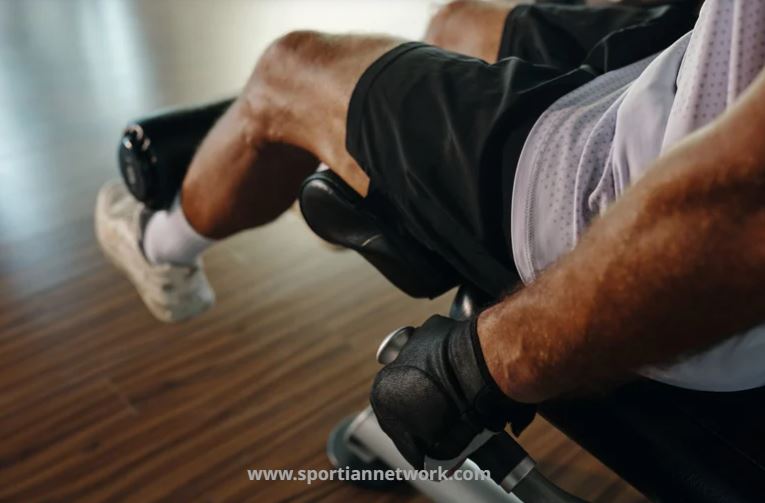
Single leg training is not a substitute for bilateral lifting. It is a necessary complement that most athletes underuse. Every sport is played on one leg at a time. Sprinting, cutting, jumping, and landing all happen in single leg positions. If your training never isolates that demand, you are building strength that does not fully transfer to how sport actually works.
What Unilateral Training Actually Means
Unilateral training means loading one limb at a time. In lower body training, that includes exercises like Bulgarian split squats, single leg Romanian deadlifts, step-ups, reverse lunges, and single leg press variations. The working leg handles the majority of the load while the other leg provides minimal or no assistance.
This is different from simply doing lunges as a warm-up filler. Proper unilateral training means loading these movements progressively with the same seriousness applied to squats and deadlifts. That distinction matters because the benefits only show up when the stimulus is sufficient.
The Bilateral Deficit and Why It Matters
There is a well-documented phenomenon in strength science called the bilateral deficit. When both legs work together during a squat or leg press, the total force produced is actually less than the sum of what each leg can produce independently. In other words, one leg working alone generates more force than its proportional share during a two-leg movement.
The reason is largely neurological. The nervous system appears to apply a regulatory brake on motor unit recruitment when both limbs work simultaneously. Single leg training removes that brake, which means higher motor unit recruitment per leg and greater neuromuscular stimulus per session. For athletes chasing every available performance adaptation, that is a meaningful difference.
Exposing Imbalances That Bilateral Work Hides
Bilateral lifts mask side-to-side strength differences. When both legs work together, the stronger leg compensates for the weaker one without either the athlete or the coach noticing. That compensation can persist for years under heavy bilateral loading while the underlying imbalance quietly builds injury risk.
Research consistently shows that significant asymmetries between legs are associated with higher rates of hamstring strains, ACL tears, and ankle injuries in team sport athletes. A strength difference of more than 15 percent between limbs is considered clinically meaningful in most return-to-sport protocols. However, most athletes who train exclusively with bilateral movements have no idea what their actual imbalance looks like.
Why This Connects to Injury Risk
Single leg training forces each limb to work independently. There is nowhere to hide. Weaknesses become visible immediately, which is exactly the point. Addressing those imbalances through targeted unilateral loading is one of the most practical injury prevention strategies available.
This is a core principle in how we approach ACL tear prevention, where single leg strength and stability work forms the backbone of the program. The same logic applies to hamstring strain prevention, particularly in cutting and sprinting sports where the working leg must absorb and produce force in isolation with every stride.
Sport Specificity: Why One Leg at a Time Makes Sense
Think about what actually happens during athletic movement. A sprinter’s foot contacts the ground one leg at a time and must produce enough force to propel the entire body forward. A basketball player planting for a cut is loading a single leg against the ground with bodyweight plus momentum. A soccer player striking the ball is balanced entirely on one leg at the moment of contact.
Training the Pattern That Sport Actually Uses
Bilateral squats and deadlifts build general lower body strength. But they do not replicate the single-support demand that defines almost every athletic movement. When an athlete trains exclusively with two-leg movements and then sprints, cuts, or jumps, there is a translation gap between the strength built and the strength required.
Unilateral training closes that gap. The Bulgarian split squat, for example, places nearly all of the load on the front leg while requiring significant hip stability from the glutes. That combination of strength and stability under single-leg demand is almost a direct simulation of the force production requirements in sprinting and cutting. It transfers in a way that barbell back squats, despite their value, simply do not replicate as specifically.
The Bulgarian Split Squat: The Most Valuable Single Leg Exercise
The Bulgarian split squat earns a specific mention because it is the most loaded and most sport-relevant unilateral exercise available to most athletes. The rear foot is elevated on a bench, the front leg handles the majority of the load, and the depth of the movement produces a significant hip flexor stretch on the rear leg simultaneously.
That combination of quad loading, glute activation, and hip flexor lengthening in one movement is remarkably efficient. Athletes who build serious strength in the Bulgarian split squat consistently report improvements in sprint mechanics, jump height, and change of direction speed. Furthermore, the hip flexor lengthening component addresses one of the most common mobility limitations in athletes who spend time in chairs between training sessions.
Loading the Bulgarian Split Squat Correctly
The mistake most athletes make with this exercise is treating it as an accessory movement and never loading it seriously. Holding a pair of 25-pound dumbbells for sets of 15 will not produce the strength adaptation that transfers to sport. Athletes who commit to this exercise with the same progressive overload discipline applied to a squat, working toward heavy dumbbell loads or barbell variations, develop a level of single-leg strength that bilateral training cannot replicate at equivalent loading.
Start with bodyweight to establish the balance and movement pattern. Add load progressively once the pattern is clean. Sets of six to ten reps with meaningful load produce the strength adaptation. Higher rep, lighter sets have their place for conditioning, but they should not be the primary loading strategy.
Step-Ups: Underrated and Underloaded
Step-ups are another exercise that athletes consistently underestimate. When performed correctly with a box height that creates a 90-degree knee angle and loaded progressively, the step-up demands pure single-leg strength without the rear leg assistance present in a split squat.
The working leg must produce enough force to elevate the entire body from a dead stop. There is no stretch reflex, no momentum, and no contribution from the trailing leg. That pure concentric demand builds a specific type of starting strength that transfers to acceleration and first-step quickness in team sports.
How to Make Step-Ups Actually Work
The error most athletes make is pushing off the rear foot. If the trailing foot contributes to the movement, the exercise becomes a glorified calf raise on the bottom leg rather than a true single-leg strength drill. The fix is simple: place only the toe of the rear foot lightly on the ground for balance and consciously drive all force through the heel of the working leg. Adding a pause at the bottom of each rep before initiating the drive eliminates the temptation to use momentum.
Single Leg Romanian Deadlift: Posterior Chain and Balance Combined
The single leg RDL is the unilateral answer to the bilateral Romanian deadlift. The working leg handles the full load while the hips hinge and the free leg extends behind for counterbalance. The hamstrings of the working leg load eccentrically exactly as they would during a sprint stride, which makes this exercise one of the most specific hamstring strength tools available to athletes.
Beyond the posterior chain loading, the single leg RDL demands significant frontal plane stability from the glutes, particularly the gluteus medius. That hip abductor stability is essential for maintaining alignment during single-leg landings and cutting movements. Athletes who build strength in this exercise typically show measurable improvements in landing mechanics and single-leg balance under fatigue.
Connecting This to Hamstring Health
The eccentric hamstring loading in the single leg RDL complements exercises like Nordic curls for comprehensive hamstring resilience. Our hamstring strain rehab guide uses single-leg RDL progressions as a primary return-to-sport tool because the movement so closely mirrors the mechanics where hamstring strains actually occur. Preventing that injury in the first place follows the same logic.
How to Program Unilateral Work Alongside Bilateral Lifts
Single leg training does not replace bilateral lifting. It works alongside it. The squat and deadlift build global lower body strength and allow heavier absolute loads that drive general adaptation. Unilateral work then targets the specific transfer gaps, addresses imbalances, and trains the stability demands that bilateral movements leave untouched.
A Practical Weekly Structure
A straightforward structure for most athletes is one bilateral-dominant lower body session and one unilateral-dominant lower body session per week during off-season training. The bilateral session anchors around squats, trap bar deadlifts, or conventional deadlifts. The unilateral session prioritizes Bulgarian split squats, single leg RDLs, and step-up variations.
In-season, when total training volume must drop, unilateral work is often more efficient because it achieves higher relative stimulus per leg with lower absolute load. A heavy Bulgarian split squat session is less systemically taxing than a comparable back squat session while still maintaining single-leg strength through the competitive period. That is a practical advantage when recovery capacity is already stretched by competition.
This fits into the broader framework of how to create your own off-season training program, where the balance between bilateral and unilateral loading shifts based on training phase and competition schedule.
What Coaches at the Highest Level Are Doing
Elite strength and conditioning programs across the NFL, NBA, and professional soccer have moved significantly toward unilateral loading over the last two decades. This is not a trend driven by aesthetics or novelty. It is driven by injury data and performance outcomes.
Programs that increased unilateral lower body training reported reductions in non-contact lower limb injuries. Athletes who showed meaningful bilateral strength alongside strong unilateral numbers returned to sport faster after injury and showed lower re-injury rates. The evidence has shifted the standard in elite sport, and it should shift the approach for any serious athlete, regardless of level.
The Final word on Single Leg Training
Two-leg lifts build the foundation. Single leg training builds the transfer. Both are necessary, and prioritizing one at the expense of the other leaves real performance and durability on the table.
If your program currently has no serious unilateral lower body work, that is the most immediate thing to fix. Add the Bulgarian split squat, load it properly, and watch what happens to your sprint speed, jump height, and single-leg stability within eight to twelve weeks. The results are usually enough to make unilateral training a permanent part of the program.