Powerlifting and weightlifting are not the same sport. They are not even close to the same sport. They share a barbell, a platform, and a competitive format built around lifting as much weight as possible, and that is roughly where the similarity ends. The movements, the physical demands, the training methods, and the athletic qualities they develop are fundamentally different. Understanding those differences matters whether you are choosing between the two sports, deciding which training methods to borrow for athletic development, or simply trying to follow a conversation about strength sports without getting confused.
The Simplest Version of the Difference
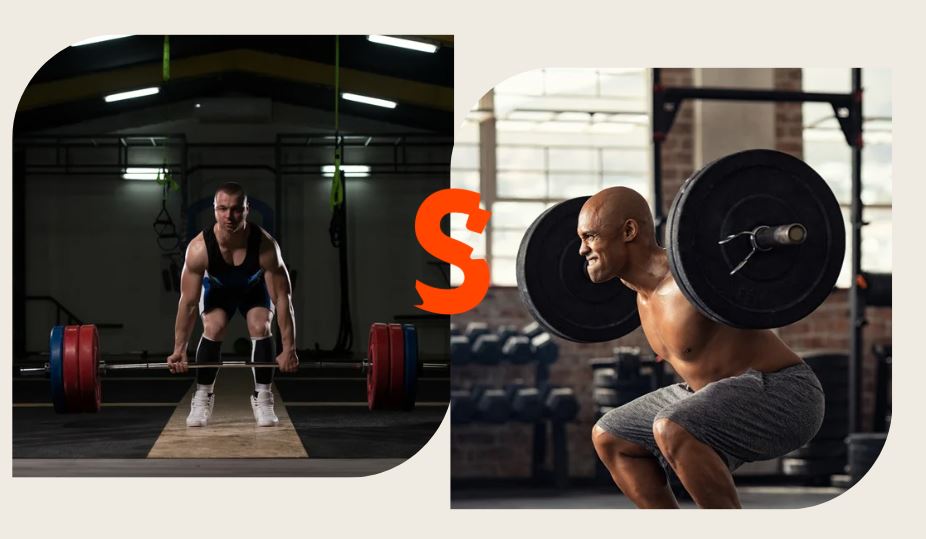
Powerlifting tests maximum strength in three movements: the squat, the bench press, and the deadlift. The lifts are slow, grinding, and measured entirely by the load moved from point A to point B. Speed is irrelevant as long as the weight completes the movement.
Weightlifting, which is the sport contested at the Olympic Games and is correctly called Olympic weightlifting to distinguish it from the generic term, tests explosive power in two movements: the snatch and the clean and jerk. These lifts must be completed in a single continuous motion and require the bar to travel from the floor to overhead. Speed is everything. A barbell that moves slowly in Olympic weightlifting is a barbell that is going to fail.
That distinction, maximum strength versus explosive power, is the root from which every other difference between the two sports grows.
The Powerlifting Movements
The Squat
The powerlifting squat starts with the bar on the lifter’s back. The lifter descends until the crease of the hip is below the top of the knee, which is the depth standard enforced by judges in competition, then stands back up. The movement is judged on three criteria: correct depth, control throughout, and a successful lockout at the top with knees and hips fully extended.
Powerlifting squats are often performed with a wide stance and significant forward lean that distributes load across the hips and lower back rather than concentrating it at the knee. This is a deliberate mechanical choice that allows more total weight to be moved rather than a technical error. Federation rules vary on equipment, with some allowing supportive squat suits and knee wraps and others requiring raw lifting with only a belt.
The Bench Press
The bench press in powerlifting is performed with the lifter’s back on a flat bench, feet on the floor, and the bar lowered to the chest before being pressed to lockout. The pause at the chest is mandatory in competition. Referees look for a controlled descent, a visible pause at the chest with no downward movement of the bar, and a complete lockout at the top with arms fully extended.
The grip width, arch position, and leg drive used by competitive powerlifters are often surprising to athletes unfamiliar with the sport. A significant arch in the upper and lower back, a wide grip, and aggressive leg drive into the floor are all legal and strategically sound. They reduce the range of motion the bar must travel and increase the mechanical advantage of the press, which is entirely the point.
The Deadlift
The deadlift in powerlifting starts with the bar on the floor and ends with the lifter standing fully erect with knees and hips locked out. There is no requirement that the bar travel in a specific path, only that it reaches the lockout position under control. Two primary stances are used in competition: conventional, with feet roughly hip-width and hands outside the legs, and sumo, with a very wide stance and hands inside the legs. Both are legal in most federations and suit different body proportions and strength profiles.
The deadlift is often where powerlifters express their highest absolute strength numbers, and elite deadlifts in open weight classes exceed 1000 pounds in equipped competition. These numbers are extraordinary by any measure and represent the upper boundary of human maximum strength expression.
The Weightlifting Movements
The Snatch
The snatch takes the barbell from the floor to a locked-out overhead position in a single continuous movement. The lifter grips the bar with a very wide grip, generates maximal pulling force through the legs and hips, and then transitions from pulling to receiving the bar in a deep overhead squat position. The entire movement happens in roughly one second at the elite level.
The technical demands of the snatch are extraordinary. The bar must travel in a precise vertical path. The lifter must time the transition from pull to squat with perfect precision. The overhead squat position requires exceptional shoulder mobility, thoracic extension, and wrist flexibility. The receiving position at the bottom of the snatch, with the bar locked out overhead while sitting in a deep squat, is one of the most technically demanding positions in all of sport.
The Clean and Jerk
The clean and jerk is two movements combined into one lift. The clean brings the bar from the floor to the front rack position at the shoulders, where the lifter catches it in a front squat. After standing up from the clean, the lifter performs the jerk, driving the bar overhead through an explosive leg drive and then splitting the feet front and back to receive the bar in a locked-out overhead position.
The clean and jerk typically allows lifters to move more total weight than the snatch because the two-phase structure distributes the demands differently and the receiving position is more mechanically stable. World-record clean and jerks in the heaviest weight classes exceed 260 kilograms, which is roughly 573 pounds moved from the floor to overhead by a single human being in approximately three seconds.
Physical Demands: What Each Sport Actually Requires
Powerlifting Physical Profile
Powerlifting rewards maximum muscle mass, favorable leverages, and the neurological ability to recruit the maximum number of motor units simultaneously under near-maximal load. Limb length proportions matter significantly. Shorter arms relative to torso length help the bench press. Shorter femurs help the squat. Longer arms help the deadlift by reducing the distance the bar must travel.
Body composition requirements in powerlifting are limited to making a specific weight class. Beyond that, more muscle mass is generally advantageous regardless of how it affects aesthetics or athleticism. Elite powerlifters in heavier weight classes often carry significant body fat alongside their muscle mass because the body fat contributes to making weight in a higher class where the absolute strength numbers are greater.
Flexibility requirements in powerlifting are modest compared to weightlifting. Sufficient hip mobility to reach squat depth, shoulder mobility to hold a bar on the back, and hamstring flexibility to maintain a neutral spine in the deadlift are necessary. Beyond those functional minimums, extreme flexibility is not required and may not be advantageous.
Weightlifting Physical Profile
Weightlifting rewards explosive power, mobility, technical precision, and the ability to express maximum force in minimum time. The rate of force development is the critical physical quality, not raw maximum strength, though maximum strength provides the ceiling from which explosive power is expressed.
Body proportions in weightlifting favor shorter torsos, longer legs, and proportionally longer arms. These proportions optimize the pulling mechanics and receiving positions that make the snatch and clean and jerk biomechanically efficient. Elite weightlifters from countries with deep coaching traditions are often identified and selected in part based on body proportion measurements taken in childhood.
Flexibility requirements in weightlifting are extreme. The overhead squat position of the snatch requires shoulder mobility, thoracic extension, hip mobility, and ankle dorsiflexion simultaneously. Athletes who cannot achieve these positions cannot perform the competition movements safely or effectively, and developing them is a significant portion of early weightlifting training. This connects to the mobility work covered in our thoracic spine mobility and ankle dorsiflexion articles, both of which are directly relevant to weightlifting position development.
Training Methods: How Each Sport Prepares Athletes
How Powerlifters Train
Powerlifting training is built around the competition movements and variations of them. The squat, bench press, and deadlift appear in nearly every training week throughout the year, with variations like pause squats, close-grip bench press, and deficit deadlifts used to address specific sticking points and build strength in particular positions.
Volume and intensity are the primary training variables. Powerlifters manipulate how much total weight is lifted across a session and how close that weight is to their maximum across training blocks. Periodization approaches vary considerably across powerlifting programs, from linear progression models used by beginners to conjugate and block periodization systems used by advanced lifters.
The Westside Barbell conjugate system, which we cover in detail in our Westside Barbell method guide, is one of the most influential powerlifting training systems and illustrates how advanced powerlifters structure their training across Max Effort and Dynamic Effort days throughout the year.
Accessory work in powerlifting addresses the muscles that support the competition movements. Squat accessories target hamstrings, glutes, and lower back. Bench accessories target triceps, upper back, and shoulders. Deadlift accessories often overlap significantly with squat accessories given the shared posterior chain demands.
How Weightlifters Train
Weightlifting training is built around technical refinement and power development in the snatch and clean and jerk. Because the movements are so technically demanding, a significant portion of training time is devoted to position work, segment drills, and movement quality at submaximal loads rather than simply lifting as heavy as possible.
Training frequency in weightlifting is typically higher than powerlifting, with many elite programs training six days per week and some training twice daily. This high frequency reflects the technical nature of the sport, where motor patterns are refined through repetition, and the relatively lower systemic fatigue of skill-focused sessions at submaximal loads compared to the near-maximal grinding efforts of powerlifting training.
The clean pull, snatch pull, front squat, overhead squat, and back squat are the primary supplementary movements in weightlifting training. These exercises reinforce the positions and strength qualities of the competition movements without the full technical demand of the complete snatch or clean and jerk. They allow higher total training volume without the fatigue that comes with repeated maximal technical lifts.
What Each Sport Develops That Transfers to Athletic Performance
What Powerlifting Transfers
Maximum strength is the primary transfer from powerlifting. The ability to produce enormous force in the squat, press, and pull develops the muscular strength and tendon resilience that supports performance across almost every sport. Athletes who have spent time in powerlifting-style training carry a strength base that makes subsequent athletic development faster and more robust.
The posterior chain development from powerlifting is particularly valuable. Heavy squats and deadlifts build the glutes, hamstrings, and lower back to a degree that most sport-specific training programs do not approach. This posterior chain strength transfers directly to sprinting, jumping, and change of direction as covered in our posterior chain training guide.
However, powerlifting training does not develop explosive power, speed of movement, or the dynamic coordination required by most sports. Athletes who train exclusively with powerlifting methods are strong but not necessarily fast or explosive. The rate of force development that sports require is not specifically trained by slow, grinding maximal efforts, which is why most sport-specific strength programs borrow from powerlifting for the strength base while borrowing from weightlifting for the power development.
What Weightlifting Transfers
Explosive power is the primary transfer from weightlifting. The snatch and clean and jerk develop rate of force development, triple extension mechanics, and the coordination of the entire kinetic chain in a way that no other training method replicates as specifically. Athletes who develop proficiency in Olympic lifting movements typically show improvements in vertical jump, sprint acceleration, and change of direction that reflect the training of these explosive qualities.
The triple extension pattern, where the ankle, knee, and hip extend simultaneously and explosively, is the fundamental movement of athletic power production. It appears in every jump, every sprint stride, every throw, and every explosive athletic action. Weightlifting trains this pattern more specifically and with greater loading than any other exercise available, which is why Olympic lifting movements appear in the strength and conditioning programs of elite sprinters, basketball players, football players, and combat athletes.
The Technical Learning Curve
The limitation of weightlifting as a training tool for sport athletes is the technical learning curve. Learning the snatch and clean and jerk to a standard where they are safe and productive training tools takes months of consistent practice under qualified coaching. Many sport athletes do not have that time or access. For these athletes, power versions of the movements, the power clean, power snatch, and hang power clean, reduce the technical demand while preserving most of the explosive power development benefit. These variations are more accessible and more commonly seen in sport-specific strength programs as a result.
Competition Format and Culture
Powerlifting Competition
Powerlifting competition is organized around weight classes, with athletes competing against others in their bodyweight division. Each lifter receives three attempts at each of the three competition lifts. The highest successful attempt in each lift is summed to produce the total, and the highest total in each weight class wins.
Federation rules vary considerably across powerlifting organizations, creating a somewhat fragmented competitive landscape. The primary distinction between federations is equipment rules, specifically whether supportive gear like squat suits, bench shirts, and knee wraps are allowed. Raw federations prohibit most supportive equipment. Equipped federations allow it. Records and totals are tracked separately across these categories because the equipment allows significantly more weight to be lifted.
Weightlifting Competition
Olympic weightlifting competition is more standardized globally because it falls under the governance of a single international federation, World Athletics, and must meet Olympic standards. Each lifter receives three attempts at the snatch followed by three attempts at the clean and jerk. The best successful lift in each is combined for the total.
Unlike powerlifting, there are no equipment variations in competitive weightlifting at the international level. All athletes compete in essentially the same equipment: a weightlifting singlet, weightlifting shoes, and optionally a belt and wrist wraps. This standardization makes international records more directly comparable than powerlifting records across different federations and equipment categories.
Which Should Athletes Borrow From
For most sport athletes, the answer is both, selectively. Powerlifting movements build the strength foundation. Olympic lifting movements and their power variations build the explosive expression of that strength. A sport-specific strength program that uses heavy squats and deadlifts alongside power cleans and hang power snatches is drawing from both traditions in the way that produces the most complete athletic development.
Athletes who are deciding between competing in one of these sports should consider their physical profile and temperament honestly. Powerlifting rewards patience, methodical progressive overload, and the psychological tolerance for grinding near-maximal efforts. Weightlifting rewards technical obsession, explosive athleticism, and the willingness to spend months perfecting movement before loads become meaningful.
Both sports demand more than they appear to from the outside. Both produce athletes who are exceptional in their physical development. And both have contributed more to our understanding of how to train the human body for strength and power than almost any other competitive context in the history of sport.