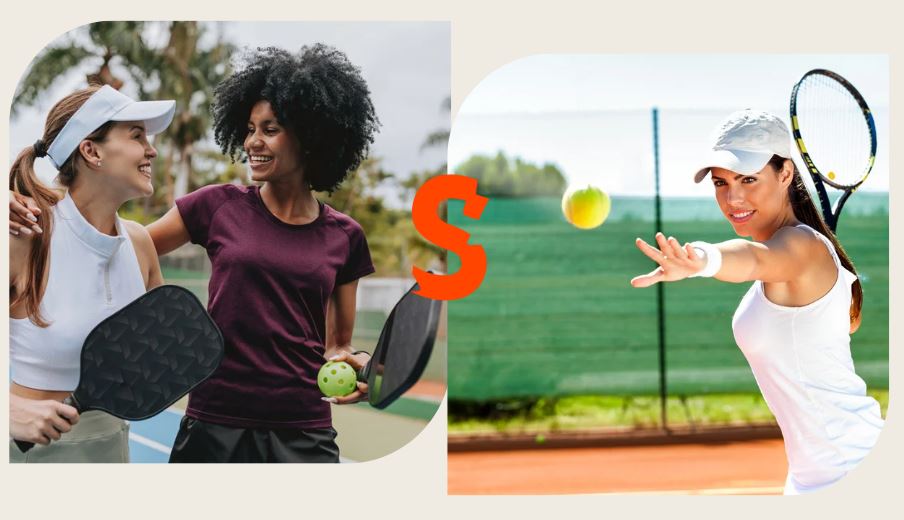
Pickleball is easier to start and harder to master than most people expect. Tennis is harder to start and demands more athleticism at every level. As exercise, tennis burns more calories per hour and taxes the cardiovascular system more heavily, but pickleball gets people moving who would never step on a tennis court, and that consistency advantage matters more than most fitness comparisons acknowledge. This article breaks down both sports honestly across skill difficulty, physical demand, injury risk, and long-term athletic development.
Why This Comparison Matters Right Now
Pickleball is the fastest growing sport in America. It went from a backyard novelty to a competitive sport with professional tours, dedicated facilities, and millions of recreational players in under a decade. Tennis, meanwhile, has been a mainstream sport for over a century with an established competitive structure, a global professional circuit, and a deeply entrenched recreational culture.
The two sports share a racket, a net, and a court with lines. Beyond that, they are genuinely different athletic experiences. Understanding exactly how they differ helps anyone trying to decide between them, or trying to understand what each one actually does for fitness and athletic development.
The Learning Curve: Which Sport Is Actually Harder to Start
Pickleball Is Genuinely More Accessible
The shorter court, slower ball, and underhand serve make pickleball approachable for almost anyone within the first hour of playing. The paddle face is larger than a tennis racket head relative to the ball size, which means mishits that would fly out on a tennis court stay in play on a pickleball court. New players can sustain rallies relatively quickly, which makes the sport immediately enjoyable rather than frustrating.
This accessibility is not a knock against pickleball. It is a deliberate design feature of a sport originally created so that families with mixed athletic abilities could play together. The game rewards patience, placement, and strategic thinking from the very beginning, which means intelligent players can compete effectively without exceptional athleticism.
Tennis Has a Steeper Entry Ramp
Tennis takes significantly longer to become functional. The serve alone, which must be hit overhand and cleared over a net at a regulation height on a full-length court, requires weeks or months of deliberate practice before it becomes consistent enough to not constantly hand opponents free points. The larger court demands more footwork, more power generation, and more endurance than most beginners anticipate.
However, that steeper entry ramp means tennis rewards athletic development more continuously over a longer timeline. Players who commit to tennis for several years develop footwork, timing, hand-eye coordination, and cardiovascular fitness at a level that pickleball’s shorter learning curve simply does not produce at the same depth.
Skill Ceiling: Which Sport Is Harder at the Top
Pickleball’s Hidden Complexity
The pickleball community has a phrase that captures the skill paradox of the sport perfectly: easy to learn, hard to master. The kitchen, which is the non-volley zone that extends seven feet from the net on both sides, creates a strategic chess match at the net that takes years to develop genuine competence in.
Elite pickleball involves dinking exchanges that require touch, patience, and precise control of ball trajectory and speed. The third-shot drop, which transitions a team from the baseline to the kitchen line against opponents already positioned at the net, is a technically demanding shot that separates intermediate players from advanced ones. Speed-up attacks, resets, and erne volleys all add layers of complexity that make high-level pickleball genuinely difficult to play well.
The problem is that many recreational players never encounter this complexity because they play against opponents who also lack it. The sport can feel deceptively simple if you only compete at the recreational level.
Tennis Demands More From Every Physical System
At the competitive level, tennis is objectively harder. The serve requires explosive rotational power, precise timing, and the ability to generate pace and spin simultaneously. The full-court footwork demands that players cover a surface more than twice the size of a pickleball court at speeds that require genuine athletic conditioning. The topspin groundstrokes used at competitive levels take years of muscle memory development to execute under pressure.
Professional tennis players are among the most well-rounded athletes in any individual sport. They combine explosive speed, endurance, power, coordination, and mental resilience across matches that can last four or five hours. That combination of demands does not exist in pickleball at any level, which is why tennis has a deeper skill ceiling even though pickleball has its own legitimate technical complexity.
Physical Demands: What Each Sport Actually Does to Your Body
Cardiovascular Output
Tennis produces significantly higher cardiovascular output than recreational pickleball. A singles tennis match burns roughly 400 to 600 calories per hour depending on intensity and player size. Competitive doubles tennis burns somewhat less. Recreational pickleball typically burns 200 to 350 calories per hour for most players.
The reason is primarily court size and movement demand. Tennis players cover far more ground per point than pickleball players, and the larger court requires more explosive sprinting rather than the shorter shuffle steps that dominate pickleball movement patterns. Heart rate data from recreational players consistently shows higher average heart rates during tennis compared to pickleball at equivalent perceived exertion levels.
That said, pickleball still provides meaningful cardiovascular stimulus, particularly for older adults or previously sedentary individuals for whom even moderate continuous movement represents a genuine training effect. For someone choosing between pickleball and the couch, the cardiovascular benefit is real and significant. The comparison becomes more complicated when tennis is the alternative because tennis simply asks more of the cardiovascular system.
For athletes who want to understand cardiovascular training zones and how racket sports fit into a broader conditioning framework, our piece on Zone 2 training and endurance development gives context for where these sports sit in the aerobic training spectrum.
Movement Patterns and Lateral Demand
Both sports require lateral movement, split steps, and rapid direction changes. However, the scale and speed of those movements differ substantially. Tennis footwork covers longer distances at higher speeds. The split step timing in tennis must account for a faster incoming ball over a greater range of possible court positions. The recovery run after a wide ball in tennis can cover ten to fifteen feet at near-sprint speed. In pickleball, most court coverage happens within a few feet of a base position.
This means tennis develops more comprehensive lower body athleticism. The acceleration, deceleration, and change of direction demands in tennis are closer to what team sport athletes experience than pickleball’s shorter, more contained movement patterns. Athletes trying to maintain sport-specific movement quality during an off-season would benefit more from tennis than pickleball as a cross-training tool for this reason.
The lateral movement demands of both sports, however, require the kind of ankle stability and hip mobility work that underpins all court sport performance. Our basketball ankle mobility and injury prevention guide covers the foundational movement prep that applies equally to any court sport athlete.
Upper Body Demands
Tennis produces significantly greater upper body muscular demand. The serving motion is one of the most shoulder-intensive actions in recreational sport. The topspin forehand and two-handed backhand require substantial rotational power from the core and shoulder complex. Players who play tennis regularly develop forearm, wrist, shoulder, and rotational core strength as natural byproducts of the game.
Pickleball paddles are lighter, the swings are shorter, and the overhead serve is eliminated. The dinking game that dominates advanced recreational pickleball requires touch and control rather than power. The result is a significantly lower upper body demand that makes pickleball more accessible for players with shoulder issues or limited upper body strength, but also means it produces less upper body conditioning as a training stimulus.
Injury Risk: Which Sport Is Harder on the Body
Tennis Elbow Is Actually Often Pickleball Elbow
Lateral epicondylitis, commonly called tennis elbow, is paradoxically more prevalent among pickleball players than tennis players in recent years, primarily because pickleball has attracted a large population of older adults who may have pre-existing elbow sensitivity and who are playing high volumes of a new sport their tissues are not conditioned for.
The shorter swing in pickleball actually concentrates force at the elbow rather than distributing it across the full kinetic chain of a full tennis stroke. Players who rely on arm strength rather than body rotation in their pickleball strokes are particularly vulnerable. Proper technique in both sports requires driving force from the legs and hips through the core to the arm rather than generating force from the arm and shoulder alone.
Knee and Hip Demands
The lower body injury profile differs meaningfully between the sports. Tennis, with its explosive lateral movements over a larger court, produces more hamstring strains, ankle sprains, and knee injuries related to the demands of high-speed court coverage. Pickleball produces more overuse injuries in the knees related to the repetitive lateral shuffling and the semi-crouched ready position that players hold near the kitchen.
Neither sport is particularly high-risk for healthy, conditioned athletes. Both become higher risk for athletes who skip proper warm-up preparation before play. A structured pre-sport dynamic warm up routine that includes hip mobility, ankle preparation, and lateral movement activation reduces injury risk in both sports significantly.
Joint Impact and Long-Term Sustainability
This is where pickleball has a genuine advantage over tennis that extends beyond accessibility. The shorter court, lighter paddle, and lower-speed ball produce substantially less joint impact per session than tennis. For athletes over 40, or those managing existing joint issues, pickleball allows high-frequency play without the cumulative impact stress that tennis can accumulate over many sessions per week.
This is one of the primary reasons pickleball has grown so rapidly among the 50-plus demographic. It provides genuine athletic engagement, social competition, and physical activity at a joint impact level that allows four or five sessions per week where tennis might allow two or three for the same individual.
Athletic Development: What Each Sport Builds
What Tennis Builds
Tennis is one of the most complete individual sport athletic development tools available. Regular tennis play develops hand-eye coordination, explosive lateral footwork, rotational power, cardiovascular endurance, and competitive mental toughness simultaneously. Players who grow up with tennis typically demonstrate superior athletic qualities across multiple domains compared to sport-naive peers.
The mental demands of tennis are also exceptional. Managing a full match alone, without coaches calling timeouts or teammates sharing the emotional load, requires the kind of self-regulation, focus management, and resilience under pressure that translates broadly to athletic performance. Our piece on mental skills that separate good athletes from great ones covers these qualities in depth, and tennis is one of the sports that most directly trains all of them.
What Pickleball Builds
Pickleball builds genuine athletic qualities even if it builds fewer of them than tennis. The sport develops hand-eye coordination, reaction time, tactical thinking, and the kind of consistent low-to-moderate intensity cardiovascular activity that supports long-term health outcomes. For older athletes or those returning to sport after a long layoff, pickleball provides a competitive athletic environment with manageable physical demands and a social structure that supports consistent participation.
Consistency is the variable that actually determines fitness outcomes over time. An athlete who plays pickleball four times per week for two years will be significantly fitter than one who plays tennis twice a month because the barrier to participation feels lower. That reality matters more than the per-session calorie comparison in the long run.
Equipment and Accessibility
The equipment cost comparison favors pickleball clearly. A quality beginner pickleball paddle runs $50 to $150. Quality beginner tennis rackets run $80 to $200. However, tennis balls are cheaper than pickleballs over time, and both sports require court access that varies significantly by location.
For athletes already invested in tennis equipment, our tennis racket buying guide for 2026 covers how to choose the right racket for your skill level and playing style. For those starting pickleball from scratch, our pickleball beginners guide covers equipment, rules, and what to expect in the first few weeks of play.
Court availability varies by region. Tennis courts are more numerous nationally but are sometimes harder to book at peak times. Dedicated pickleball facilities are growing rapidly in most metro areas and suburban communities, and many existing tennis courts have been converted or lined for dual use.
Which Is Better for Different Types of Athletes
For younger athletes seeking athletic development: Tennis. The demands are higher, the skill ceiling is deeper, and the athletic qualities it builds transfer more broadly to other sports. The investment in learning tennis during formative athletic years pays dividends across every physical domain.
For athletes over 40 seeking sustainable active competition: Pickleball. The joint impact reduction, lower barrier to entry, and social structure of pickleball make it more sustainable as a primary sport for older athletes who want genuine competition without the physical toll of high-intensity tennis.
For cardiovascular fitness as a primary goal: Tennis. The calorie burn, heart rate elevation, and movement demands are meaningfully higher per session.
For anyone currently inactive: Either, but probably pickleball first. The sport’s accessibility makes it the most likely to convert a sedentary person into a consistently active one, which is a more important health outcome than which sport theoretically provides a better workout.
For cross-training alongside a primary sport: Tennis edges ahead for most team sport athletes because the footwork, power, and cardiovascular demands are closer to team sport physical profiles. The 6-week off-season agility blueprint pairs well with tennis as a complementary sport during off-season training blocks.
The Honest Answer to Both Questions
Tennis is harder. At every level from beginner to professional, tennis demands more athleticism, more technical precision, and more physical output than pickleball. That is not a close call.
Pickleball is better exercise for more people more consistently, because the lower barrier to entry means more people actually play it, more often, for more years of their lives. And consistent moderate exercise beats occasional intense exercise in almost every long-term health and fitness outcome that matters.
The better question is not which sport wins a comparison. It is which sport you will actually show up for regularly, push yourself in, and keep playing as you age. For most people, that question has a more individual answer than any fitness metric can capture.