The best training environment is the one you actually use consistently. For athletes without gym access, travelling mid-season, working around limited budgets, or simply preferring to train outside, the outdoor environment provides more training tools than most people realise. The problem is not availability. It is knowing how to read a space and turn it into a structured session.
This guide covers how to use parks, open fields, and public stairs to build genuine athletic qualities across strength, speed, power, and conditioning, with enough structure to replace a gym session rather than substitute for one.
Why Outdoor Training Works for Athletes
The argument for outdoor training is not about convenience or minimalism. It is about load, variety, and specificity. Many athletic qualities develop better outdoors than on a gym floor. Sprint speed is built by sprinting on grass or track. Change of direction is trained by moving on open surfaces. Conditioning responds to sustained uphill effort in ways a treadmill cannot fully replicate. The outdoor environment also imposes natural variability in terrain, footing, and resistance that challenges the neuromuscular system differently than flat, predictable indoor surfaces.
Athletes who supplement structured gym work with outdoor sessions often find that the qualities that transfer most directly to competition are built outside. Speed, reactive footwork, conditioning under fatigue, and mental resilience from training in variable conditions all develop in ways that a controlled indoor environment cannot produce to the same degree.
Using Parks for Strength and Conditioning
Pull-Up Bars and Parallel Bars
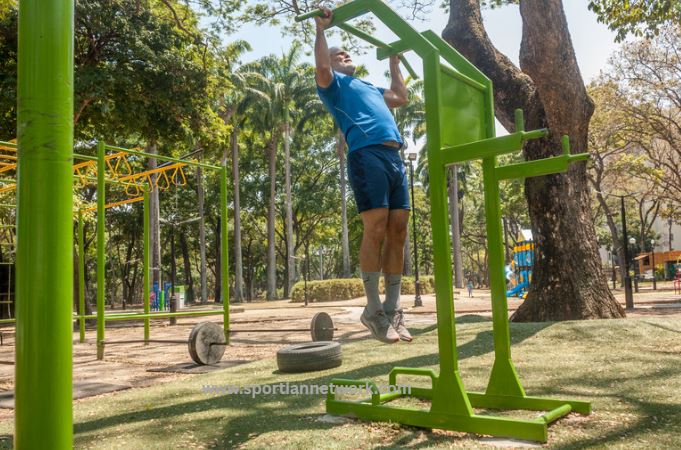
Most public parks with outdoor fitness installations include pull-up bars at varying heights and parallel bars for dipping. These two pieces of fixed equipment cover the primary upper body pushing and pulling patterns that athletes need. Pull-ups and chin-ups build vertical pulling strength through the lats, biceps, and upper back. Dips load the triceps, chest, and anterior shoulder in a pushing pattern. Together they replicate the core upper body work of a gym session without any portable equipment.
An athlete who can perform ten strict pull-ups and ten strict dips has a meaningful foundation of upper body relative strength that transfers to throwing, wrestling, climbing, and contact sport. The variation available from pull-up bars is also substantial. Grip width, grip orientation, tempo of movement, and added loading through a weighted vest or backpack all produce different training stimuli from the same fixed structure.
Our upper body strength guide covers the full range of pulling and pressing patterns relevant to sport, and the pull-up sits at the centre of that picture as one of the most reliable indicators of functional upper body strength relative to bodyweight.
Benches and Low Walls for Lower Body Work
Park benches and low retaining walls create a plyo box equivalent for jumping, stepping, and split squat work. A standard park bench at roughly 45 centimetres of height allows box jumps, step-ups, Bulgarian split squats with the rear foot elevated, and depth drops for reactive landing work. None of these require any equipment beyond the bench itself.
Step-ups with a controlled tempo build single leg strength in a way that directly transfers to running, cutting, and any sport involving unilateral propulsion. Bulgarian split squats from a bench create significant quad and glute loading that rivals barbell work in terms of mechanical demand. Our article on single leg training covers why unilateral lower body work produces adaptations that bilateral squatting cannot fully replicate, and the park bench makes that work accessible anywhere.
Grass Surfaces for Bodyweight Strength
Open grass areas in parks accommodate the full range of bodyweight strength work that athletes commonly neglect in favour of equipment-based training. Push-up variations covering wide, narrow, decline, and archer positions address chest and tricep development across multiple angles. Single leg Romanian deadlifts on grass train balance and hip hinge mechanics without external load. Bear crawls and lateral crawls develop shoulder stability and hip mobility simultaneously under low-load, high-movement-quality conditions.
Grass also provides a forgiving surface for landing mechanics practice and for the dynamic warm-up work that precedes any serious training session. Our dynamic warm-up guide covers the activation and mobilisation sequence that should precede outdoor sessions just as it would any gym session.
Using Open Fields for Speed and Power Development
Sprint Training on Grass
The most underused training tool available to any athlete with access to a field is a flat stretch of grass long enough to sprint. Thirty to fifty metres is enough for acceleration development. One hundred metres accommodates top-speed work for sprinters, though most team sport athletes rarely train in this range and benefit more from repeated acceleration work over shorter distances.
Grass sprinting produces higher hamstring activation during the late swing phase of the stride than track sprinting because the surface compliance and grip coefficient differ. This makes grass sprint training a genuine posterior chain developer as well as a speed training method. The shin splints and tibial stress that can accumulate from high-volume track work are also less likely on grass because impact forces are absorbed differently. Our speed training fundamentals guide covers the acceleration mechanics and technical cues that make sprint training productive rather than just tiring.
A basic grass sprint session for field sport athletes looks like this. After a thorough warm-up of ten minutes, perform six to eight repetitions of twenty metre accelerations with full recovery of ninety seconds to two minutes between each. Then progress to four repetitions of forty metres with two to three minutes recovery. Finish with four repetitions of sixty metres at ninety percent effort, not maximal, with three minutes recovery. Total session time including warm-up is forty to fifty minutes.
Agility and Change of Direction Work
Open grass fields allow cone-free agility work using landmarks as turning points. A tree, a painted line, a discarded item of kit, anything visible at distance can serve as a change of direction point. Pro agility shuttle runs, T-drills, and figure-of-eight patterns all require nothing more than markers placed at appropriate distances and a stopwatch.
Unstructured reactive agility is also possible outdoors in ways that gym-based cone drills cannot replicate. Two-person reactive drills where one athlete mirrors the movement of another, or where the direction of the next sprint is called by a partner at the last moment, develop reactive agility that transfers more directly to competition than pre-planned cone patterns. The off-season speed and agility blueprint provides a structured programme that fits well into an outdoor field setting.
Plyometric Work on Grass
Grass fields provide excellent surfaces for jumping and landing work. Broad jumps, lateral bounds, single leg hops, and depth jumps off a low park bench all develop the reactive strength and power that directly transfer to athletic performance. Grass absorbs landing impact better than hard floors, which makes it appropriate for higher-volume plyometric sessions where total impact accumulation matters.
A simple plyometric circuit for an open field session includes five broad jumps for maximum distance with reset between efforts, ten lateral bounds alternating sides, and six single leg hops on each leg covering as much distance as possible in three contacts. Performed for three rounds with full recovery between rounds, this develops the reactive qualities covered in depth in our plyometric training article.
Hill Sprints on Natural Slopes
Any park or field with a slope of five to fifteen degrees provides a hill sprint surface that develops both conditioning and strength simultaneously. Hill sprinting forces higher knee drive, greater push-off force, and a forward lean position that builds the posterior chain under cardiovascular stress. The reduced top speed on an incline also reduces injury risk compared to flat sprinting at maximal velocity, making hills a safer entry point for athletes returning to sprint work after time off.
Six to ten repetitions of twenty to thirty seconds at near-maximal effort up a moderate slope, with a walk-down recovery, produces a session that challenges the phosphocreatine and glycolytic energy systems simultaneously. This type of session fits within the conditioning model described in our zone 2 training guide as a high-intensity complement to lower-intensity aerobic base work.
Using Stairs for Conditioning and Strength
What Stairs Actually Train
Public stairways in parks, stadiums, apartment blocks, and pedestrian bridges are training tools that most athletes walk past without recognising. Stair training loads the quads, glutes, and calves concentrically on the way up and eccentrically on the way down. It elevates heart rate faster than flat running at equivalent effort because of the vertical displacement component, which makes it highly efficient for conditioning work.
The step height of public stairs varies from roughly fifteen to twenty centimetres, which determines the range of motion and the degree of hip and knee flexion involved. Standard public stairs provide a moderate step height appropriate for sustained climbing. Stadium stairs with higher steps and steeper angles produce a more demanding single-step pattern that further loads the glutes and hamstrings per step.
Stair Sprint Protocols
Sprinting upstairs two steps at a time develops explosive hip extension and single leg power in a way that closely mimics the force production demands of athletic acceleration. The wide step pattern requires full hip extension on each push-off, which directly develops the glute and hamstring strength that underpins sprint performance. Our posterior chain training guide covers why this hip extension emphasis matters so much for sport performance, and stair two-step sprints are one of the few bodyweight methods that genuinely load this pattern with enough intensity to drive adaptation.
A practical stair sprint session uses six to ten maximal effort sprints up a flight of at least thirty steps, with a walk-down recovery after each. Rest at the top for thirty seconds before walking down and resetting. Total sprint volume should feel genuinely taxing by the fifth or sixth repetition. If it does not, the steps are not steep enough or the effort is not maximal.
Stair Conditioning for Aerobic Development
Sustained stair climbing at a moderate pace, not sprinting but above walking pace, develops aerobic capacity with less impact stress than road running. For athletes who are managing shin pain, stress reactions, or other lower leg issues that limit flat running volume, stair climbing provides a high-quality cardiovascular stimulus with a different loading pattern that may be tolerated when road running is not.
Twenty to thirty minutes of continuous stair climbing, ascending and descending repeatedly, elevates heart rate into a useful aerobic training zone for most athletes. Adding a weighted backpack increases the metabolic demand without increasing impact forces, making it an appropriate loaded carry variation for athletes who want to develop their conditioning alongside some functional strength. The loaded carry principle is covered as a strength training method in our hip hinge mechanics article.
Single-Step Lunge Pattern
Walking up stairs in a slow, controlled single-step lunge pattern, pausing briefly at the top of each step before stepping up, turns a staircase into a lower body strength circuit. The pause removes momentum and forces the glute and quad of the working leg to control the movement entirely. Three to four ascents of a long staircase at this tempo with thirty seconds rest between produces significant lower body fatigue without any external load.
Structuring a Complete Outdoor Session
Sample Session One: Field Power and Conditioning
Begin with ten minutes of dynamic warm-up including leg swings, lateral shuffles, high knees, and A-skips on grass. Move into six repetitions of twenty metre acceleration sprints with ninety seconds recovery. Follow with three rounds of a plyometric circuit covering five broad jumps, ten lateral bounds, and six single leg hops per leg, resting two minutes between rounds. Finish with five hill sprint repetitions of twenty seconds each with walk-down recovery. Cool down with five minutes of light jogging and static stretching.
Sample Session Two: Park Strength Circuit
Warm up for ten minutes as above. Perform four rounds of a circuit including eight pull-ups or chin-ups, ten Bulgarian split squats per leg from a bench, eight parallel bar dips, ten step-ups per leg with a slow three-second lowering phase, and ten single leg Romanian deadlifts per leg on grass. Rest ninety seconds between rounds. Total working time is approximately forty minutes.
Sample Session Three: Stair Conditioning and Bodyweight Strength
Warm up with five minutes of dynamic mobility. Perform eight maximal stair sprint repetitions with walk-down recovery. Follow with three rounds of push-up variations covering standard, wide, and decline positions for ten reps each, followed by ten inverted rows using a low park bar if available, or ten renegade row substitutes using the ground. Finish with fifteen minutes of sustained stair climbing at a moderate pace.
Managing the load of these sessions against other training in the week requires the same attention to total stress that gym sessions demand. The session RPE method applies just as directly to outdoor sessions as to gym work, and athletes who treat outdoor training as somehow less demanding than gym training tend to accumulate fatigue faster than they expect.
What Outdoor Training Cannot Replace
Honest guidance acknowledges limitations. Outdoor training cannot replicate heavy barbell loading for maximal strength development. An athlete who needs to add significant lower body strength in the off-season needs a barbell squat and a deadlift, not park bench step-ups. Outdoor training also cannot easily replicate the controlled loading progression of resistance machines, which is sometimes necessary during rehabilitation.
For athletes who need to supplement outdoor training with minimal home equipment, our home gym under $300 guide covers the highest-value equipment additions that extend the range of training available without a full gym setup. A set of resistance bands and a pull-up bar extension adds meaningful training variety to what parks and fields already provide.
The combination of structured outdoor training for speed, conditioning, and bodyweight strength, supplemented by occasional access to a gym for heavy compound loading, covers the training needs of most competitive athletes without requiring daily gym attendance. Understanding which qualities develop best outdoors and which require equipment lets athletes allocate their training time and resources with genuine precision.