
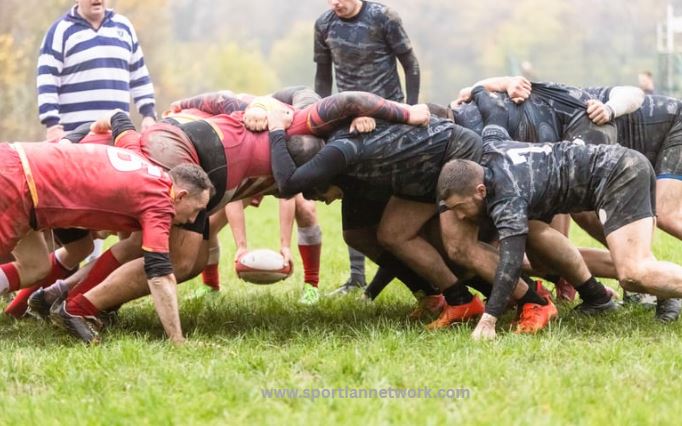
Most sports have a single governing body and one recognised version of the game. Rugby has two, and the reason why reveals as much about class, money, and power as it does about sport. The 1895 split between Rugby Union and Rugby League is one of the most consequential moments in sport history, and its effects are still visible in how both codes are played, funded, and followed today.
The Origin: One Game, One Set of Rules
Rugby football grew out of the chaos of 19th-century English school sport. The story of William Webb Ellis picking up a football and running with it at Rugby School in 1823 is almost certainly myth, but the school did formalise a distinctive handling game that spread through English public schools and universities during the mid-1800s.
In 1871, representatives of clubs across England met in London to establish the Rugby Football Union. The RFU created the first standardised rules and positioned rugby as a sport governed by gentlemen. The amateur ethos was baked in from the start: playing for money or receiving any financial compensation was considered incompatible with the spirit of the game.
For clubs based in northern England, this created a problem that would eventually become unsolvable.
The Northern Problem: Class and Compensation
The industrial towns of Yorkshire and Lancashire produced outstanding rugby players. Miners, mill workers, and factory hands played the game with ferocity and skill. But unlike the gentlemen amateurs of the south, these men could not afford to take time off work to play or travel to away fixtures without losing wages.
The concept of broken time payments emerged as a practical solution. Clubs wanted to compensate players for the income they lost when representing their teams. The RFU refused. For them, any form of payment, however indirect, crossed the line into professionalism and threatened the amateur ideal the sport was built on.
The tension simmered for years. Northern clubs repeatedly proposed reforms at RFU meetings. Southern clubs repeatedly voted them down. By the early 1890s it was clear that compromise was impossible.
1895: The Huddersfield Meeting
On 29 August 1895, representatives of 21 northern clubs met at the George Hotel in Huddersfield. They voted to form a new body, the Northern Rugby Football Union, and resigned from the RFU.
The immediate cause was the broken time dispute. But underneath it ran a deeper conflict about who rugby belonged to. The RFU’s amateur rules effectively made high-level rugby a sport for men who could afford to play it for free. Working-class players from the north could not. The split was as much a class rebellion as a sporting one.
The Northern Union initially kept the same rules as the RFU. But over the next two decades, the two codes diverged significantly. The Northern Union reduced the number of players per side from 15 to 13, eliminated the line-out, changed the rules around the ruck and maul, and eventually adopted the six-tackle rule that defines modern Rugby League. By the time the game was renamed Rugby League in 1922, it had become genuinely distinct from Union, not just administratively separate.
What Makes the Two Codes Different
Understanding the split matters partly because the two games play very differently. Athletes who switch between codes face a genuine adjustment, not just a rule change but a shift in how the game flows and what physical qualities it demands.
Rugby Union: 15 Players, Contested Possession
Union is played between teams of 15. Possession is contested at every breakdown. The line-out, scrum, ruck, and maul are all live phases where either team can win the ball. This creates a game with more tactical complexity around set pieces and a higher premium on the specialist skills of forwards, particularly in the scrum and line-out.
The physical demands of Union are closely tied to managing repeated high-intensity contact over 80 minutes. If you are building a strength base for Union, posterior chain training is non-negotiable for the contact requirements forwards face in scrums, rucks, and mauls.
Rugby League: 13 Players, Six Tackles
League strips the game back. Teams of 13. After a tackle, the ball-carrier gets up and plays the ball with their foot, a device called a play-the-ball. The attacking team gets six tackles before possession transfers. There is no contested ruck or line-out. The game is faster, more open, and structurally simpler.
The physical demands shift accordingly. League places a higher premium on repeated sprint capacity, handling skills under fatigue, and the ability to produce explosive effort at tackle after tackle across a shorter but more intense game. Aerobic base building is foundational for both codes, but League players lean harder on repeated sprint ability than sustained endurance.
The Amateur-Professional Divide That Lasted a Century
After 1895, Union maintained its amateur status with extraordinary rigidity. Players who played League, even a single game, were banned from Union for life. Former League professionals who wanted to coach Union were barred. The contamination rule, as it was effectively known, lasted until 1995 when Union finally turned professional exactly one hundred years after the split.
The 1995 Rugby World Cup in South Africa was a catalyst. The tournament’s global success made the sport’s commercial potential impossible to ignore. Within weeks of the final, the International Rugby Board declared the sport open, meaning players could be paid without losing their eligibility.
The switch created immediate chaos. Clubs signed players on huge contracts without sustainable revenue models. Several went bankrupt. The sport spent the next decade trying to build a professional structure on foundations that had never been designed for one.
League had been openly professional since its earliest years and had a century of experience managing the relationship between clubs, players, and money. Union had none. The long-term effects of that structural gap are still visible in how differently the two games are financed today.
Geography Still Defines It
The split created geographic fault lines that have barely shifted in 130 years. Rugby League remains dominant in Yorkshire, Lancashire, Cumbria, and parts of Greater Manchester. It is also deeply embedded in Queensland and New South Wales in Australia, and in New Zealand’s working-class communities. In France, League has a strong base in the southwest, though it operates under a different set of historical pressures: the Vichy government actually banned the sport during World War II, confiscated its assets, and handed them to Union, a wound that French League has never fully recovered from.
Union is the dominant code in the rest of the world. It is the national sport of New Zealand, South Africa, Wales, Ireland, Scotland, and Argentina. In England, Union is strongest in the southwest and southeast. The north-south divide in English rugby has never fully healed.
Code Switching: What Happens When Players Cross Over
Players who move between codes are one of the most interesting windows into how different the two games genuinely are. The physical tools transfer: size, speed, power, and handling ability are valuable in both. But the tactical reading of the game, the positioning instincts, and the specific contact mechanics are different enough that elite players often need a full season to feel comfortable in the new code.
Union-to-League crossings have produced some of the greatest players in League history. League-to-Union crossings have also happened, though historically they required a player to effectively retire from League first, given the amateur laws.
Understanding load management across a season in either code requires structure. Tools like session RPE help coaches and athletes monitor cumulative stress, which matters when the physical toll of contact sport is high across both formats.
The Reconciliation That Never Quite Happened
Since Union went professional in 1995, there have been periodic calls for the two codes to reunite or at least create formal pathways between them. Neither has happened at any meaningful structural level. The two sports have separate governing bodies, separate World Cups, separate club structures, and separate media rights.
There are more links now than before 1995. Some clubs share stadiums. Some players move between codes mid-career. A few coaches have worked in both. But the cultural identities of the two games remain distinct, and in areas like West Yorkshire and South Lancashire, the local rivalry between Union and League clubs still carries genuine edge.
The mental performance demands of high-level contact sport are significant in both codes. Handling pressure, managing identity within a team structure, and competing at intensity week after week are challenges that athletes in Union and League share regardless of which side of the split their club falls on.
Why the Split Still Matters for Athletes
Understanding rugby’s divided history is not just interesting context. It shapes how the sport is funded, where talent develops, which communities have access to the game, and how players are treated commercially.
For anyone serious about contact sport, whether they play, coach, or work in sport, the 1895 split is a case study in how governance decisions made for ideological reasons can fracture a sport for generations. The amateur-professional debate that drove the Huddersfield meeting in 1895 resurfaced in athletics, swimming, tennis, and cricket at various points during the 20th century. Rugby resolved it particularly badly, and particularly late.
Both codes produced extraordinary athletes and produced rugby in forms that millions of people around the world care passionately about. That the game split at all is a failure of leadership. That both versions survived and thrived is a testament to the players and communities who kept playing regardless.
For athletes building the physical base to compete in either code, upper body strength specific to contact demands and speed training fundamentals that transfer to open-field situations are two areas worth investing in early. The game has changed enormously since 1895. The physical requirements keep rising in both codes.