Off-ice training builds faster hockey skating by targeting the specific muscles and movement patterns that generate edge power on the ice. The most important qualities are single-leg strength, explosive hip extension, adductor and abductor strength for edge control, and deep hip mobility. Skaters who train these qualities systematically off the ice show measurable improvements in stride length, first-step quickness, crossover power, and the ability to hold a low, aggressive stance through an entire shift.
If you skate hard but never do targeted off-ice work, you are leaving a significant amount of speed on the table, because the ice limits how much you can train the specific strength qualities skating demands.
Why Skating Speed Is a Strength Problem First
Most players think of skating as a technique issue. And technique matters. But at a certain point, technique cannot outrun a weak posterior chain, poor single-leg stability, or tight hip flexors that prevent full hip extension at the back of the stride.
Watch a powerful skater in slow motion and you will see complete hip extension at the end of each push, a low trunk angle maintained for several strides, and crisp lateral weight transfers during crossovers. All of those require specific muscular strength and mobility that skating practice alone does not build fast enough. Ice time trains skating patterns. Off-ice training builds the physical foundation that makes those patterns actually powerful.
The posterior chain — glutes, hamstrings, and the muscles around the hip — is the engine of the skating stride. Weakness there creates short, choppy strides regardless of how good a player’s on-ice mechanics look during slow drills. Furthermore, the adductors, the muscles on the inside of the thigh, are involved in every single skating push and are dramatically undertrained in most standard programs. That combination of weak glutes and underdeveloped adductors is probably the most common physical limiter in recreational and junior hockey players.
The Skating Stride: What Muscles Are Actually Working
Understanding the movement helps you train it intelligently. The forward skating stride involves three primary phases, and each one has a dominant muscle group.
The push phase begins when your skate blade sets the edge and your leg drives laterally and backward into the ice. This is primarily powered by the glutes, specifically the gluteus medius and maximus, along with the hip abductors. The force here is not simply backward. It is diagonal, pressing outward through the blade edge. This is why training hip abduction strength produces real speed gains that bilateral squatting alone cannot replicate.
The extension phase is where the skating leg reaches full extension behind the body. Full hip and knee extension multiplies the stride length directly. Athletes with tight hip flexors or weak hamstrings cut this phase short and lose significant distance per stride. Every centimeter of additional extension translates to more ground covered per push, which is why hip hinge mechanics and hamstring strength are directly relevant to skating speed.
The recovery phase involves pulling the extended leg back under the body quickly and cleanly to prepare for the next stride. Hip flexor strength and hip flexor-to-glute coordination govern how fast and efficiently this happens. A slow recovery phase means the stride rate drops, regardless of how powerful the push was.
Crossover skating adds the adductors into the equation in a much more demanding way. The crossing leg has to pull powerfully across the midline while the outside leg pushes and extends. Adductor weakness makes crossovers feel unstable and sluggish, and it is one of the most common unaddressed weaknesses in hockey-specific strength programs.
Single-Leg Strength: The Foundation of Every Stride
Skating is entirely unilateral at the moment of force application. Both feet touch the ice, but you are only generating propulsive force from one leg at a time. This is why single-leg training is more directly transferable to skating performance than bilateral work like conventional back squats.
The key exercises here are not complicated. Single-leg squats, Bulgarian split squats, single-leg Romanian deadlifts, and lateral step-ups all train the specific unilateral strength and stability that skating demands. However, the depth and position matter significantly.
Hockey players skate in a flexed-knee, hinged-hip position. Training single-leg strength in a tall, upright stance does not develop strength in the actual positions used on the ice. The Bulgarian split squat, done with significant forward lean and deep hip flexion, trains the position far more specifically than an upright step-up. Over time, this specificity of position is what separates training that shows up as faster skating from training that just makes athletes stronger in movements unrelated to their sport.
For junior and younger players, the strength training for teenagers framework applies directly here. Single-leg bodyweight work is the appropriate starting point before loading is added. The movement pattern needs to be established cleanly before external load becomes part of the equation.
The Trap Bar Deadlift for Hockey Players
If there is one bilateral loaded movement that transfers cleanly to hockey skating, it is the trap bar deadlift. The setup positions the athlete with the feet hip-width apart, a neutral torso angle, and load distributed through the quads, glutes, and hamstrings in a way that mirrors the skating power position remarkably well.
Unlike the conventional barbell deadlift, where the bar rests in front of the shins and demands significant hip hinge depth, the trap bar keeps the load centered over the feet. This creates a more upright torso angle that replicates the hockey player’s positional demands on the ice. As covered in the trap bar deadlift article, the movement pattern is also safer for athletes still developing their hip hinge technique, which makes it particularly useful for high school players early in their off-season programming.
Heavy trap bar deadlifts done explosively, in the three to five rep range, build the maximum strength base that explosive skating movements draw from. There is a clear transfer: a player who cannot produce high force through the hips and legs under load cannot produce high force through a skate blade at game speed. Strength is the ceiling. Explosiveness operates within that ceiling.
Glute Training for Edge Power
The glutes do more in skating than most players realize. Beyond the obvious role in pushing and extending, the gluteus medius specifically controls lateral pelvic stability during the single-leg support phase of the stride. A weak gluteus medius lets the hip drop on the unsupported side, which destabilizes the base of the stride and bleeds power before it ever reaches the blade.
The glute training guide for speed and power covers the distinction between training the glutes for size and training them for sport-specific force production. Hockey skating needs the latter. That means exercises that load the glute at end range hip extension and that challenge lateral hip stability, not just sagittal plane pushing movements.
Hip thrusts and glute bridges build strength through the extension range. Lateral band walks, standing hip abductions, and cable hip abduction exercises target the medius and minimus. Side-lying clamshells and hip circles maintain mobility alongside strength. A complete off-ice glute program for a hockey player addresses all three: extension strength, abduction strength, and rotational control.
Beyond that, the posterior chain connection between the glutes and hamstrings matters enormously for skating. The hamstring exercises for injury prevention and speed article covers why the hamstrings are not just injury prevention tissue but active contributors to stride extension and eccentric deceleration during skating. A player who strengthens their hamstrings off the ice will feel the difference in how they absorb force during stride transitions, particularly during stops and direction changes at full speed.
Calf and Ankle Strength for Blade Control
The calf complex, specifically the soleus and gastrocnemius, is involved in every moment the skate is in contact with the ice. The ankle is the last joint in the kinetic chain before force transfers to the blade, which means any weakness or instability there leaks power at the very end of the push.
Hockey skates provide significant ankle support, which is a double-edged situation. The support means players can skate through weaknesses that would be obvious in barefoot or running movement. However, that support does not eliminate the need for calf and ankle strength. It just masks it temporarily. Players who build calf strength and ankle stability off the ice produce cleaner, more complete edge engagement and maintain power output in the later periods of a game when fatigue starts to reduce force through that final joint.
Single-leg calf raises, performed with a slight knee bend to target the soleus, are the primary exercise. Elevated single-leg calf raises that allow a deeper range of motion build the tissue length and strength needed for the full extension phase of the stride. Ankle circles, band-resisted ankle work, and single-leg balance challenges add stability training that the skate alone cannot develop.
Adductor Training: The Most Overlooked Piece
Ask most hockey players if they train their adductors specifically and the answer is almost always no. Ask the same players if their groins have ever bothered them during a demanding practice or season and the answer is almost always yes.
The adductors are primary skating muscles. They pull the leg back toward the midline after each lateral push, they stabilize the pelvis during crossovers, and they contribute to the skating push itself during lateral striding. An underdeveloped adductor complex means more groin strain risk, slower crossovers, and reduced push efficiency on inside edges.
The Copenhagen adductor exercise is one of the most effective and specific strengthening movements for hockey skaters. It loads the adductors eccentrically and concentrically through a skating-relevant range of motion, and research in soccer and ice hockey populations consistently shows it reduces adductor strain incidence when programmed regularly. Lateral lunges, sumo deadlifts, and banded adductor squeezes are useful complements.
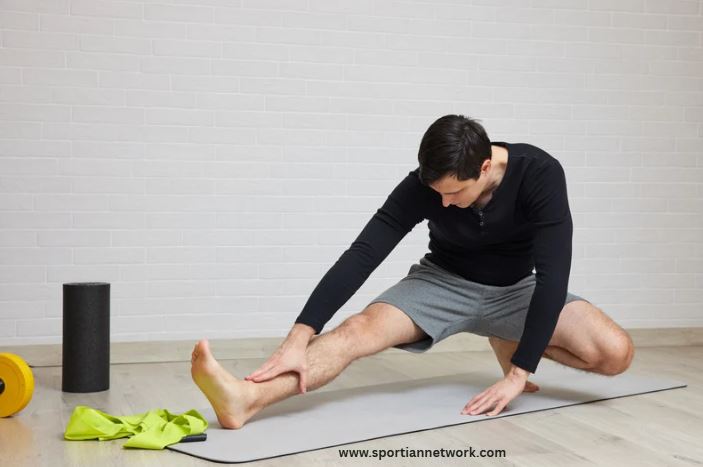
Importantly, adductor strength also needs to be paired with hip mobility. Tight hip flexors and limited hip internal rotation are common in hockey players because the skating position encourages these patterns over a long season. Without addressing the mobility side, strength gains in the adductors produce limited transfer because the joint range is not available to express that strength. This is exactly the kind of limiter that mobility work for athletic training programs addresses and why it belongs in every hockey player’s year-round routine.
Plyometric Work for First-Step Explosiveness
Strength builds the ceiling. Plyometrics convert that strength into the explosive power skating demands in live play. A player who is strong but does not train explosively will skate with authority but not with burst. The first two or three strides, the ones that separate a player from their check or allow them to reach a puck before the defender, come from reactive power, not sustained strength output.
The most sport-specific plyometric movements for hockey are lateral jumps, lateral bounds, and lateral hurdle hops because skating power is produced in the frontal plane, not the sagittal plane like most conventional jump training. Bilateral lateral jumps build general power. Single-leg lateral bounds closely mimic the actual force application angle of the skating stride and are the most direct plyometric transfer tool available off the ice.
Box jumps contribute too, building vertical force production that carries over into the push-off phase of the stride. The plyometric training science article covers the stretch-shortening cycle, which is exactly what makes a crisp skating push feel different from a slow, grinding one. The elastic energy stored and released during each stride transition is trained through plyometric work, not strength work alone.
For players new to plyometric training, the progressions in the plyometrics done right article apply directly. Jumping before the athlete has adequate landing mechanics and single-leg stability creates knee and ankle injury risk, especially on the hard lateral cuts of hockey. Earn the right to jump explosively by building the strength base first.
Off-Ice Skating Position Training
One aspect of off-ice training that most programs miss entirely is training in the actual body position used while skating. A hockey player spends their entire ice time in a position of significant hip flexion, knee flexion, and trunk forward lean. However, most gym programs train them in tall, upright positions that have limited specificity to this demand.
The solution is not complicated. Performing exercises with the torso angle and hip flexion depth that matches the skating position makes the strength gains more directly transferable. A Bulgarian split squat with forward lean, a sled push in a low aggressive stance, and goblet squats to depth all develop strength in positions the body actually uses on ice.
Sled pushes deserve particular mention. Pushing a sled at low height with a forward-inclined body closely mirrors the low-start skating position used in acceleration out of a turn or after a puck stop. The hip extension and ground force application pattern is nearly identical. Including sled pushes in the off-season program, progressed carefully as covered in the off-season training program guide, is one of the most underutilized tools available to hockey players training without ice access.
Sample Weekly Off-Ice Structure for Hockey Players
The off-season is the primary window for building skating-specific strength before training camp. The six-week off-season speed and agility blueprint provides the structural framework. Here is how the principles apply specifically to a hockey player’s off-ice strength week.
Three strength days per week is the standard, with two focused heavily on lower body power and one managing upper body and recovery work. Each lower body day should include one primary bilateral movement like the trap bar deadlift, one primary unilateral movement like the Bulgarian split squat or single-leg RDL, one glute-specific accessory, one adductor-specific movement, and one calf and ankle exercise. Plyometric work should come at the start of each session, before strength work, when the nervous system is fresh and explosive output is maximal.
Before every session, a proper warm-up targeting activation specific to skating muscles matters enormously. Hip flexor mobilization, glute activation with banded clamshells, and lateral band walks are the three most important pre-session primers for a hockey athlete. The dynamic warm-up routine can be adapted by replacing forward-focused movements with lateral and rotational patterns that match hockey’s frontal plane demands.
Using session RPE to track load across off-season training weeks helps prevent the common problem of over-training early in the summer when motivation is high, which then leaves athletes depleted and underperforming by the time training camp arrives. The goal is to peak physically in the final weeks before the season begins, not in July.
The Angle Nobody Talks About: Eccentric Strength for Stopping and Changing Direction
Hockey players stop, change direction, and absorb force from checks constantly throughout a game. The eccentric strength capacity of the quads, glutes, and adductors governs how cleanly they handle these deceleration demands. Eccentric weakness in any of those muscles results in either reduced stopping power or increased injury risk, and often both.
Eccentric-focused training means controlling the lowering phase of movements slowly and under control. Tempo Bulgarian split squats where the descent takes three to four seconds, Nordic hamstring curls for the eccentric hamstring strength that protects against adductor and hamstring strains, and slow eccentric single-leg calf raises all build the braking capacity that separates a player who can accelerate from a player who can also stop and redirect explosively.
This eccentric dimension is why ACL tear prevention exercises overlap so directly with hockey performance training. The landing and deceleration mechanics that protect the knee in jumping athletes apply equally to hockey players absorbing force during skating direction changes. Training for injury resilience and training for performance are the same work. The movements are identical. The intent just needs to be stated clearly so athletes understand the dual purpose.
The player who gets faster edges on the ice is not usually the one who skated more in the summer. More often, it is the one who spent the summer building the specific strength foundation that skating requires and then stepped on the ice with a physical capacity they did not have the season before.