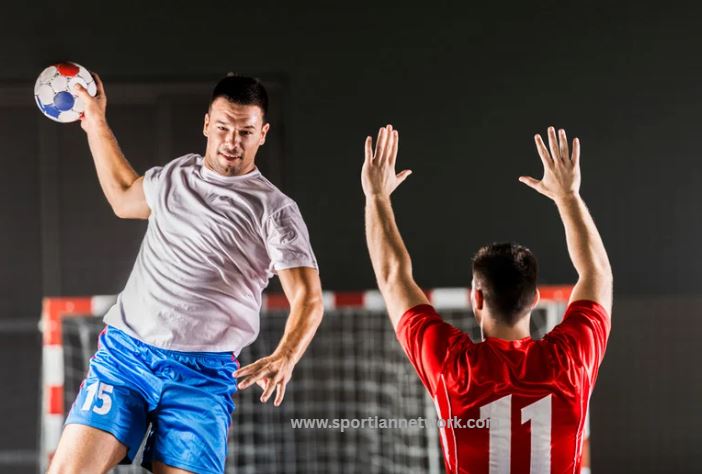
Handball is a fast-paced team sport played on an indoor court where two teams of seven players each try to throw a ball into the opposing team’s goal. Players can run with the ball, pass it to teammates, and shoot at goal — but cannot kick it with their feet or hold it for more than three steps without bouncing it. Games last sixty minutes split into two halves, and the team with the most goals wins. It is one of the most athletically demanding team sports in the world, combining the speed of basketball, the contact of rugby, and the throwing demands of baseball all in one.
If you have never watched or played handball before, the first few minutes of a game will leave you thinking it is chaotic. Give it ten minutes and patterns start appearing. Give it a few practices and you will understand why it is the second most popular team sport in Europe.
What Makes Handball Different from Other Sports
The most common question new players ask is how handball compares to sports they already know. The court dimensions and shot-clock style of play will feel familiar to basketball players. The physicality in close quarters will resonate with anyone who has played water polo or rugby. The throwing mechanics overlap meaningfully with baseball and water polo.
However, handball has a combination of characteristics that make it genuinely unique. Players are allowed to make body contact with opponents who have the ball, but contact must come from the front and cannot be excessive. The goalkeeper is the only player who can touch the ball with their feet and is the only person allowed inside the semicircular goal area, called the crease. Outfield players can jump into the crease to shoot but must release the ball before landing inside it. That jumping element creates some of the most spectacular plays in any court sport.
The sport rewards athletes who combine size and aggression near the goal with speed and court vision in transition. Unlike basketball, where elite height is almost mandatory at certain positions, handball accommodates a wider range of body types because the physical contact and throwing power elements create pathways for different kinds of athletes to contribute meaningfully.
The Court, Goal, and Basic Dimensions
An official handball court measures 40 meters long by 20 meters wide, which makes it slightly larger than a basketball court. The goals are 3 meters wide and 2 meters tall, significantly larger than an ice hockey goal but smaller than a soccer goal. The crease, which is the D-shaped area in front of each goal that only the goalkeeper can occupy, extends 6 meters from the center of the goal line.
There is also a dotted 9-meter line that represents the free-throw line and a 7-meter mark used for penalty shots. The center line divides the court in half and plays a role in restarts after goals.
The ball itself comes in three sizes. Size 3 is used for men’s competition and measures 58 to 60 centimeters in circumference. Size 2 is for women’s competition and youth boys over 16, measuring 54 to 56 centimeters. Size 1 is for younger youth players. The ball has a slightly tacky surface by design, which allows players to grip it with one hand and hold it in ways that seem physically impossible to newcomers.
The Basic Rules Every Beginner Needs to Know
Learning the rules in layers is the most practical approach. You do not need to know every regulation before your first session, but these core rules will stop you from making the most common beginner mistakes.
The three-step rule is the most distinctive movement rule in handball. When you receive the ball while stationary or while moving, you may take up to three steps with the ball in your hands before you must either pass, shoot, or dribble. There is no limit to how many times you can dribble, but once you pick up your dribble and hold the ball, the three-step clock restarts. After that, you must pass or shoot.
The three-second rule prevents players from holding the ball without doing something with it. Once you have the ball and are stationary, you have three seconds to act. Combining the step and time rules keeps the game moving at an extremely high pace.
The crease rule means no outfield player’s feet can touch or cross the 6-meter line while they have the ball. However, you can jump from outside the crease, enter the air above it, and shoot as long as you release the ball before any part of your body contacts the ground inside. This creates the diving shots that define the visual spectacle of the sport.
Physical contact is permitted but governed by the rule that you can only use your body to push, block, or crowd an opponent who has the ball. No grabbing, holding, or pulling. Contact from behind is not permitted. Violations result in free throws or, for serious offenses, yellow cards, two-minute suspensions, or red card ejections.
Free throws are taken from behind the spot of the foul and the defending team must be at least 3 meters away. Seven-meter penalties, equivalent to a penalty kick in soccer, are awarded for fouls that directly deny a clear goal-scoring chance.
Positions and What Each Role Does
Handball uses seven players per team on the court, including one goalkeeper. The six outfield positions divide into three general categories, though modern handball increasingly uses fluid positional systems.
The goalkeeper is the only player who can block shots with their feet and legs as well as their hands. They operate entirely within the crease during play, command of the D-shaped area, and initiate counterattacks with their distribution after saves. Goalkeeping in handball requires extraordinary reflexes because shots regularly travel at 80 to 100 kilometers per hour from close range.
The backs are the three central outfield players: left back, center back, and right back. They typically operate behind the 9-meter line and are responsible for orchestrating the attack, delivering accurate long-range shots, and creating space through their positioning and movement. Center backs are often the playmakers, equivalent to point guards in basketball. Backs tend to be the larger, more powerful players because their role involves holding position against defenders and generating throwing power from distance.
The wings play on the far left and right edges of the court and are typically the fastest, most agile players on the team. Their role involves making sharp angled runs to receive passes near the crease and finishing from tight angles. Wing shots often go to the near top corner or use the post as a reference point because of the angle involved.
The pivot is a specialized position that operates closest to the opposition goal, often with their back to goal, similar to a basketball center posting up. The pivot screens defenders, creates passing lanes for the backs, and looks for opportunities to receive the ball in close-range positions for high-percentage shots. Physical durability and body strength matter enormously here.
Throwing Mechanics: The Skill That Takes Longest to Develop
Handball throwing is not just about arm strength. The most powerful and accurate handball throws use a full-body kinetic chain, from ground contact through the hips, trunk rotation, shoulder, elbow, and wrist. Beginners typically throw with just their arm and wonder why their shots lack pace and accuracy compared to more experienced players.
The key mechanical points for a basic overhand throw are the same foundations used in baseball pitching or javelin throwing. Plant the foot opposite your throwing arm, open the hip toward your target, rotate the trunk aggressively, lead with the elbow, and snap through with the wrist at release. The grip matters too. In handball, the ideal grip wraps the fingers around the upper half of the ball with the thumb underneath, allowing the wrist to generate significant spin and trajectory control.
Developing an effective throwing motion takes repetition over time. For new players who want to accelerate this, upper body strength training focused on shoulder stability, rotator cuff health, and lat strength directly supports the throwing chain. The rotator cuff exercises article is particularly relevant because the repetitive overhead throwing demands of handball place significant stress on the shoulder complex, and injury prevention work should start from day one, not after a problem appears.
Grip strength also matters more in handball than most beginners expect. Catching a fast cross-court pass, maintaining possession under physical pressure, and executing a one-handed shot all require a grip capacity that casual athletes rarely train specifically.
Defense: How It Works and What Beginners Get Wrong
Handball defense operates on a zone-first principle at the elite level, but beginners are best served understanding both man-to-man and zone concepts from the start.
The most common defensive formation is the 6-0, where all six defenders stand roughly along the 6-meter line and work collectively to block passing lanes, contest shots, and limit the offense’s ability to penetrate the crease. This formation requires excellent communication and coordinated lateral movement. Beginners often drift too far forward trying to intercept passes and leave gaps behind them.
The 5-1 formation pulls one defender forward to press the opposing center back and disrupt the attack’s rhythm at the point of initiation. This is riskier but effective against teams that rely heavily on their playmaker.
Physical contact in defense takes adjustment for athletes coming from non-contact sports. The legal body contact in handball feels aggressive to newcomers, but learning to use your body position, hip, and shoulder to slow a driving attacker without grabbing is one of the fundamental skills the sport teaches. It requires confidence and body awareness that develops with practice.
Anticipation matters enormously. Because the game moves so quickly, reactive defense is rarely good enough. Reading the body language of the ball carrier, tracking off-ball movement, and positioning yourself to cover the most dangerous passing option before the ball arrives separates average defenders from good ones. This is where visualization in sport practice pays dividends for handball players specifically. Mentally rehearsing defensive reads and positioning before training sessions accelerates pattern recognition in ways that purely reactive learning cannot match.
The Physical Demands: What Your Body Needs to Handle
Handball is genuinely one of the more physically demanding team sports a beginner can take up. A single 60-minute game involves repeated explosive sprints, frequent change of direction, jumping, physical contact, and throwing. High-level players cover 4 to 6 kilometers per game with a significant portion at high intensity.
For beginners, the cardiovascular demand hits first. New players often find themselves winded within the first five minutes because handball’s pace is relentless. Building an aerobic base before joining a team or shortly after starting will make every session more productive. Zone 2 training — easy sustained effort over 30 to 45 minutes — is the most efficient way to build this base without accumulating excessive fatigue.
The leg and hip demands come next. Explosive jumping for shot attempts, rapid lateral cuts on defense, and the deceleration loads from changing direction all stress the quads, hamstrings, glutes, and groin. Preventing ACL tears and hamstring strains is a real concern in handball because of how frequently players cut and land. Getting a solid dynamic warm-up routine established before every session is not optional at any level.
The upper body and shoulder fatigue in later sessions surprises many beginners who underestimate how many throws happen across a full practice or game. Shoulder health maintenance, including external rotation work, scapular stability exercises, and thoracic mobility, should be built into any handball player’s training routine from the beginning.
Common Beginner Mistakes and How to Fix Them
Understanding where new players go wrong saves months of frustration and accelerates development significantly.
Holding the ball too long is the most universal beginner mistake. New players receive the ball and freeze while their brain processes what to do next, which lets defenders close down and makes good options disappear. The fix is practicing quick passing decisions in drills and training your mind to look ahead before you receive the ball. Where are your teammates? Where is the space? Answer these questions before the pass arrives, not after.
Shooting too early from bad positions is equally common. Beginners see the goal and throw immediately, even from positions where the goalkeeper can comfortably cover the angle. Learning to assess whether a shot is genuinely a good option versus driving deeper or finding a better-positioned teammate takes game experience, but the habit of asking “is this the best option?” before every shot starts to correct it.
Standing flat-footed on defense makes you easy to step around. Good handball defense requires staying on the balls of your feet with slightly bent knees, ready to move laterally in either direction. When you stand flat and straight-legged, a half-step fake by the attacker beats you completely.
Forgetting the three-step count is a purely mechanical error that disappears with practice but draws constant whistles in early sessions. Some beginners find it helpful to count steps silently during their first few weeks until the awareness becomes automatic.
Neglecting off-ball movement is a mistake that reflects the difficulty of transitioning from individual skill sports to team sport thinking. In handball, your positioning and movement without the ball directly determines whether your teammates can create goals. Running purposeful routes, screening defenders, and creating passing lanes when you do not have the ball is as important as what you do when you do.
Getting Fit for Handball: Where to Start
For a complete beginner building physical preparation for handball, three qualities matter most: aerobic capacity, explosive leg power, and upper body throwing strength.
Aerobic capacity supports the game’s relentless pace. Explosive power determines how high you jump for shots and how fast you accelerate past defenders. Upper body strength governs your shot velocity and your ability to maintain throwing accuracy when fatigued.
A practical four-week entry program for a new handball player might look like this. Two days per week of aerobic work, either a 30-minute easy run or 45 minutes of cycling at conversational pace. Two days per week of strength training focused on lower body squatting and hinging movements, plus upper body pressing and pulling for the throwing chain. One or two handball practices per week as available. Use session RPE to track how demanding each session feels and adjust training volume accordingly, because new handball players frequently underestimate how much the sport taxes their body and accidentally overtrain in their enthusiasm.
Recovery deserves specific attention for beginners. The muscular soreness in the legs and throwing shoulder after early handball sessions can be significant. Foam rolling, light mobility work, adequate sleep, and proper protein intake all accelerate adaptation and reduce the soreness that discourages new players from continuing.
The Mental Side of Learning a New Team Sport
Starting any new team sport as an adult comes with a specific psychological challenge that pure fitness or skill training cannot solve. You will make mistakes constantly at first. Your decisions will be slower than everyone else’s. You will feel like you understand the rules but cannot apply them under pressure.
This is universal and temporary. Every experienced handball player went through this same phase. The athletes who progress fastest are the ones who stay focused on process rather than performance, who ask questions after practice, who watch games attentively, and who approach each session as information gathering rather than performance evaluation.
The six mental skills that separate good athletes from great ones are relevant here even at a beginner stage. Focus control, the ability to bring your attention back to what matters in the current moment rather than dwelling on the last mistake, is probably the most immediately applicable mental skill for new handball players. A missed pass or a wrong decision happens and is over. The next possession requires your full attention.
Managing pre-competition anxiety also becomes relevant once you start playing in organized sessions or matches. That nervous energy before a game is not a problem. Channeled correctly, as covered in that article, it sharpens focus and prepares the body for intense physical output. Interpreting nerves as readiness rather than fear changes how you show up in the opening minutes of a game.
Finding Your First Team and What to Expect
Handball clubs exist across the United States, Canada, and throughout the UK, though the density varies significantly by region. USA Team Handball maintains a club finder on their website that lists clubs by state. In the UK, the British Handball Association has a similar directory.
College programs are another entry point. NCAA handball does not exist at the Division I level in the US, but club handball is active at many universities, and it offers structured competition alongside access to coaching. For athletes aiming at elite levels, the pathway through Division I scholarships does not apply directly to handball in America, but European professional leagues offer genuine pathways for talented players who develop through the club system.
At most recreational clubs, your first few sessions will involve basic drills covering passing accuracy, shot mechanics, and simple attack-defense scenarios before you get into full game situations. Do not rush this phase. The foundational mechanics established in these early weeks carry forward into every game situation you encounter later. Players who skip foundational work and jump straight into game play often develop habits that cap their ceiling at the recreational level.
Handball rewards patience, consistent practice, and physical investment. It is also one of the most rewarding team sports to learn because the combination of physicality, skill, and tactical complexity creates an enormous ceiling for growth that recreational players rarely reach. Most people who try it once find themselves coming back.