Walk into any sports store and the grip strengthener section looks straightforward. Spring-loaded squeezers in different colours, a couple of rubber balls, maybe a hand grip trainer with a digital counter. Pick one up, squeeze it repeatedly, and your grip gets stronger. That is the assumption most athletes operate on, and it is only partially correct. The type of grip strength you build depends almost entirely on the tool you use, and the tool that builds strength for a powerlifter is not the same one a BJJ athlete needs, and neither of those serve a climber optimally. Understanding the difference between tools is what separates productive grip training from wasted time.
The Four Types of Grip Strength Worth Training
Before discussing tools, it helps to understand what grip strength actually means in a sporting context. There is no single quality called grip strength. There are several distinct capacities, each demanding different training stimulus.
Crushing strength is the ability to close the hand forcefully against resistance. This is what most people think of as grip strength and it is what spring squeezers primarily train. It matters in grappling, racket sports, and any pulling movement in the gym.
Supporting strength is the ability to hold a position under sustained load without the grip failing. Think of holding the bar at the top of a deadlift, hanging from a pull-up bar, or maintaining clinch control in wrestling across multiple rounds. This is an endurance quality as much as a strength quality.
Pinch strength is the force produced between the thumb and fingers without the palm being involved. It matters in climbing, wrestling tie-ups, and carrying odd objects. It is almost completely neglected in standard grip training.
Wrist and forearm stability is the ability to maintain position through the wrist under load, particularly during rotation or impact. This affects every throwing, striking, and racket sport. It is not the same as finger flexor strength, and it requires different training entirely.
The detailed breakdown of why grip matters across different sports is at Grip Strength: Why It Matters for Every Sport and How to Improve It. This article focuses on the tools themselves and what each one actually builds.
Spring-Loaded Hand Grippers
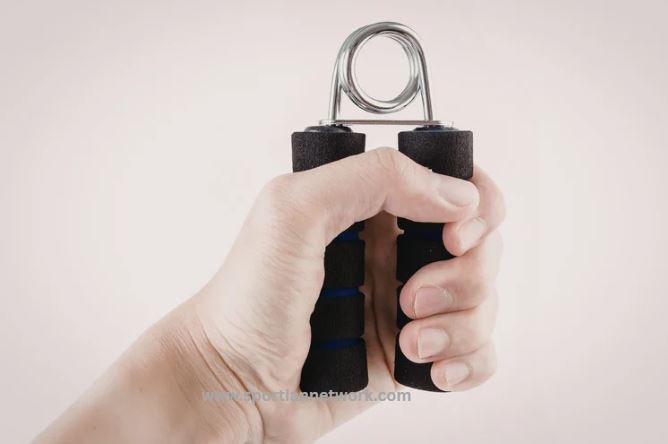
The most common grip tool in any gym or sports store. A spring-loaded gripper consists of two handles joined by a coiled spring. You close it repeatedly against the spring’s resistance.
What it builds well: crushing strength in the finger flexors, particularly the middle and ring fingers which do the most work in a closing grip. Progressive overload is possible by purchasing grippers at different resistance levels, ranging from around 40kg up to over 100kg for the heavy calibrated versions used in grip sport competition.
What it does not build: supporting strength, pinch strength, or wrist stability. The motion is a pure open-close cycle that does not challenge the hand in any sustained position.
Best suited for: combat athletes in grappling sports, rowers, and anyone whose sport involves repeated forceful gripping. BJJ and wrestling athletes benefit from consistent gripper work because the ability to re-close the hand rapidly after it is pried open is a direct competitive skill. The BJJ guide covers how much grip fatigue affects grappling performance over the course of a match. Wrestling training has the same dependency.
Avoid if: your primary sport requires sustained hangs, pinch work, or forearm stability rather than repeated squeezing. A climber who only trains spring grippers is building the wrong capacity for most climbing demands.
Programming note: grippers respond well to sets of five to ten slow, controlled repetitions with full closure, rather than high-rep pumping. The temptation to do fifty fast reps is counterproductive for strength development. Treat them like a strength exercise with rest between sets.
Captains of Crush and Heavy Calibrated Grippers
A step up from standard spring grippers. These are precision-calibrated tools with consistent, rated resistance. The Captains of Crush range from Trainer level at around 45kg through to the No.4 at over 165kg, which has been closed by only a handful of people in recorded history.
What they add over standard grippers: precision and progressive overload. You always know exactly what resistance you are working against, which makes programming straightforward. The heavier range genuinely builds maximal crushing strength in a way that colour-coded department store grippers cannot approach.
What they do not add: anything beyond crushing strength. They are a refined version of the same tool, not a different category.
Best suited for: serious grip sport athletes, powerlifters, and anyone who has exhausted lighter spring grippers and needs continued progressive overload. For the deadlift specifically, crushing grip strength is a real limiter at heavier loads. The deadlift form checklist identifies grip failure as a common technical breakdown point, and heavy calibrated grippers address that directly.
Thick Bar and Fat Grip Attachments
Rather than a dedicated grip tool, fat grip attachments are rubber sleeves that slide over a standard barbell or dumbbell handle and increase its diameter from roughly 28mm to 50mm or more.
What they build: all-around grip strength through increased diameter demand. A standard barbell allows the fingers to wrap around and overlap, meaning the thumb and fingers create a mechanical lock. A fat bar eliminates that lock, forcing the hand to work harder across all finger flexors simultaneously. This recruits more of the hand musculature than standard-diameter work.
Supporting strength improves rapidly with thick bar training because the sustained hold under load is harder to maintain. The forearm musculature works harder throughout the entire set, not just at the moment of maximal effort.
Best suited for: lifters who want grip development without dedicated grip sessions. Adding fat grips to rows, deadlifts, curls, and pull-ups turns every upper body session into grip training. For upper body strength programmes, fat grips are a low-cost, high-return addition. Anyone building a home gym on a budget who wants grip training without buying multiple tools will find that a set of fat grips added to existing equipment gives them more grip stimulus than most dedicated tools. The home gym under $300 guide explains where this kind of accessory sits in a minimal setup.
What they do not build in isolation: pinch strength or the specific crushing strength that spring grippers develop. They build a broader, more general grip quality.
Pinch Blocks and Hub Lifting
Pinch training involves gripping a plate, block, or hub by its face rather than through a closed-hand grip. The thumb opposes the fingers across a flat surface, which is a fundamentally different demand from standard gripping.
Pinch blocks are typically wooden or metal blocks with a loop of rope or chain at the top. You hold the block by its sides with a pinch grip and either hold it for time or lift it for reps. Hub lifting involves gripping the centre hub of a weight plate with a full pinch grip and lifting it.
What it builds: thumb strength, radial grip strength, and the specific force production pattern used in climbing, wrestling tie-ups, and any situation where objects must be controlled without a full hand wrap. Climbers who train pinch strength alongside their other finger training see direct carryover to pinch-style holds on rock and board routes. The climbing strength training guide covers how pinch capacity fits into a complete climbing preparation programme.
What it does not build: crushing strength or supporting endurance to any significant degree.
Best suited for: climbers, wrestlers, and any athlete who needs thumb strength for sport. Pinch training is probably the most sport-specific grip tool for grappling that most people have never used. A wrestler who can out-pinch their opponent in a tie-up has a genuine competitive advantage that no amount of spring gripper training develops.
Hangboards and Fingerboards
A fingerboard is a board mounted to a wall or door frame with recesses of various sizes and depths, allowing the user to hang their bodyweight from different finger positions.
What it builds: finger flexor strength specifically adapted to hanging and contact strength, supporting endurance through sustained holds, and the specific finger positions used in climbing. The ability to maintain a half-crimp or open-hand position under bodyweight for ten seconds is a fundamentally different strength quality from anything a spring gripper produces.
The capacity for sustained hanging transfers directly to pull-up performance as well. Pull-up progression is partly a grip endurance issue, and hangboard training addresses that limiter directly.
What it does not build: crushing strength in the closing motion, pinch strength, or wrist stability.
Best suited for: climbers first, but also any athlete who needs sustained hanging or pulling endurance, including gymnasts, obstacle course racers, and military athletes. Combat athletes who compete in gi grappling find fingerboard training useful for developing grip endurance across longer matches.
A note on injury risk: fingerboard training is the highest-risk grip training category for tendon injury. The A2 pulley at the base of the ring finger is the most commonly injured structure in climbers, and aggressive hangboard programming is a primary cause. Progressive loading, adequate warm-up, and avoiding full crimp positions early in a training programme are essential.
Wrist Rollers
A wrist roller is a cylinder with a rope or cord attached to its centre, with a weight hanging from the other end of the cord. The athlete holds the cylinder at arm’s length and winds the weight up by rotating the wrists alternately.
What it builds: wrist extensor and flexor endurance, forearm mass through sustained contraction, and the rotational strength of the forearm that transfers to racket sports, throwing, and striking. The connection between forearm and wrist health in racket and combat sports is covered in the wrist flexor and extensor training guide, and the wrist roller is one of the most direct tools for loading those tissues through a full range of motion.
What it does not build: crushing strength or finger flexor strength to any meaningful degree. The fingers are largely passive in a wrist roller; the forearm muscles do the work.
Best suited for: tennis players, badminton players, baseball pitchers, and any athlete who produces force through forearm rotation. Hockey players benefit from wrist roller work for similar reasons, as the wrist snap in shooting and the forearm demand in board battles are both rotational in nature. The hockey skating strength guide covers upper body contributions to on-ice performance, and forearm development is part of that picture.
Programming note: wrist rollers cause more forearm pump faster than almost any other tool. Start with a very light weight, around 2.5 to 5kg, and focus on controlling the descent as well as the ascent. The eccentric phase of the roller is where the most productive stimulus occurs and where the most common mistake of dropping the weight quickly wastes most of the benefit.
Stress Balls and Soft Squeeze Tools
These sit at the bottom of the grip training hierarchy for athletes. A soft rubber ball or therapy putty provides minimal resistance and does not create meaningful progressive overload for anyone with even a basic training history.
Where they have value: in rehabilitation contexts after hand surgery, nerve injury, or during the early stages of tendon recovery where loading must be minimal. They are appropriate medical rehabilitation tools that have migrated into mainstream sport with a reputation that outstrips their actual training effect.
For healthy athletes with any training background: they are largely a waste of training time. The stimulus is too low to drive meaningful adaptation in grip strength for sport performance purposes.
Rice Bucket Training
Plunging the hand into a bucket of dry rice and performing opening, closing, and rotating movements against its resistance is a training method with a long history in throwing sports, particularly baseball.
What it builds: finger extensor strength, which is the often-neglected counterpart to the flexor strength built by squeezing tools. Balanced development between finger flexors and extensors reduces injury risk, particularly for the tendons and ligaments of the hand. It also develops the opening strength of the hand that matters in ball release patterns and in re-opening the hand quickly after a grip in grappling.
What it does not build: any significant level of maximal grip strength. The resistance is too diffuse and inconsistent to drive strength adaptation beyond a beginner level.
Best suited for: throwing athletes as an injury prevention and finger extensor development tool, and as a warm-up or prehab method for any athlete doing heavy grip work.
How to Choose Based on Your Sport
For combat grapplers in BJJ and wrestling: prioritise spring grippers for crushing strength, pinch blocks for tie-up strength, and add fat grips to pulling movements in the gym. The BJJ guide and wrestling training both point to grip endurance as a performance separator in longer matches, so supporting endurance work through fat grip lifting and timed holds should be included.
For climbers: fingerboards are the primary tool, with pinch block work for specific hold types. Spring grippers add limited value unless the athlete is severely deficient in crushing strength.
For powerlifters and strength athletes: fat grips on accessory work and heavy calibrated grippers for dedicated grip sessions address the supporting strength and crushing strength that heavy barbell work demands. The posterior chain training that forms the core of a powerlifter’s programme becomes grip-limited at certain loads, and targeted tool use resolves that bottleneck before it stalls progress.
For racket sport and throwing athletes: wrist rollers and rice bucket training address the rotational and extensor demands that no other grip tool targets adequately.
For general athletic development: fat grips added to existing training provide the broadest grip stimulus with the least additional equipment. For athletes building a home gym under $1000 who want grip training integrated rather than isolated, a pair of fat grip attachments returns more value than most dedicated grip tools at a fraction of the cost.
Programming Grip Work Into Your Training Week
Grip training does not need its own session. The most efficient approach is to integrate it into existing upper body work rather than adding sessions. Use fat grips on pulling movements two to three times per week. Add dedicated gripper or pinch work at the end of upper body sessions for two to three sets. Reserve fingerboard or wrist roller work for sport-specific periods where those qualities are a priority.
The periodisation principles that govern strength training apply to grip work too. In-season, grip volume should be maintained at a lower level to avoid cumulative forearm fatigue that spills into sport performance. Off-season and pre-season are the periods to accumulate grip training volume and progress loads systematically. Grip strength responds to the same adaptation principles as any other strength quality: progressive overload, adequate recovery, and specificity of training to the demands of the sport.