
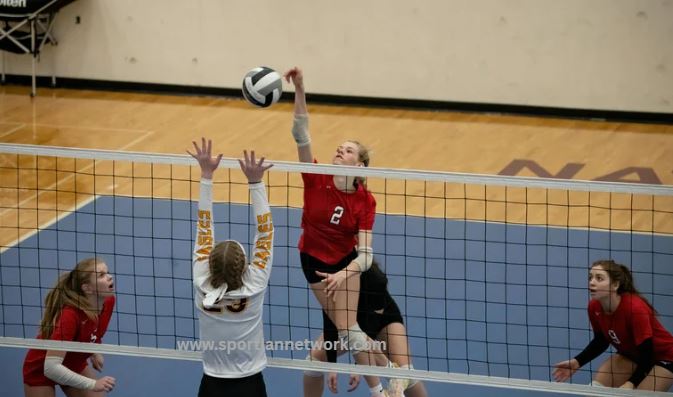
Volleyball looks simple from the stands. Six players per side, a net in the middle, keep the ball off the floor. Watch a few minutes of real play, though, and the questions start piling up. Why did that player just swap with someone in a different jersey? Why did the serve switch sides? Why is everyone rotating after every point?
This guide answers all of it. Read this once and volleyball will never feel confusing again.
The Basic Setup
Each team fields six players on a rectangular court divided by a net. The net height is 2.43 metres for men and 2.24 metres for women at the international level. Your team gets a maximum of three contacts to return the ball over the net. One player cannot hit the ball twice in a row. That is the foundation everything else builds on.
The six positions split into two rows of three. The front row contains positions 2, 3, and 4, left to right from the server’s perspective. The back row holds positions 1, 5, and 6. Position 1 is always the server. Understanding where the positions sit matters because rotation flows from there.
Before you even get to serving and scoring, it helps to have a solid foundation of dynamic warm up habits that prepare your body for the explosive lateral movement volleyball demands.
How Rotation Works
Rotation is the rule that confuses new players most. Here is the simple version: every time your team wins a rally AND earns the right to serve, all six players rotate one position clockwise.
Think of the six positions as a clock face. When your team wins the serve, position 1 rotates into position 6, position 6 into position 5, position 5 into position 4, and so on all the way around. The player who moves into position 1 becomes the next server.
Why Teams Rotate
Rotation exists to prevent one dominant player from staying at the net for the entire match. It keeps the game fair by forcing all six players to serve and to play both front and back court roles at some point.
The Starting Positions Rule
At the moment the server contacts the ball, every player must be in their correct rotational position. Front row players must be closer to the net than their corresponding back row partners. Left side players must be left of center, right side players must be right of center.
Once the ball is served, however, players are free to move anywhere on the court. This is why you see trained setters sprint to their preferred position the instant the serve happens. Coaches design these positional patterns so that each specialist reaches their optimal zone as fast as possible.
This movement requires quick feet and good body awareness. Reading more about change of direction speed and how athletes train court awareness will help you appreciate what trained volleyball players actually do between rallies.
Overlap and Positional Faults
If players are out of position when the ball is served, the referee calls a positional fault. Your team loses the rally and gives a point to the opposition. Coaches drill starting positions relentlessly to avoid this costly and entirely preventable mistake.
Rally Point Scoring
Modern volleyball uses rally point scoring, which means a point is awarded after every single rally regardless of which team served. This replaced the old side-out system in 1999 and made the game faster and more watchable for broadcasters and fans.
How Sets Are Scored
A standard match plays best of five sets. Each of the first four sets is won by the first team to reach 25 points, provided they lead by at least two points. So if the score reaches 24-24, play continues until one team opens a two-point gap.
The fifth and deciding set, if needed, plays to 15 points with the same two-point minimum lead requirement. Teams also switch ends of the court when the first team reaches 8 points in the fifth set. That sideline change keeps things fair if one side of the arena has a lighting or wind advantage.
Serving Changes Under Rally Scoring
Under rally point rules, the serving team scores and keeps the serve if the receiving team fails to return the ball legally. When the serving team loses the rally, the receiving team wins the point and also earns the right to serve. That moment of earning the serve triggers rotation.
This is important. Your team does not rotate every time you win a point. Your team rotates only when you win a rally that transfers the serve back to your side.
Understanding the mental side of absorbing these rule systems under match pressure connects directly to what goal setting frameworks for athletes teach about process focus over outcome anxiety.
Contact Rules Explained
Each team gets three contacts maximum per possession. In practice, the standard sequence is pass, set, attack. First touch controls the incoming ball, second touch places it for the hitter, third touch sends it over the net.
A player can use any body part to contact the ball legally, including the foot. The ball must not come to rest or be caught. Double contacts on the first touch are permitted in limited circumstances, particularly when the ball arrives hard and fast from an attack. The referee uses judgment on whether a contact was clean or a carried ball.
Blocking Does Not Count as a Contact
When a front row player blocks an attack at the net, that contact does not count toward the team’s three-touch limit. After a block, the blocking team can still use all three contacts. Additionally, the player who blocked can be the next person to play the ball, which would not be legal for any other sequence of contacts.
The Libero Rule
The libero is the player in the different jersey. This specialist role was introduced to international volleyball in 1998 and changed the defensive shape of the game permanently.
What the Libero Does
The libero is a back row defensive specialist. This player cannot attack the ball above the height of the net. The libero cannot serve in FIVB international play, though many domestic and collegiate competitions allow libero serving under modified rules. Most importantly, the libero cannot block and cannot attempt to block.
What the libero can do is receive serve and dig with exceptional skill. Teams deploy their best defensive player as libero specifically because the role keeps that player on the court longer and in the back row where passing and digging happen.
How Libero Substitution Works
The libero operates under a completely separate substitution system from the rest of the roster. The libero can replace any back row player without the replacement counting toward the team’s official substitution limit. The swap happens during a dead ball, between rallies, and does not require the referee to formally record a substitution.
When the player being replaced by the libero rotates back to the front row, the original player returns. The libero stays in the back row at all times. This cycle can repeat as many times as necessary throughout the set.
One practical rule worth knowing: the libero cannot directly replace the player they just substituted for in the same rotation cycle. There must be at least one rally in between before the same exchange can happen again.
The libero position rewards athletes with exceptional reaction time and agility. The physical demands of constant diving, sprawling, and explosive lateral movement make ankle mobility work and posterior chain strength non-negotiable parts of every serious volleyball player’s training week.
Serving Rules
Every rally begins with a serve. The server stands behind the end line in the service zone and has eight seconds after the referee whistles to contact the ball. Serving into the net or out of bounds gives a point directly to the opposition.
Modern volleyball at every level favors the jump serve and the float serve. Jump serves generate tremendous pace and topspin. Float serves move unpredictably in the air and are harder to pass cleanly because the ball lacks spin and behaves erratically near the end of its flight path.
The serve is the only contact in volleyball where one player fully controls the outcome. Coaches treat serving as the single most important skill for building pressure. A consistent server who forces weak passes disrupts the entire opponent’s offensive system before the attack even begins.
Net Rules and the Center Line
Players cannot touch the net during play. If any part of a player’s body makes contact with the net while the ball is live, the referee calls a fault and the opposing team wins the rally.
The center line runs under the net along the floor. Players are permitted to cross the center line partially, as long as some part of the foot remains in contact with or directly above the center line. Full crossing of the center line into the opponent’s court is a fault.
Antenna violations also end rallies. Two red and white flexible rods extend above the net at the sideline boundaries. Any ball that passes outside the antenna, or contacts it, is out of play.
Front Row vs Back Row Player Rules
The three players in the front row at any given moment are the only ones permitted to attack the ball above the net height from inside the attack zone. The attack zone is the area between the net and the three-metre line on each side of the court.
Back row players can attack from behind the three-metre line. When a back row player jumps and hits from behind that line, it is a legal attack. When a back row player jumps from in front of the line and contacts the ball above the net, it is a back row attack violation.
This rule is why you see players check their feet carefully before jumping in certain situations. The three-metre line governs enormous tactical decisions about where to set for specific players depending on their rotational position at any given moment.
The physical requirements for attacking effectively from the back row demand serious vertical jump training. Anyone looking to add height to their approach jump will benefit from a structured volleyball jump training program that builds the fast-twitch power these movements require.
Timeouts and Substitutions
Each team receives two technical timeouts automatically in sets one through four when the leading score reaches 8 and 16 points. Each team also has two additional requested timeouts per set to use at any dead ball moment they choose.
Substitutions are limited to six per set for the team, not counting libero exchanges. A player who leaves the court can return only once per set, and only to the position they originally occupied. Coaches plan substitution strategy carefully because running out of substitutions in a long set removes tactical flexibility at critical moments.
Beach Volleyball vs Indoor Volleyball
Beach volleyball looks similar but runs on different rules. Two players per side replace the six-player format. Sets go to 21 points rather than 25. There is no libero. Blocking counts as one of the three contacts. Players switch ends of the court every seven points in the first two sets.
The scoring and rotation logic stays similar enough that understanding indoor volleyball gives you a head start on beach rules. The physical differences are enormous, though. Sand surface requires far more leg strength and conditioning than a hard indoor court. If you play both formats, your calf and lower leg training needs to account for the extra demand that sand places on the ankles and soleus.
Common Beginner Mistakes
New players consistently make the same rule errors. Touching the net during a block attempt is probably the most frequent. Players new to the libero concept often fail to track which back row player has temporarily left the court, causing confusion when rotation brings that player back to the front row.
Positional faults at the moment of serve happen constantly at recreational level because players drift into comfortable positions before the serve happens rather than waiting for the ball to be contacted first. Training the habit of holding your rotational position until serve contact sounds simple. In practice, it takes focused repetition to build consistently.
Additionally, new hitters approach from the wrong depth and jump too close to the three-metre line when rotating through back row positions. Understanding the attack line and respecting it eliminates a frustrating and entirely avoidable source of lost points.
Start Playing With Confidence
Volleyball rewards players who understand why the rules exist, not just what they are. Rotation creates fairness and forces versatility. The libero adds a specialist layer that rewards elite defensive skill. Rally point scoring demands mental toughness on every single contact because every rally counts.
Learn the rotation sequence until it is automatic. Understand what triggers it. Track where the libero is and why they moved. Watch where players position themselves the instant the serve happens. These habits separate players who look confused from players who look composed.
The physical preparation matters just as much as the rule knowledge. Building explosive lower body power and training your hip mobility will make every rule you have learned here easier to execute when the match pressure is real and the rallies are fast.
Volleyball is one of the most physically and tactically demanding team sports in the world. Now you know how the framework holds it all together.