
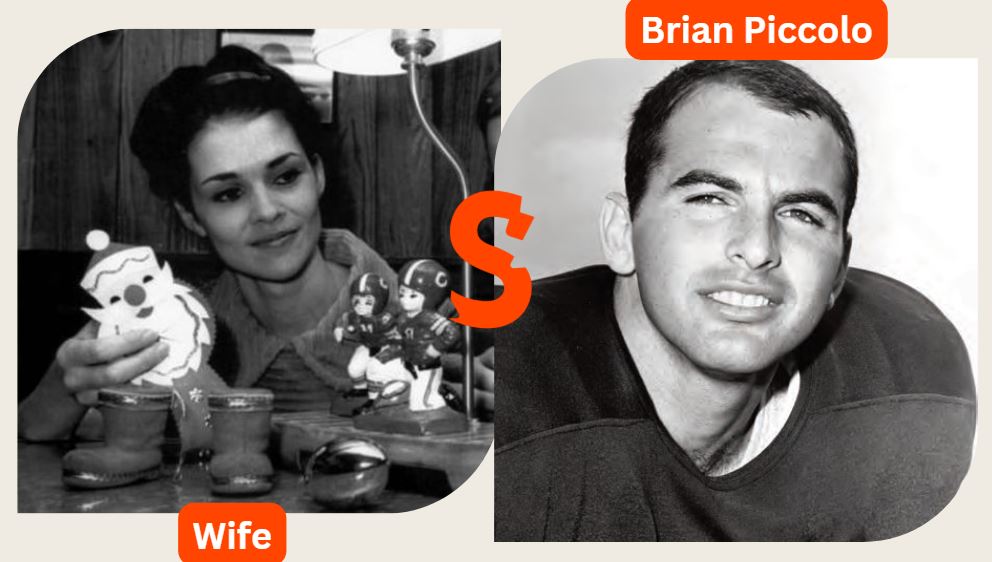
Joy Murrath was married to Brian Piccolo for six years. She was 27 when he died. She had three daughters under the age of five. Fifty-five million people watched a movie about her husband’s life the following year, and the version of Joy they saw on screen was played by actress Shelley Fabares.
That is one version of Joy Murrath’s story. The actual version is longer, quieter, and in some ways more surprising. She has spent over five decades shaping what Brian’s name means to the world, while living a life that has almost nothing to do with football.
Fort Lauderdale and the Family That Shaped Her
Joy Murrath was born in 1943 and grew up in Fort Lauderdale, Florida. Her full name is Joy Grace Murrath. She attended Central Catholic High School, a Catholic school that later became St. Thomas Aquinas High. Her upbringing was shaped heavily by her family, and specifically by her younger sister Carol, who was born with cerebral palsy.
That relationship defined Joy in ways that outlasted everything else. She grew up as a caregiver before she had any idea what caregiving would demand from her as an adult. Helping Carol was not a chore she resented. By all accounts, it was simply part of who she was. The patience and emotional steadiness she developed in that environment would, decades later, carry her through a husband’s terminal illness and a very public grief.
Meeting Brian Piccolo
Brian Piccolo moved to Fort Lauderdale from Pittsfield, Massachusetts, when he was three years old. He and Joy were at Central Catholic High School at the same time. He was a running back with real ability and a personality that filled every room he entered. She was a cheerleader. Their connection was immediate and deepened through high school into a serious relationship.
One moment from their engagement captures something essential about Brian. When he asked Joy to marry him, he gave her a large diamond ring. He also gave Joy’s sister Carol a smaller diamond ring. He had developed his own independent friendship with Carol, and he wanted her to feel included rather than overlooked. Joy later described that gesture as one of the clearest signs of who Brian was as a person. It was not a grand public act. It was something he did because it was the right thing to do, and he did not need an audience for it.
They married on December 26, 1964. Three days before the wedding, Brian had signed his first contract with the Chicago Bears. His professional career and their marriage started at almost exactly the same moment.
Life During the Bears Years
Brian Piccolo went undrafted in 1965 despite being the ACC Player of the Year and the nation’s leading rusher at Wake Forest. He tried out for the Bears as a free agent, made the practice squad, and worked his way onto the main roster by 1966. His career was built entirely on effort rather than given opportunity.
Joy managed their household and raised their daughters through all of it. Lori was born first, then Traci, then Kristi. Brian was, by everyone’s account, an intensely present father. He played with his daughters for hours. He took them shopping. He sat in the kiddie pool with them in the backyard. Joy described him as someone who understood that football was temporary and family was not, long before his illness forced that realization on him publicly.
In 1967, something happened that became the central narrative of Brian’s later public life. The Bears assigned him and Gale Sayers as roommates on road trips, making them the NFL’s first interracial roommates. Sayers was already a superstar, a two-time All-American and one of the most electrifying players in football. Piccolo was still fighting for playing time. Their friendship grew over time, and when Sayers suffered a severe knee injury in 1968, Piccolo helped him rehab and return. It was a real friendship. However, Joy told the Chicago Sun-Times years later that the Sayers friendship was actually a small part of Brian’s life, and that Brian was closer to another teammate, Ralph Kurek. The film exaggerated it into the center of everything.
The Illness
In late 1969, Brian began coughing and losing weight. Tests revealed embryonal cell carcinoma, an aggressive germ cell testicular cancer that had already spread to his chest cavity before it was detected. He was 26 years old. Their youngest daughter Kristi was still a toddler.
Joy never left. Through surgeries, chemotherapy, a mastectomy, and eventually the removal of his left lung, she was there. Doctors had informed her early that the cancer was terminal. She carried that knowledge while maintaining the household, raising three very young children, and continuing to be present for Brian in a way that did not collapse into visible despair. The emotional discipline that required, over months of progressive deterioration, is not something any competitor article has adequately addressed. It is actually one of the most demanding situations any caregiver can face, and Joy did it in her mid-twenties with three daughters who needed her to remain functional.
Brian died on June 16, 1970. Six Bears teammates served as his pallbearers: Gale Sayers, Dick Butkus, Ed O’Bradovich, Randy Jackson, Mike Pyle, and Ralph Kurek. Joy was 27 years old and effectively a single parent of three children under five.
Brian’s Song and What It Got Right and Wrong
Eighteen months after Brian’s death, ABC aired Brian’s Song. It starred James Caan as Brian and Billy Dee Williams as Gale Sayers, with Shelley Fabares playing Joy. The film was watched by 55 million people, which at the time was roughly half of all American households with a television. It won five Emmy Awards and received a brief theatrical run. It remains one of the most widely watched sports films ever made.
Before filming began, Joy spent about a month with James Caan and Billy Dee Williams. She helped prepare them by talking about how Brian moved, how he laughed when he told a joke, how he handled pain. That preparation was practical, generous, and entirely characteristic of how Joy approached most things, without drama and with real focus on the task in front of her.
However, the film took significant creative liberties with the friendship at its center. Joy has acknowledged, speaking publicly over the years, that the movie amplified the Sayers relationship far beyond what it actually represented in Brian’s daily life. The film needed a dramatic structure, and the interracial friendship in 1967 America gave it one. What it captured less accurately was the private reality of Joy and Brian’s marriage, which was the actual foundation of his final years.
Furthermore, the fund that bears Brian’s name was not created by Joy alone after his death. Multiple sources indicate it was established in 1970 with his mother’s involvement. What Joy built was a sustained, decades-long commitment to running it, growing it, and ensuring it remained functional long after the cultural moment had passed.
Rick O’Connell and the Life After
Three years after Brian’s death, Joy married Rick O’Connell. Rick was the son of a Chicago police officer, and he made his living in the ready-mix concrete business. They had two sons together, Tom and Mike. Joy now had five children and a husband who was, by all accounts, committed to the foundation work alongside her.
The family settled in Delavan, Wisconsin, where they have remained. Joy took care of her mother Grace Murrath until Grace passed away in 2022 at age 99. The same instinct that had her helping her sister Carol in childhood and sitting with Brian through chemotherapy in 1970 continued, without interruption, into her eighties.
She has never sought public attention. When Gale Sayers died in September 2020, journalists reached her at her Wisconsin home. She told them it still amazed her how the story keeps going. That is probably the most Joy has ever said publicly about any of this, and it tells you exactly who she is. She is still here, still quietly surprised by how long people have continued to care.
The Foundation and What It Has Built
The Brian Piccolo Cancer Research Fund has raised more than ten million dollars since 1970. It has funded cancer research, supported hospital programs, and kept Piccolo’s name connected to real medical progress rather than just to a film. Wake Forest University, where Brian played college football, launched the Brian Piccolo Cancer Fund Drive in 1980. Brian Piccolo Middle School opened in Queens, New York, in 1972, named by students after watching the film. Sports fields in Florida and Illinois carry his name. Joy has been the operational center of the foundation throughout.
That is not a small thing. Keeping a memorial foundation functional and relevant for more than fifty years requires consistent effort, organizational commitment, and a genuine belief in the cause. Joy has demonstrated all three, long past the point where anyone would have blamed her for stepping back.
What She Is, Exactly
Joy Murrath is not famous. She did not become famous. She was married to a man who became famous after he died, and she could have shaped that into something more publicly prominent for herself. She chose not to. Instead, she raised five children across two marriages, cared for her aging mother, ran a cancer research foundation for more than half a century, and kept Brian’s name connected to something genuinely useful.
The mental resilience required to carry loss productively over a lifetime is remarkable. Joy Murrath has demonstrated it without ever asking for recognition. Her story belongs on a sports site not because football is its center, but because football brought her to the moment that defined everything that came after it, and what she did with that moment is the whole point.