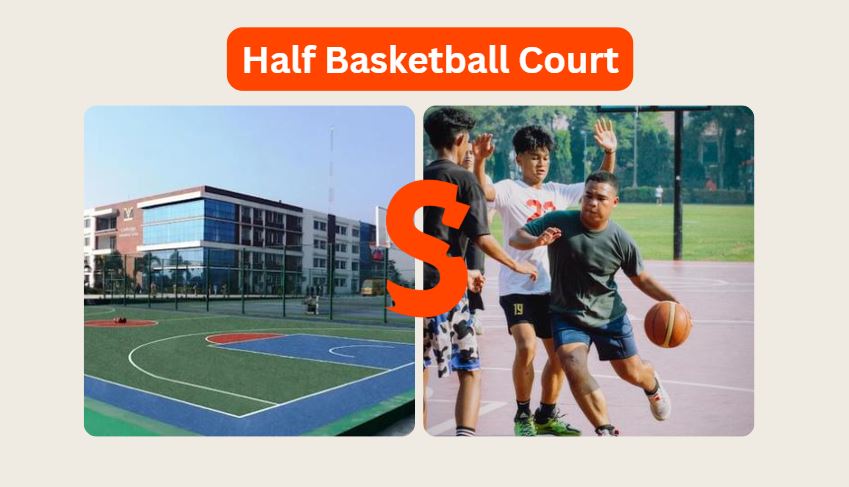
A half basketball court is where most players actually learn the game. Not the full court you see on television. Not the packed gym with ten players running end to end. Just one basket, one painted arc, and enough space to develop real skills. If you are just starting out, a half court is not a compromise. It is the right starting point.
This guide covers everything you need. Dimensions, markings, games you can run, how to practice alone or with a small group, and what to focus on in your first few months.
What Is a Half Basketball Court
A half basketball court is exactly half of a regulation basketball court. It uses one basket and one end of the floor. Everything from the midcourt line to the baseline belongs to the half court setup.
Most outdoor courts you find in parks, driveways, and recreational centers are half courts. School gyms often run half court games when the full court is occupied. Pickup basketball at almost every level defaults to half court rules when fewer than ten players are available.
The game plays differently on a half court. There is no fast break culture. Everything happens in the half court set. That makes it a better training environment for beginners because the pace is controlled, possessions are longer, and every fundamental skill gets more repetitions per game.
Official Half Basketball Court Dimensions
Knowing the dimensions matters whether you are building a backyard court, marking lines on a driveway, or just understanding what you are playing on.
A regulation NBA full court is 94 feet long and 50 feet wide. A half court is 47 feet long by 50 feet wide. That is the professional standard.
For recreational and youth play, dimensions shrink. A standard recreational half court runs 42 feet by 50 feet. A driveway half court, which is the most common backyard installation, typically measures 30 feet by 30 feet at minimum, though 30 by 50 gives you a more complete experience.
Here are the key measurements you need to know:
The three-point line sits 23 feet 9 inches from the center of the basket at its deepest point in the NBA. For high school and recreational play, that drops to 19 feet 9 inches. On a driveway or backyard court, most installations use the recreational standard.
The free throw line is always 15 feet from the backboard, measured to the front of the line. This measurement does not change between professional and recreational standards.
The paint or lane is the rectangular area directly under the basket. In the NBA it is 16 feet wide. In college and recreational settings it narrows to 12 feet. The paint is 15 feet deep from the baseline to the free throw line in all versions.
The basket height is 10 feet from the floor to the rim in every standard version of the game, from youth leagues through professional. Some youth programs use 8-foot or 9-foot rims for players under ten years old.
The backboard extends 4 feet from the baseline and sits 6 feet above the floor at its bottom edge.
The Key Markings and What They Mean for Beginners
Every line on a basketball court has a specific function. Understanding them early saves confusion and builds game intelligence faster.
The baseline is the out-of-bounds line running behind each basket. On a half court, this is the end boundary. Any ball that crosses the baseline is out of bounds and possession changes.
The sidelines run the length of the court. On a half court setup, only the sidelines on either side of the lane apply directly to your play area.
The three-point arc separates two-point field goals from three-point field goals. A shot made with both feet behind the arc counts three points. One foot on or inside the arc counts two. For beginners, this line also serves as a reference for spacing. Good half court offense uses the arc to keep players spread out.
The restricted area arc is a small semicircle directly under the basket. It exists in NBA and college play to protect offensive players driving to the rim from charge calls. In recreational half court play it is less formally enforced, but understanding it helps you know when a charge call is likely.
The top of the key is the area at the peak of the three-point arc directly in front of the basket. It is the most common spot for pick and roll plays, jump shots, and half court offensive resets. As a beginner, understanding that the top of the key is the central hub of half court offense is one of the most useful things you can learn early.
The elbow refers to the junction where the free throw line meets each side of the paint. The two elbows sit at the corners of the free throw line. Mid-range shots from the elbow are among the most reliable scoring positions in the half court game.
Half Court Rules Every Beginner Needs to Know
Pickup half court basketball runs on a consistent set of informal rules that every player is expected to know. Walking onto a court without knowing these will slow down the game and frustrate other players.
Check ball. Before every possession starts or restarts at the top of the key, the offensive player must pass the ball to the defender and receive it back. This is called checking the ball. It replaces the inbound pass system used in full court play.
Make it take it. When the offensive team scores, they keep possession. This rule is standard in half court pickup and dramatically changes how the game flows compared to full court play where scoring always results in a change of possession.
Clearing. After a defensive rebound, turnover, or change of possession, the new offensive team must dribble or pass the ball back behind the three-point arc before attempting to score. This rule prevents teams from scoring directly off a steal or rebound without resetting. It is called clearing or taking it back.
No blood, no foul. This is an informal cultural rule in competitive pickup that means minor contact is generally not called. Beginners often overcall fouls. In a competitive half court game this creates friction fast. Learn to distinguish genuine fouls from incidental contact early.
Game to eleven or twenty-one. Most half court pickup games run to either eleven points or twenty-one points, counting by ones and twos. Some courts use a win-by-two rule. Before the game starts, always confirm what you are playing to.
Games You Can Play on a Half Court
A half court handles far more than a standard five-on-five pickup game. These formats work for beginners and are excellent for skill development.
One on one. The purest form of basketball. One offensive player, one defender, one basket. Every fundamental skill gets tested. This is the best format for beginners who want fast improvement because every possession requires you to make decisions independently.
Two on two. Introduces basic passing and off-ball movement without the complexity of a full team. Two-on-two forces players to learn spacing, pick and roll basics, and defensive rotations in a simplified environment.
Three on three. The official Olympic format and the most common pickup game at outdoor courts. Three-on-three is where most beginners develop real game instincts. It is complex enough to teach team concepts but small enough that every player touches the ball regularly.
Twenty-one. A multi-player game where each player competes individually. A made shot from outside earns three points and gives the shooter a free throw attempt. A made free throw earns one point and another free throw attempt. A miss from the free throw line and any player who grabs the rebound scores from where they catch it. The first player to reach exactly twenty-one wins. This game is excellent for beginners because it combines shooting, rebounding, and pressure free throws in a single format.
Around the world. Players shoot from specific spots around the arc in a set sequence. Each player advances around the court by making shots in order. A miss stops your turn and passes it to the next player. This is one of the best half court games for beginners practicing shooting form from multiple spots.
Horse. One player attempts any shot they choose. Every other player must make the same shot from the same spot. A miss earns a letter. Spell out HORSE and you are eliminated. This game builds creativity and shooting range in a low-pressure setting.
How to Practice Alone on a Half Court
Solo practice on a half court is where real skill development happens. Games are fun. But individual repetition builds the mechanics that make you useful in games.
Mikan drill. Stand under the basket on the right side. Use your right hand to lay the ball softly off the backboard and into the basket. As it goes through, catch it before it hits the floor, step to the left side, and repeat with your left hand. Alternate sides continuously for sixty seconds. This drill builds finishing touch at the rim, the most important skill for a beginner who wants to score in real games.
Free throw routine. Pick a number. Fifty made free throws per session is a good starting point. Stand at the line, go through the same pre-shot routine every time, and do not move on until you hit your number. Free throws win close games at every level. Beginners who build a consistent free throw routine early develop a mental anchor that holds up under pressure. For how mental routines affect performance under pressure, our piece on mental performance training breaks down the psychology behind pre-shot and pre-performance routines.
Form shooting. Start one foot from the basket. Focus only on your release. The ball should roll off your fingertips, your elbow should be under the ball, and your follow-through should hold until the ball hits the rim. Make ten in a row from one foot. Move back two feet. Make ten more. Continue until you reach the free throw line. This is the fastest way to fix a broken shooting form.
Dribble series. Stationary first. Right hand only for sixty seconds. Left hand only for sixty seconds. Alternate hands for sixty seconds. Then add movement. Dribble to the baseline, change direction, come back to the three-point arc. This builds the handle you need to keep possession under light pressure in a real game.
Spot shooting. Choose five spots around the arc. Take ten shots from each spot, tracking makes and misses. Record your totals. Return to the same five spots the next session. The data tells you where your shot is reliable and where it still needs work.
What to Wear and Bring
Beginners often show up underprepared for the physical demands of even a casual half court session.
Shoes matter most. Basketball is a lateral sport. Running shoes are built for forward motion and offer almost no ankle support for the side-to-side cuts the game demands. A dedicated basketball shoe changes your comfort, stability, and injury risk significantly. Our full breakdown of basketball shoes covers what to look for by position and budget.
The ankle is the first thing that goes. Ankle sprains are the most common basketball injury at every level. They happen on landings, cuts, and defensive shuffles. The half court game is full of all three. Mobility work before you play is not optional if you want to stay on the court. Our basketball-specific ankle mobility and injury prevention routine is built specifically for this.
Bring water. A thirty-minute half court session burns more than most beginners expect. Dehydration affects reaction time and decision-making before it affects physical performance. Drink before you feel thirsty.
A pump and a pressure gauge. Outdoor courts are full of balls that are either overinflated or dead flat. A properly inflated basketball bounces predictably and dribbles true. A flat ball teaches you bad habits because you compensate for unpredictable bounces. NBA regulation pressure is between 7.5 and 8.5 PSI.
Building Your First Month of Half Court Practice
Week one should be entirely fundamentals. Mikan drill every session. Form shooting from close range. Free throw routine. No games yet. This sounds boring. It is not. Players who skip the fundamentals phase spend years unlearning bad habits.
Week two, add basic dribble work and light spot shooting from the elbow and free throw line extended. Still no games. Your form is not ready to hold up under defensive pressure yet.
Week three, join a two-on-two or three-on-three game. Play only one game. Go back to solo work immediately after. The game session shows you what your practice gaps are. The solo session addresses them.
Week four, increase game volume. Two or three games per session. But never eliminate solo work entirely. The best players at every level still spend more time in individual skill work than in games.
The half court is not a lesser version of basketball. It is where basketball actually lives for most players. The NBA game you watch on television is the rare exception. The half court pickup game at your local park is the standard. Learn it well and the full game opens up naturally.
For younger players building their athletic base alongside their basketball skills, our guide on strength training for teenagers covers how to develop the body for court sports without risking growth-related injury. And when you are ready to add the explosive jumping ability that separates good half court players from dominant ones, our full breakdown of plyometric training for athletes gives you a structured path from beginner jumps to serious vertical development.