So you’ve been thinking about trying Brazilian Jiu-Jitsu. Maybe you saw it on a UFC broadcast and got curious, maybe a friend won’t stop talking about it, or maybe you just want to try something that isn’t a treadmill or another boot camp class. Whatever brought you here, one thing is almost certain: once you step on the mats, you’re going to get hooked.
BJJ is one of those things that’s genuinely hard to explain to someone who hasn’t tried it. It’s a workout, a puzzle, a social club, and a life skill all wrapped into one. But if you’ve never done any martial arts, the whole thing can feel pretty intimidating from the outside. This guide is here to change that.
We’ll go through everything: what BJJ actually is, what your first class will look like, what gear you need, the belt system, how to get better faster, and the mistakes that trip up almost every beginner. By the time you finish reading, you’ll feel ready to walk through those gym doors with confidence.
What Is Brazilian Jiu-Jitsu, Exactly?
Brazilian Jiu-Jitsu is a grappling-based martial art. That means no punching, no kicking, no striking at all. The whole game is about controlling your opponent on the ground and submitting them using chokes, joint locks, and body positioning. Think of it less like a street fight and more like a very physical, very intense game of human chess.
BJJ has its roots in Japanese Judo and traditional Jiu-Jitsu, but it was adapted and developed in Brazil by the Gracie family in the early 20th century. The Gracies basically spent decades refining the art specifically to prove that a smaller, less athletic person could neutralize and defeat a much bigger opponent through technique and leverage alone. That’s still the core philosophy today.
The core principle of BJJ is that a smaller, weaker person can successfully defend themselves against a larger opponent through proper technique, leverage, and body positioning. It’s not about who’s stronger. It’s about who’s smarter. That’s what makes it genuinely different from most other sports and physical activities.
It’s also why BJJ works for absolutely everyone. You don’t need to be athletic, young, or in great shape to start. People begin in their 40s and 50s all the time. Women train alongside men. People of every body type find their place on the mats. The art genuinely scales to whoever is practicing it.
Why Are So Many People Getting Into It Right Now?
BJJ has been growing steadily for years, but it’s really exploded in the last few years into mainstream fitness culture. Part of that is the rise of MMA and the UFC, where you constantly see grappling and ground fighting decide outcomes. Part of it is the podcast world, where prominent voices openly talk about training. And part of it is just word of mouth: people try it and can’t stop talking about it.
But beyond the trend aspect, people stick with BJJ for reasons that go deeper than any other gym workout. BJJ is often likened to solving a puzzle, where timing, precision, and strategic planning play critical roles in success. The combination of mental engagement and physical effort sets it apart from other martial arts.
When you’re rolling with someone on the mat, you are completely present. You literally cannot think about work emails or what’s for dinner. Your brain is entirely focused on the problem in front of you. A lot of people describe it as the closest thing to a moving meditation they’ve ever experienced. That mental escape is one of the biggest reasons people become obsessed with the sport.
Your First Class: What to Actually Expect
This is the part most beginners stress about most, so let’s just walk through it.
Showing Up
Wear athletic clothes. A plain t-shirt, athletic shorts without pockets or metal zippers, and nothing on your feet. You don’t need a gi (the traditional uniform) for your very first class. Most gyms will let you try a session in regular workout clothes to see if you like it before you spend money on gear. Just call ahead and ask.
When you walk in, you’ll be met by someone at the front desk or the instructor themselves. Good gyms are very welcoming to new people. Everyone in there remembers their first day. Introduce yourself, mention it’s your first time, and follow their lead on where to go and what to do.
Warm-Up
The class starts with a warm-up conducted by an instructor. This is not just about getting circulation going, but also your first experience of BJJ movement. You’ll be drilled in a hip escape movement, forward rolls and backward rolls, and crawling basics. These movements are the basics of Jiu-Jitsu that train your body how to move on the mat.
Don’t worry if the movements feel completely foreign. Shrimping especially looks weird the first time. You basically wiggle across the mat like a fish out of water. Everyone looks goofy doing it for the first few weeks. That’s perfectly normal.
Technique Instruction
After the warm-up, the instructor demonstrates a technique or a series of related moves, breaking each one down step by step. Your instructor will illustrate one or two techniques, showing you not only the “how” but the “why” of each step. Then you practice in pairs.
As a first-timer, you’ll likely be paired with a white belt who’s been there a few months, or sometimes a more experienced student who’s good at teaching beginners. Either way, your partner is there to help you, not to test you. Ask questions. Nobody minds.
Rolling
Rolling is basically live sparring, where you apply what you’ve learned against a resisting partner. Whether beginners roll in their first class depends on the gym’s policy. Some academies have you watch sparring for the first session. Others will have you participate in very light, controlled rolls right away. Either approach is fine.
Participation in full sparring may depend on experience level and gym policies. Some academies require beginners to earn a certain number of stripes before rolling, while others allow all students to spar but provide guidance on safe and controlled participation.
If you do roll early on, go light. Relax your grip. Don’t try to win. Just try to apply something you learned and survive. Tapping out (slapping the mat or your partner to signal you’re caught in a submission) is completely normal and expected. Tap early, tap often, and tap without any shame. It’s how you keep training tomorrow.
Gi vs. No-Gi: What’s the Difference?
You’ll hear these terms right away, so let’s clear them up.
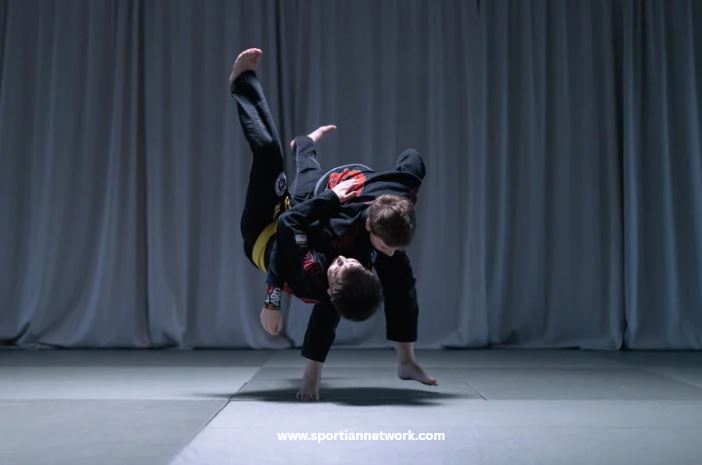
Gi training uses the traditional uniform, which is basically a heavy cotton jacket, pants, and a belt. The jacket has thick lapels and sleeves that both you and your opponent can grab. This gives the game a whole different layer of grip and control options. Gi training tends to be a bit slower and more technical, which many coaches say makes it the better starting point for beginners.
No-Gi training involves wearing a rash guard and shorts instead. No fabric to grab, which makes the game faster and more athletic. The grips are different: underhooks, overhooks, and body control take the place of lapel and sleeve grips.
Gi Brazilian Jiu-Jitsu beginners often find that training with the gi helps slow down the pace, allowing more time to understand positions and techniques. No-gi training, on the other hand, tends to be faster-paced and more athletic, focusing on underhooks, overhooks, and body control.
Most gyms offer both, and the honest answer is to try both and see which one you enjoy more. Plenty of practitioners do both regularly, and the skills transfer between the two.
The Gear You Actually Need
For your first class: Just athletic clothes and flip-flops or sandals to walk to the mat. That’s it.
Once you decide to stick with it:
A gi is your first real purchase. Expect to pay $80 to $150 for a decent beginner gi. Brands like Hayabusa, Fuji, and Tatami make solid entry-level options. You don’t need to spend $200 on a premium competition gi when you’re three weeks in. Get something that fits well and holds up to washing.
A rash guard is useful even for gi training because it protects your skin and makes movement smoother under the jacket. For no-gi classes, it’s pretty much required.
Mouth guard and ear guards are optional for most beginners, but if you’re going to roll regularly, a basic mouth guard is cheap insurance. Cauliflower ear is a real thing in grappling sports, and if that worries you, wrestling ear guards prevent it entirely.
Flip-flops matter more than people realize. You wear them to walk to the bathroom or off the mat, then leave them at the mat’s edge. This keeps the mats clean, which is genuinely important for hygiene at any BJJ gym.
The Belt System Explained
BJJ belts go: white, blue, purple, brown, black. Simple, right? The less simple part is that each belt can take years to progress through. On average, it can take 8 to 12 years to earn a black belt, but the real reward is the growth you experience along the way.
This is very different from the belt systems you might know from karate or other martial arts where kids earn black belts in a year or two. In BJJ, a black belt genuinely means something. It represents thousands of hours on the mat, against countless different training partners, in all kinds of conditions. When you see someone with a BJJ black belt, they’ve earned it the hard way.
Most gyms also use stripes (small tape marks on the belt) to show progress within each belt level. Four stripes on a white belt, for example, typically means you’re getting close to a blue belt promotion. Stripe promotions are common and give you something to feel good about in between the big belt jumps.
Don’t rush any of it. The people who chase belts usually progress slower than the people who just fall in love with the process and keep showing up. Your belt will come. Focus on getting better at the actual jiu-jitsu.
The Basic Positions Every Beginner Needs to Know
You don’t need to memorize a library of techniques in your first few months. What you need is a solid understanding of positions, because positions determine everything else.
Guard: You’re on your back with your legs around or in front of your opponent. The guard is where a grappler is below the opponent, freely utilizing both their arms and legs. The most common guards you’ll learn are closed, half, and open guards. Being in the guard doesn’t mean you’re losing. A good guard is an active, attacking position.
Mount: You’re sitting on top of your opponent’s torso with your knees on the ground beside their hips. This is one of the most dominant positions in BJJ. From here you have a lot of options to attack, and your opponent has limited ways to escape.
Side Control: You’re beside your opponent, chest to chest, with your weight across their body. Another very dominant position.
Back Control: You’re behind your opponent with your hooks (heels) inside their hips. This is widely considered the most dominant position in all of grappling. From the back, you have access to the rear-naked choke, which is one of the highest-percentage finishes in the sport.
The basic rule to internalize early: being on top is generally better than being on bottom, but having a good guard from the bottom can neutralize that advantage. Position before submission. Get the position right first, then look for the finish.
7 Tips to Get Better Faster as a Beginner
1. Show up consistently. This is the single biggest factor. Training twice a week consistently beats training five days for two weeks and then burning out. Train 2 to 3 times a week and you’ll improve faster than someone who goes hard for one week and then disappears.
2. Tap early. The people who tap quickly are the ones still training ten years later. There’s zero benefit to fighting through a joint lock you’re already caught in. Tap, reset, go again.
3. Focus on fundamentals. It’s tempting to hunt for flashy techniques on YouTube and show up trying to pull them off. Resist that. The basics win fights at every level. Mastering your closed guard, your mount escapes, and your hip escape movement will carry you further than any fancy leg lock you’re not ready for yet.
4. Roll with people who are better than you. This is where real learning happens. Better training partners expose your weaknesses in real time. You learn more from getting tapped in a roll than from any amount of drilling. If you want to know how to build the athletic base that makes your BJJ even more effective, this breakdown of the most important strength exercises for athletes is worth your time.
5. Relax. Beginners burn out in five minutes because they’re tense the whole time. Tension is the enemy of technique. Breathe. Use your arms and legs, not your whole body at maximum effort. The more relaxed you are, the longer you last and the better you actually move.
6. Ask questions. Your instructors and training partners want you to understand. Don’t sit there confused about a technique for three classes. Raise your hand. Ask after class. Most BJJ practitioners genuinely love talking about the art.
7. Take care of your body. BJJ is physical and your body will feel it. Sleep, nutrition, and recovery matter a lot when you’re asking your muscles and joints to do something completely new. Recovery is more important than most people think, especially in a contact sport where your body is taking on a lot of new physical stress in a short period of time.
BJJ Etiquette: The Unwritten Rules
Every BJJ gym has a culture, and fitting into it matters. Here are the things that will make you immediately well-liked on the mats.
Keep yourself clean. Shower before class, trim your fingernails and toenails, and wash your gi after every session. This is non-negotiable. Skin infections like ringworm and staph spread fast in grappling environments, and hygiene is a community responsibility. A dirty training partner is a disrespectful training partner.
Don’t coach people who didn’t ask. When you’re a new white belt and you’ve been there two weeks, you don’t give technique advice to other students. Watch, listen, and learn. Your time for teaching will come.
Respect the tap. When your partner taps, let go immediately. Every time. No exceptions. You are their training partner, not their opponent.
Bow on and off the mat. Most gyms observe this tradition as a sign of respect for the training space. Follow the lead of the experienced students at your gym.
Leave your ego at the door. This one actually takes a while for most people. Getting tapped by someone smaller, lighter, or less experienced than you feels bad. It’s supposed to feel bad, for about five seconds, and then you reset and figure out what happened. The fastest-progressing students are almost always the most humble ones on the mat.
How to Choose the Right Gym
Not all BJJ academies are the same, and where you train matters a lot, especially early on.
Look for a gym that has a structured beginner program. Some schools just throw new students into the regular class and hope for the best. That works for some people but it can also be overwhelming and frustrating. A dedicated fundamentals program means you learn the basics properly before getting dropped into advanced classes.
Visit before you commit. Most gyms offer a free trial class. Use it. Watch how the instructor interacts with beginners. Notice whether higher belts help lower belts or ignore them. Feel the general vibe. A gym that feels welcoming and supportive on day one will still feel that way on day one thousand.
Proximity matters more than you’d think. A world-class gym that takes you 45 minutes to get to will get skipped on tired days. A solid gym ten minutes from your house will become part of your routine. Consistency beats prestige for most recreational practitioners.
Check the mat hygiene. Clean mats, cleaned regularly, are a signal of how the gym operates generally. If the mats smell and look dirty, that tells you something about how the place is run.
What BJJ Does to You Over Time
This is the part people don’t expect. They come in thinking they’re joining a fitness class and they end up with something much bigger.
The community aspect is real in a way that’s hard to find in most gyms. When you roll with someone, you’re trusting them with your joints and your safety. That builds a kind of connection pretty fast. The friends you make in a BJJ gym tend to be solid ones.
The mental side also carries over into daily life. Jiu-Jitsu requires mental discipline and concentration. Training helps you develop focus and mindfulness, skills that are beneficial in all areas of life, from work to personal relationships. Learning to stay calm when someone is trying to choke you turns out to be excellent training for staying calm when your project is falling apart at work or your flight gets cancelled.
And honestly, the confidence that comes from knowing you can handle yourself, from knowing that you’ve been in uncomfortable situations and found your way through them, is quiet and genuine in a way that’s hard to describe. It’s not arrogance. It’s just a steady sense that you’ve got resources most people don’t.
Building a strong physical foundation alongside your BJJ also makes a bigger difference than most beginners realize. If you’re working on your explosive speed and athletic movement, you’ll notice the carryover on the mats surprisingly quickly.
Ready to Start?
Here’s the short version of everything above.
Find a local gym with good reviews and a beginner program. Show up in athletic clothes. Introduce yourself. Pay attention during technique instruction. Go light when rolling. Tap when you’re caught. Ask questions. Wash your gear.
Come back next week and do it again.
That’s basically it. The rest figures itself out on the mat. BJJ rewards people who show up, stay humble, and keep going when it gets hard. And it will get hard. But it also gets really, really good.
The only class you’ll regret is the first one you never take.