
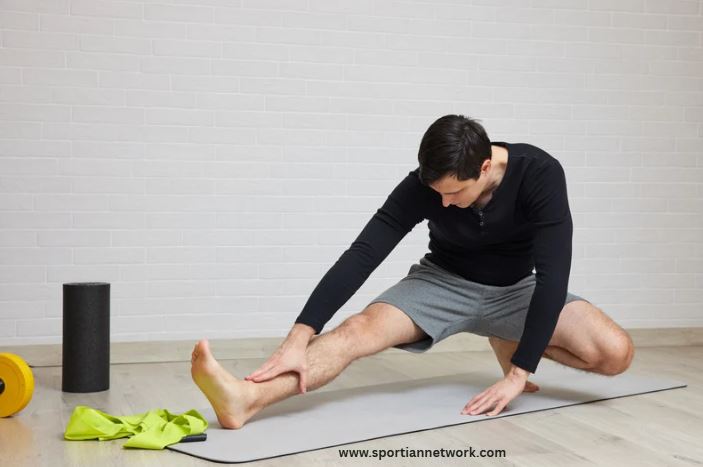
Most soccer players train their hamstrings wrong. They do a few leg curls, maybe some Romanian deadlifts, and call it a day. Then they wonder why hamstring strains keep showing up in training, in games, sometimes at the worst possible moment of a season.
Professional clubs have a completely different approach. It is not just about doing more reps. It is about understanding what the hamstrings actually do in soccer and building a program around that reality.
What Soccer Actually Demands from Your Hamstrings
The hamstrings are not just a “back of the leg” muscle group. In soccer, they do three things constantly. They decelerate the leg during sprinting, they stabilize the knee during cutting and landing, and they help extend the hip when you drive forward. That is a lot of work across a 90-minute game.
Most recreational players train the hamstrings concentrically. That means they focus on the curling motion, shortening the muscle under load. But the majority of hamstring injuries in soccer happen eccentrically. That means the muscle tears while it is being lengthened under tension, usually during the deceleration phase of a sprint.
Professional programs are built around this fact.
The Nordic Hamstring Curl Is Non-Negotiable at the Top Level
Ask any sports scientist working with a top European club and they will bring up the Nordic hamstring curl. It is not a trendy exercise. It has decades of research behind it.
The movement is simple. You kneel on a pad, anchor your ankles, and lower your body toward the ground as slowly as possible using only your hamstrings. That is pure eccentric loading, the exact type of strength that prevents tears during sprinting.
A landmark study published in the British Journal of Sports Medicine found that regular Nordic hamstring curl training reduced hamstring injury rates in soccer players by over 50 percent. That number is not a rounding error. That is a training intervention that genuinely changes injury outcomes.
Elite clubs program the Nordic curl year-round. They adjust volume and intensity based on the competition schedule, but they never drop it entirely. It is a non-negotiable part of the week.
Sprint Mechanics and the Weight Room Working Together
Here is something most gym programs miss entirely. At the professional level, hamstring training is tied directly to sprint mechanics. Strength coaches and sprint coaches work together. The weight room and the training pitch communicate constantly.
Professional players do not just sprint to get faster. They sprint with specific intent, working on the late swing phase of the stride where the hamstring is most vulnerable. Coaches use GPS tracking and high-speed cameras to identify exactly when and how each player’s hamstring is being loaded during match-like efforts.
When a weakness or imbalance shows up in the data, it gets addressed immediately, sometimes the same day. That kind of feedback loop does not exist in amateur training environments, but understanding the principle matters. Sprinting is hamstring training. Done with the right mechanics and at the right intensity, it builds specific resilience that a leg curl simply cannot replicate.
If you want to build the kind of explosive speed that actually stresses the hamstring properly, read how to build explosive speed for athletes. It covers the sprint mechanics side of this equation in full detail.
Asymmetry Is Taken Seriously
One of the biggest differences between professional and amateur hamstring training is how seriously clubs treat left-to-right imbalances.
Most recreational players have a stronger hamstring on their dominant leg. They never think about it. Professional clubs test for this constantly using isokinetic dynamometers, machines that measure force output through a range of motion at a controlled speed. If a player’s weaker hamstring is producing less than 90 percent of the output of the stronger side, that gets flagged as an injury risk.
The program then targets the weaker side with single-leg work. Single-leg Romanian deadlifts, single-leg hip hinges, unilateral cable pull-throughs. The goal is not to make both legs identical. The goal is to get them close enough that one side is not carrying an unfair load during the physical demands of a full match.
This is exactly why strength exercises for athletes should always include unilateral movements. Both legs need to be trained independently, not just together.
Load Management During the Season
Professional clubs manage hamstring load week to week based on match frequency. After a match, the first 48 hours are low intensity. Walking, light mobility work, maybe some pool sessions. The hamstrings are in a fatigued state and that is when they are most vulnerable.
Days three and four typically bring more demanding sessions. Days five and six before the next match involve controlled sprint work to maintain sharpness without accumulating too much fatigue.
The science behind this is straightforward. Hamstring injuries spike when players return to high-speed running without adequate recovery. Clubs with sports scientists on staff track GPS data from every session and every match. Total high-speed running distance is monitored carefully. If a player has had an unusually high load week, the next session gets adjusted down.
Amateur players can apply this principle too. After a hard game, avoid sprinting flat out for at least two days. Let the muscle recover before you push it again.
Eccentric Overload Goes Beyond the Nordic
The Nordic curl is the most researched tool, but professional programs do not stop there. Other eccentric overload methods are used depending on the player’s position and individual injury history.
The glute-ham raise is common in well-equipped training facilities. It allows players to control the eccentric phase through a longer range of motion than the Nordic. The Spanish squat is used to build eccentric strength at the knee while keeping the hip in a stable position. Flywheel training, using inertia-based resistance devices, has become popular in European clubs because it forces the muscle to absorb more load on the way down than traditional weights can provide.
These tools exist because coaches understand the specific nature of hamstring injury. You cannot train your way out of the problem with concentric-only work. The overload has to match the mechanism of injury, and that mechanism is always eccentric.
For a full breakdown of the best hamstring exercises used in high-performance sports settings, check out the 5 best hamstring exercises for injury prevention and speed.
Warm-Up Protocols That Actually Prepare the Hamstring
Most amateur players jog a lap, do a few static stretches, and start playing. That is not how hamstrings get prepared for high-intensity work.
Elite clubs use progressive activation warm-ups. These typically include hip hinges under light load, banded leg swings, walking lunges with trunk rotation, and controlled high-knee drills. The goal is to gradually increase the length and tension placed on the hamstring before it is ever asked to sprint.
Static stretching before activity has actually been shown to reduce force production temporarily. Professional clubs moved away from pre-activity static stretching years ago. Dynamic warm-up routines replaced it entirely. The muscle needs to be activated, not just elongated.
Recovery Is Part of the Programe them. They have protocols in place specifically to catch the early signals before they become a missed match or a month on the treatment table.
What Amateur Players Can Actually Take from This
You do not need a GPS vest or an isokinetic testing machine to train your hamstrings like a professional. You need the right principles applied consistently.
Add the Nordic hamstring curl to your weekly routine. Start with two sets and build from there. Train both legs individually at least once a week. Take your sprint sessions seriously and give yourself real recovery days after hard matches. Ditch the static stretching before training and replace it with a proper dynamic warm-up.
These are not secrets. They are just what the best clubs in the world have been doing for years while amateur players keep pulling hamstrings and wondering why.
The gap between professional and amateur hamstring training is not about equipment. It is about understanding what the muscle actually needs and then being disciplined enough to deliver it consistently.
For more on how elite athletes structure their overall recovery between sessions, that article breaks down the full picture beyond just hamstrings.