
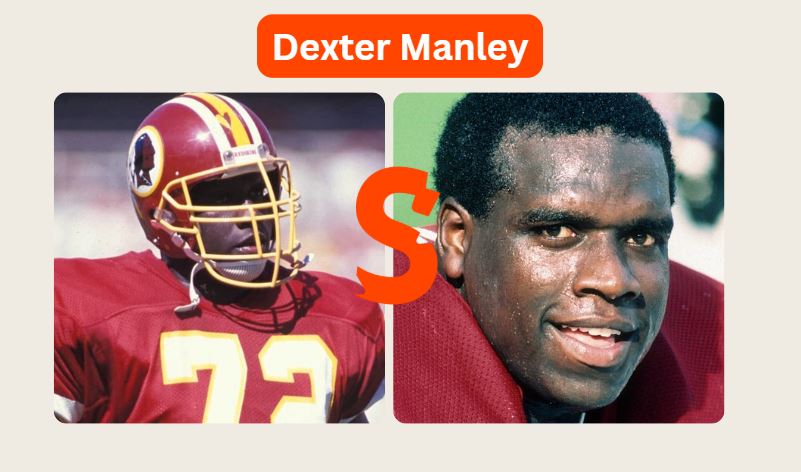
Dexter Manley terrorized NFL quarterbacks for nine seasons. He finished with 97.5 official sacks, 103.5 when his rookie year totals apply. He won two Super Bowls with the Washington Redskins. He earned a Pro Bowl berth in 1986 and set a franchise single-season sack record with 18.5 that still commands respect. His coaches called him the Secretary of Defense, and the nickname stuck because it was earned.
Then the full story came out.
Manley had played his entire NFL career functionally illiterate. He entered college at Oklahoma State University reading at a second-grade level. He graduated from four years of college without anyone forcing him to learn to read. He played nine seasons as a professional athlete surrounded by coaches, trainers, and front office staff who knew or suspected, and nobody intervened.
Today, however, Manley is nearly 20 years clean from cocaine addiction. He co-founded the Dexter and Lydia Manley Foundation, which funds literacy programs across the Washington area. He testified before Congress. He survived brain surgery. He changed his life from the inside out. That arc, from the Third Ward of Houston to two Super Bowl rings to prison to redemption, is one of the most remarkable stories in American sports.
Houston’s Third Ward and a Ticket Out
Dexter Keith Manley was born on February 2, 1959, in Houston, Texas. He grew up in the Third Ward, one of Houston’s historically Black neighborhoods, where poverty was the norm and athletic talent was often the clearest path forward.
From childhood, Manley showed the physical gifts that would eventually earn him a professional contract. His size, speed, and aggression on a football field made him stand out at every level. Yet alongside those gifts, he carried a hidden struggle. Teachers identified him as “behind” in second grade and placed him in a special education classroom. Later, when teachers moved him back into general education, Manley learned to compensate through charm, discipline, and attendance. He never missed school. His parents demanded it. So his teachers graded him partly on showing up, and his athletic talent did the rest.
Sunday school presented the clearest early window into the problem. When teachers called on him to read scripture, Manley claimed he had forgotten his glasses at home. He did not wear glasses. But the excuse worked, and the pattern of concealment took hold early.
At Yates High School in Houston, Manley became a dominant football player. His athleticism overshadowed everything else, as it did through his years at Oklahoma State University, where the Cowboys’ football program shielded him from academic demands the way college athletics often did and still does. He entered the 1981 NFL Draft having earned a degree without ever learning to properly read.
Arriving in Washington: The Fifth Round Find
The Washington Redskins selected Manley in the fifth round, 119th overall, of the 1981 NFL Draft. That same draft class included John Elway, Lawrence Taylor, and Ronnie Lott. Getting Manley in the fifth round turned out to be one of the steals of that era.
Head coach Joe Gibbs arrived in Washington the same year. Gibbs saw immediately that Manley struggled with the playbook but believed in his raw athletic ability. So Gibbs worked with him before and after practice, drilling plays one on one, until Manley understood the assignments through repetition rather than reading. That patience from a Hall of Fame coach gave Manley the chance to develop on the field even as his literacy crisis continued off it.
Moreover, Manley’s physical profile was extraordinary. He stood 6 feet 3 inches and weighed 253 pounds. He reportedly ran a 4.5-second 40-yard dash, which for a defensive end of his size in 1981 was exceptional. His ability to generate explosive speed off the line of scrimmage made him nearly impossible to block in one-on-one situations. He could bench press over 500 pounds. The combination of size, speed, and strength put him in a different category from most defensive ends of his generation.
Two Super Bowls and the Secretary of Defense
The Redskins won Super Bowl XVII after the 1982 season, beating the Miami Dolphins 27-17. Manley contributed as part of a dominant defensive unit, though he was still developing as a starter. By the mid-1980s, however, he had become the heartbeat of the Washington pass rush.
His best season came in 1986. He recorded 18.5 sacks, which set a Redskins single-season record and earned him a Pro Bowl selection and first-team All-Pro honors. His name appeared on All-Defensive team lists. Opponents built game plans specifically to account for where he lined up. By any measurable standard, he stood among the best defensive ends in football.
Washington won Super Bowl XXII after the 1987 season, crushing the Denver Broncos 42-10. Manley played a central role throughout that playoff run, applying the kind of pressure on quarterbacks that the mental toughness required to perform at elite levels can sustain even in the biggest moments. His total career production, at over 100 sacks including the 1981 season before sacks became official statistics, places him among the most productive pass rushers in NFL history.
The nickname Secretary of Defense came from the Washington media and stuck permanently. Even today, it follows his name wherever football history appears.
The Night That Changed Everything: Joe Theismann’s Leg
On November 18, 1985, Manley watched his teammate Joe Theismann suffer one of the most gruesome injuries in NFL history. Lawrence Taylor sacked Theismann during a Monday Night Football game against the New York Giants, snapping his leg in two places in a play that ended Theismann’s career instantly.
That image shook Manley to his core. For the first time, he understood viscerally that football could end without warning. Therefore, his identity, which rested entirely on being an NFL defensive end because he could not fall back on reading or formal education, suddenly felt fragile.
So in the months following that 1985 season, Manley made a decision. He entered rehab for cocaine addiction. He also began taking reading classes at the Lab School of Washington. The two problems, addiction and illiteracy, had fed each other for years. Addressing them together took enormous courage for a man whose entire public identity depended on appearing invincible.
Consequently, Manley continued his reading education even as he struggled with sobriety. He attended Literacy Foundation chapters at his stops in Phoenix and Tampa Bay. By the time his NFL career ended in 1991, he was reading at a high school level. He later described learning to read as the proudest accomplishment of his life, greater than any sack record or championship ring.
The Ban, the Arrests, and the Prison Sentence
Despite his progress on literacy, Manley’s cocaine addiction continued to derail him. He failed three drug tests, which led to a suspension in 1989 and eventually a permanent NFL ban on December 12, 1991. He had entered rehab seventeen times by his own count, and still relapsed.
After the NFL ban, Manley played two seasons with the Ottawa Rough Riders in the CFL. However, the addiction followed him. In February 1995, Houston police responded to a motel room after he threatened suicide. He spent four months in a psychiatric hospital, but then relapsed again after a traffic stop led to a foot chase on the highway.
In August 1995, a Texas court sentenced Manley to four years in prison after he pleaded guilty to two counts of cocaine possession. He had lost over $12 million to addiction, by his own account in congressional testimony years later. The money, the Super Bowl rings, the sack records, and the nickname meant nothing when he sat in a prison cell.
After serving two years, Manley was released in 2004. He emerged determined to rebuild his life differently this time.
Brain Surgery and the Road Back
In June 2006, Manley underwent approximately ten and a half hours of surgery at George Washington University Hospital. Doctors removed an enlarged colloid cyst from his brain that had been collecting fluid and raising intracranial pressure. He had first discovered the cyst in 1986 after collapsing in a Georgetown department store, but the full severity only became clear two decades later.
He recovered. Doctors noted the risk of memory loss as a common side effect, though Manley emerged without lasting cognitive deficits. Furthermore, in May 2020, he tested positive for COVID-19 and was hospitalized. He recovered from that as well.
Manley also filed a lawsuit against the NFL in 2012, arguing that his brain cyst resulted from cumulative head impacts during his career. The case did not establish causation under available medical evidence, but it reflected his broader engagement with the conversation about player health that has reshaped how the league approaches contact.
Clean, Married, and Building Something Real
Manley married Lydia in 1997, and their partnership became the foundation of his recovery and advocacy. By 2026, he approaches 20 years of continuous sobriety from cocaine. Together, he and Lydia co-founded the Dexter and Lydia Manley Foundation, based in Bethesda, Maryland.
The foundation raises funds for local literacy nonprofits and carefully vets its partners to ensure money flows toward programs with proven outcomes. One key partner is Reach Incorporated, a Southeast Washington organization that develops grade-level readers by preparing teenagers to tutor younger students. The model creates improvement for both the tutors and the students they teach.
“Our vision is that every child has the vision, and opportunity, to read,” Manley told Montgomery Magazine in a joint interview with Lydia.
In addition, Manley testified before Congress and at a 2005 congressional briefing organized by Friends of NIDA, where he detailed losing $12 million and serving prison time across two decades of addiction. He credited a prison-based therapeutic community with finally breaking the cycle. Furthermore, the National High School Football Hall of Fame honored him on June 23, 2025, for his career at Yates High School in Houston. His 2016 induction into the D.C. Sports Hall of Fame added another layer of recognition to a career that long deserved more comprehensive celebration.
He has three children, Dallis, Derek, and Dexter, along with five grandchildren. He stays connected with former Redskins teammates, including Doug Williams, Vernon Dean, Art Monk, and Darryl Green. Life in suburban Washington, near the community he once served so brilliantly on the field, gives him the platform to do the work that matters most to him now.
Quick Facts
| Detail | Information |
|---|---|
| Full name | Dexter Keith Manley |
| Born | February 2, 1959, Houston, Texas |
| High school | Yates High School, Houston |
| College | Oklahoma State University |
| NFL Draft | 1981, 5th round, 119th overall, Washington Redskins |
| Career sacks | 97.5 official, 103.5 including 1981 |
| Super Bowls | XVII (1982), XXII (1987) |
| 1986 season | 18.5 sacks, Pro Bowl, First-team All-Pro |
| NFL ban | December 12, 1991, failed 4th drug test |
| Prison | 2 years, released 2004 |
| Brain surgery | June 2006, George Washington University Hospital |
| Married Lydia | 1997 |
| Sobriety | Approaching 20 years clean as of 2026 |
| Foundation | Dexter and Lydia Manley Foundation, Bethesda, MD |