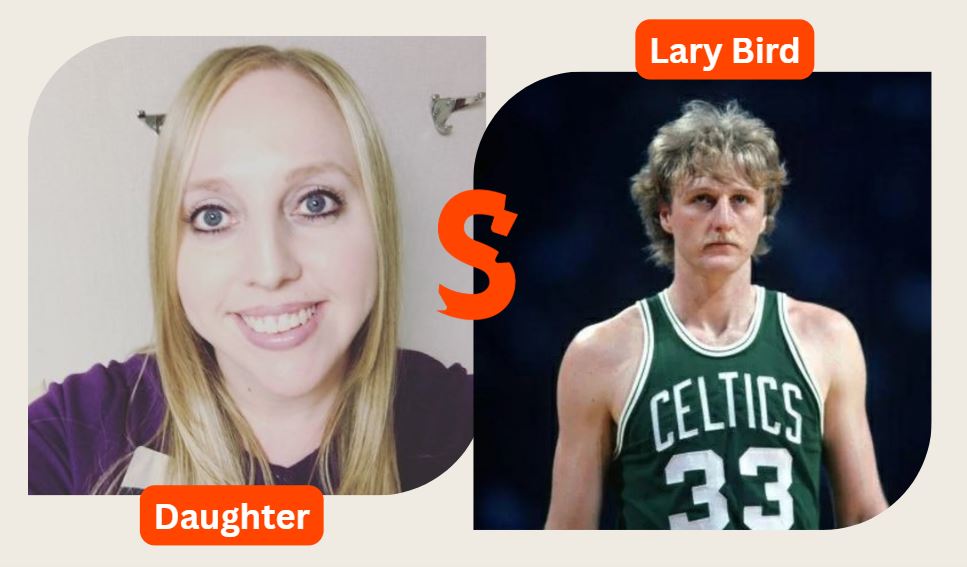
Larry Bird’s basketball career is one of the most documented in the history of American sport. Three NBA championships. Three consecutive MVP awards. Twelve All-Star selections. A Hall of Fame induction. A coaching career that produced a Coach of the Year award. The record is complete and unimpeachable.
His relationship with his first daughter is a different kind of record. It is a record of absence, of letters sent and not answered, of report cards mailed to a father who was becoming one of the most celebrated athletes in the world while his daughter grew up in a house without him. That record is also complete. And Corrie Bird has built her entire adult life in direct response to it.
Born Before the Fame Arrived
Corrie Bird was born on August 14, 1977, in Brazil, Indiana. Her parents, Larry Bird and Janet Condra, had married briefly in 1975 and separated before she was born. The marriage lasted only months. Corrie arrived without a father in the house and grew up with her mother and stepfather Joe Kerns.
At the time of her birth, Larry Bird was 20 years old and still a year away from his legendary college career at Indiana State. He was not yet the Boston Celtic who would define a decade of professional basketball. He was a young man from French Lick, Indiana, who had left a family behind before it ever fully formed.
Larry initially disputed paternity. That dispute was eventually resolved, and he provided financial support throughout Corrie’s childhood. However, he was not present. The financial responsibility was met. The emotional presence was not. That distinction defined Corrie’s childhood in ways that money could not fix.
The Letters That Did Not Get Answered
The detail that makes Corrie Bird’s story specific, rather than a generic absent-father story, is what she did about the absence. She did not simply accept it and move on. As a child, she sent letters to her father. She mailed report cards. She included photographs.
Many of those efforts went unreciprocated. She kept trying. That persistence is the most revealing character detail in her entire biography. A child who sends report cards to a parent who is not responding is not a child who has given up on the relationship. She is a child who still believes the relationship is worth pursuing, even when the evidence says otherwise.
That orientation toward the relationship, persistent even through silence, shaped how she would eventually approach the reconciliation that came decades later. It also shaped how she built her own life in the meantime. She did not wait for her father to define her. She went to school, she worked, she built something on her own terms.
The Athletic World She Grew Up Adjacent To
While Corrie was growing up in Indiana without her father, Larry Bird’s career was producing one of the greatest runs in NBA history. He joined the Boston Celtics in 1979. He won three championships in 1981, 1984, and 1986. He was voted MVP of the Finals twice. He won three consecutive league MVP awards. He was on the Dream Team that won Olympic gold in 1992.
That world was not Corrie’s world. She grew up in Indiana, not Boston. She grew up watching a public figure from a distance, knowing the biological connection existed but living outside the circle of warmth that connection might have produced.
Understanding the mental performance demands that define elite NBA careers helps explain something important about Larry Bird during those years. The focus required to sustain three MVP seasons in a row, to perform on that stage for twelve consecutive All-Star appearances, is total. That level of competitive absorption comes at a cost that is paid by the people around the athlete, not by the athlete alone. In Corrie’s case, she paid part of that cost without choosing to.
Indiana State, Then Indiana Wesleyan
Corrie Bird pursued her own education and career entirely without relying on her father’s name or resources beyond the basic financial support he provided. She attended Indiana State University to earn her bachelor’s degree in elementary education. That is the same university where Larry Bird became a legend, where he averaged nearly 29 points per game in his senior year and led the Sycamores to the 1979 NCAA Championship game against Magic Johnson’s Michigan State.
She chose that institution for her own reasons. The fact that it was his school added a layer of significance that she has never publicly elaborated on, but the choice itself stands as a quiet detail in the larger story.
After Indiana State, she continued her education and earned an MBA from Indiana Wesleyan University. That second degree placed her in healthcare administration, a field that rewards exactly the kind of systematic thinking, organizational discipline, and sustained attention to outcomes that she had been demonsteding since childhood. She entered hospital and healthcare management roles in Indiana, building a career on competence rather than name recognition.
That path connects naturally to what separates good athletes from great ones in sports performance contexts. The six mental skills that separate elite performers include delayed gratification, sustained focus despite adversity, and building toward outcomes that take years to develop. Corrie demonstrated all three, not on a court but in a classroom and a career.
The 1998 Reconciliation
The turning point came in 1998. Larry Bird was in his second year as head coach of the Indiana Pacers. Corrie attended one of his games. They met privately after it. That encounter began a slow, careful process of rebuilding something that had never fully existed.
The reconciliation was not sudden. It was not dramatic. It did not produce an interview or a documentary or a public statement. It produced a gradual shift toward mutual respect between two people who had decades of distance between them.
Since then, Larry Bird has acknowledged Corrie publicly and expressed pride in who she has become. Their relationship is described as respectful rather than deeply close. That is an honest accounting. Two decades of absence do not simply dissolve. What they do is transform into something different, something that is not the original wound and is not a complete healing either, but is a functional, dignified connection that both parties have chosen to maintain.
The recovery science that applies to physical injury has a parallel in human relationships. Recovery does not restore a person or a relationship to exactly what existed before. It creates a new kind of wholeness, one that acknowledges the damage without being controlled by it. Corrie and Larry’s relationship reflects that kind of recovery.
Marriage and Family in Indiana
Corrie Bird married Trent Batson on May 17, 2008, at the Rose-Hulman Institute of Technology in Indiana. The choice of venue reflects her Indiana roots and her lack of interest in celebrity spectacle. Rose-Hulman is a small engineering school in Terre Haute, an unlikely backdrop for a famous athlete’s daughter’s wedding and therefore exactly the right choice for a woman who has spent her entire life demonstrating that she is not interested in trading on her father’s fame.
Together, she and Trent have two children. She prioritizes her family’s privacy. She does not maintain a visible social media presence. She does not give interviews. She does not appear at NBA events or allow herself to be used as a storyline in coverage of Larry Bird’s legacy.
Her half-siblings, through Larry’s marriage to Dinah Mattingly, are Mariah Bird and Connor Bird, both adopted into that household. Corrie did not grow up with them. She grew up separately, with a different mother, in a different household, shaped by a different set of experiences. The three of them are connected by Larry Bird’s name but not by childhood.
Healthcare Administration and What It Represents
Corrie Bird’s career in healthcare administration is not accidental. Healthcare management requires a person to hold complexity without being overwhelmed by it. It requires tracking multiple systems simultaneously, managing people across different functions, maintaining standards under pressure, and making decisions that affect the wellbeing of others. Those are demanding requirements.
Furthermore, the field is fundamentally about service. You do not enter healthcare administration because it is glamorous. You enter it because the work matters and because you have the organizational capacity to make systems run well when they are supposed to keep people healthy and cared for.
In that sense, her career reflects the same values she demonstrated as a child, sending report cards into silence because she believed the relationship was worth the effort. She built a career in a field that requires showing up every day for work that is important and largely invisible to the people it serves.
The posterior chain training that builds the physical foundation of athletic performance works the same way. The exercises that produce the most durable results are often the least visible ones. The glutes and hamstrings that power an elite athlete are built in the gym, out of sight, through sustained and unglamorous effort. Corrie Bird’s career has that same quality.
What She Did Not Inherit and What She Built Instead
Corrie Bird did not inherit Larry Bird’s basketball talent, his fame, or his inner circle. She inherited his last name and the complicated circumstances that came with it. What she built on that foundation belongs entirely to her.
Two degrees. A career in healthcare administration. A marriage that has lasted. Two children raised in Indiana with privacy and stability. A relationship with her father that took 21 years to begin but that she was willing to start when the opportunity arrived.
She also did not inherit his emotional inaccessibility, at least not as a defining characteristic. The woman who sent letters as a child was someone who believed in connection even when connection was not forthcoming. That belief, sustained through the difficult years and brought to the reconciliation in 1998, reflects a kind of emotional persistence that is its own form of athletic discipline.
The Sports Story Inside This Story
Competitors writing about Corrie Bird treat this as a celebrity biography with a reconciliation arc. That is not the wrong framing. But it is incomplete. The more specific story is this: what does it mean to grow up as the biological daughter of one of the greatest athletes America has ever produced, to know that connection exists but to experience it largely through absence, and to build an adult life that is stable, grounded, and entirely self-made?
That is a sports story. It is a story about what elite athletic careers cost the people who do not choose to be inside them. It is a story about the values a person develops when the famous parent’s values about hard work and preparation are known but not transmitted through direct relationship. And it is a story about what self-made achievement looks like when it happens quietly, without recognition, and without any of the resources that Larry Bird’s name could have provided.
Corrie Bird has never asked for recognition. She has simply built a life. That is the Sportiannetwork angle. And it is the one no competitor has found.