
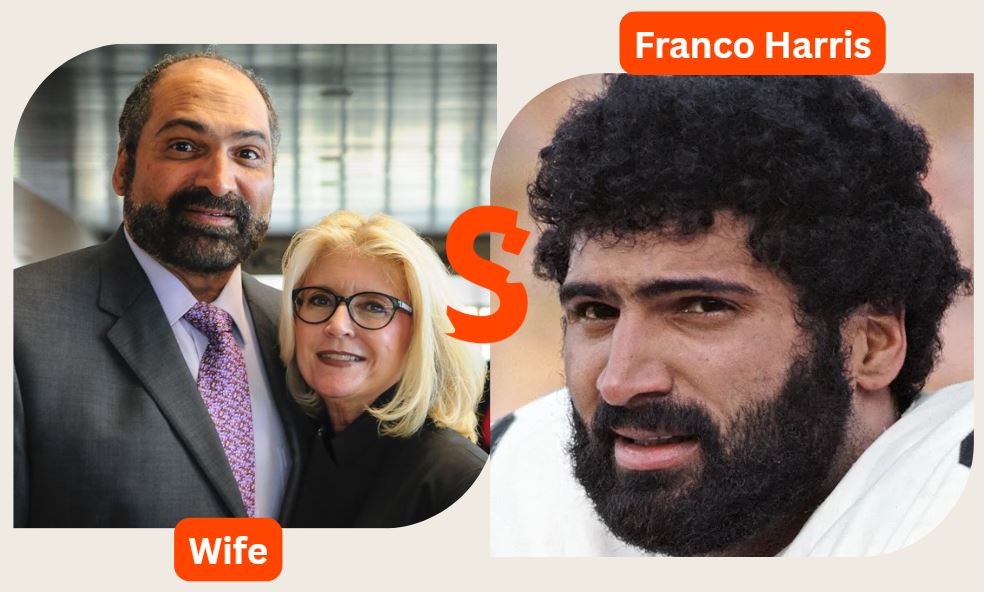
Dana Dokmanovich spent fifty years with one of the greatest running backs in NFL history. She was with Franco Harris before the Immaculate Reception. She was with him through four Super Bowl championships, through the Hall of Fame induction, through decades of Pittsburgh business and community work. On December 21, 2022, he died unexpectedly at age 72. Three days later, standing at midfield in Acrisure Stadium in eight-degree cold, she received his retired number 32 jersey while a crowd chanted his name.
She never said much publicly. Franco always introduced her as his wife, though they were never officially married. That detail says everything about how they operated: outside formal structures, on their own terms, for fifty years.
Serbian Roots and Penn State
Dana Dokmanovich was born between 1951 and 1954 in the United States to Serbian immigrant parents, Peter and Bess Dokmanovich. She grew up with a cultural identity rooted in Serbian-American values, the kind that emphasized family loyalty, hard work, and quiet dignity over public display. Her upbringing shaped her in ways that became visible throughout her adult life.
She attended Penn State University, where her path crossed with Franco Harris, then a running back building toward one of college football’s most accomplished careers. They met during those years and began a relationship that, by the early 1970s, had become permanent. She was also documented in the 1989 book “About Three Bricks Shy and the Load Filled Up” as a flight attendant for Eastern Airlines, a career that reflected her independence and preference for a life that moved on its own terms.
The modeling career attributed to her by several competitor articles, including claims of working with Calvin Klein and Victoria’s Secret, appears to have no verified sourcing. The flight attendant role at Eastern Airlines is confirmed by a primary published source. The rest is speculation dressed up as biography.
Life With Franco Harris
Franco Harris was drafted by the Pittsburgh Steelers in the first round of the 1972 NFL Draft. He would go on to become one of the defining players of his era, central to the Steel Curtain dynasty that won four Super Bowls in six years. His most famous moment came on December 23, 1972, in a playoff game against the Oakland Raiders. A deflected Terry Bradshaw pass fell toward the turf and Harris scooped it at the shoelaces, running 60 yards for a touchdown. The Immaculate Reception became one of the most analyzed plays in football history.
Dana was present for all of it. She was not a sideline personality or a press event fixture. She and Franco kept their personal life firmly private. They attended NFL Honors events together in 2016 in San Francisco and 2019 in Atlanta, which represent some of the few documented public appearances they made as a couple. Their last public appearance together was the 148th Kentucky Derby in Louisville in May 2022, seven months before Franco died.
Throughout his NFL career and afterward, Dana consistently described Franco in terms that reflected genuine admiration rather than celebrity loyalty. In interviews she gave after his death, she described him as someone who went straight up to heaven. She talked about his habit of doing charity work quietly, away from cameras, never wanting to admit the full extent of what he did for people. She noted his emotional composure, how disagreements never rattled him, how he moved at his own pace regardless of external noise. That portrait of Franco Harris, told by Dana, is more specific and more convincing than anything written about him from outside the relationship.
Raising Dok
Dana and Franco had one son, Franco Dokmanovich Harris, known as Dok. He attended Princeton University for his undergraduate degree, then the University of Pittsburgh School of Law. He became an attorney. In 2009, he ran for mayor of Pittsburgh as a Democrat and lost in the primary. He has remained in Pittsburgh and is involved in managing Super Bakery, the nutritional food business his father founded to supply healthy baked goods to school systems. Physical performance and nutritional discipline were values Franco carried into his business life, and Dok has carried that forward.
The way Dana raised Dok reflects her priorities clearly. He did not pursue sports. He pursued law, public service, and business. He went to Princeton, not because his father was a Hall of Famer but because he earned it. He ran for political office in the city where his father was a legend, on his own merits and with his own platform. That outcome does not happen without a parent who emphasized substance over proximity to fame.
What They Were, Exactly
One of the most significant verified details about Dana and Franco’s relationship is that they were never officially married. Franco consistently introduced Dana as his wife to everyone he met, including publicly and at official NFL events. The Pittsburgh Steelers refer to her as his widow. She received his jersey at the retirement ceremony in that capacity, presented by team president Art Rooney II. She spoke at the podium as his widow.
However, no verified record of a formal marriage exists. The 1989 book documenting their relationship describes them as long-term partners. Their son carries both surnames: Franco Dokmanovich Harris. The relationship was real, lasting, and fully committed for five decades. The absence of legal formality does not diminish any of that. However, it does correct a widely repeated error in competitor profiles that confidently state they married in 1972.
December 2022 and the Ceremony
Franco Harris died on December 21, 2022, just days before the 50th anniversary of the Immaculate Reception. His death was unexpected. The jersey retirement ceremony had been planned for months as a celebration. Instead it became a memorial.
On Christmas Eve, Dana stood at midfield at Acrisure Stadium in Pittsburgh as the temperature hovered near eight degrees. With her son Dok beside her and Art Rooney II presenting the jersey, she faced a crowd of thousands chanting Franco’s name. Joe Greene was on the field. Mel Blount was wiping tears with a Terrible Towel. Frenchy Fuqua, whose body the original deflection had bounced off, led the pregame Terrible Towel twirl.
Rooney told the crowd: it wasn’t supposed to be like this, the big man was supposed to be standing right here. He hugged Dana. She leaned her head on his shoulder.
She did not say much. When she did speak, she focused on Franco’s humility and his generosity toward people who were struggling. She asked the crowd to keep his spirit alive. That was it. Composed, specific, and brief, entirely consistent with who she had been for fifty years.
Pittsburgh as Home
Dana and Franco were not transient figures who passed through Pittsburgh on the momentum of his career. They built a genuine life there. The Harris family was embedded in the city through business, charity, and civic engagement in ways that outlasted Franco’s playing days by decades. Super Bakery was a Pittsburgh enterprise. Dok ran for city office in Pittsburgh. Dana lived there through all of it.
That rootedness is part of her story in a way that most profiles ignore. She is not primarily a football widow or a celebrity spouse. She is a woman who chose a city, built a life inside it for half a century, and is still there. The mental commitment required to sustain decades of quiet dedication to family and community, without a public platform or external recognition, is the actual substance of her biography.
What She Did Not Do
Dana Dokmanovich does not have social media. She does not give regular interviews. She has not written a memoir, launched a foundation in her own name, or sought any platform from Franco’s legacy. In the months after his death, when she could have commanded significant media attention, she remained largely invisible.
The balzaromagazine.co.uk profile lists modeling for Calvin Klein and Victoria’s Secret with zero sourcing, gives her a specific net worth of $600,000 with no basis provided, and states she married Franco in 1972 despite no verified record of a legal marriage. That pattern of confident fabrication represents exactly what happens when people article writers fill gaps with invention rather than acknowledging what is actually unknown.
What is known: Serbian-American heritage, Penn State, Eastern Airlines flight attendant, five decades with Franco Harris, one son who attended Princeton and Pittsburgh Law, quiet community presence in Pittsburgh, and a composed appearance at one of the most emotional jersey retirement ceremonies in NFL history. Everything beyond that should be held loosely.