
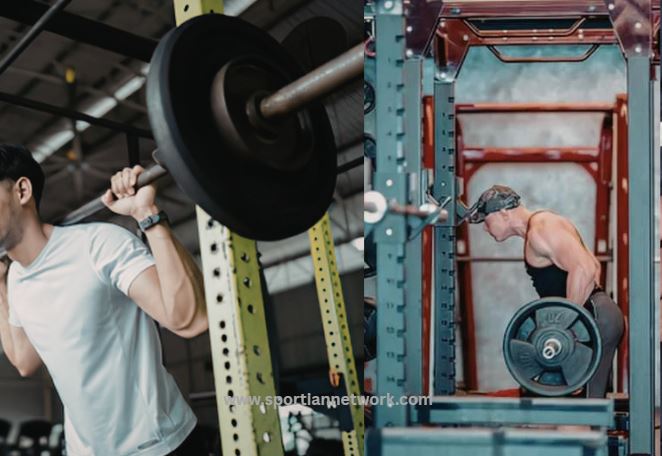
If you are deciding between a power rack and a squat stand for your home gym, here is the short answer: buy the power rack. It is safer, more versatile, and built for the kind of progressive overload that serious athletic training demands. Squat stands have a place, but that place is not under a heavy barbell when you are training alone. This guide breaks down exactly why, and covers the situations where a squat stand actually makes sense.
What Each Piece of Equipment Actually Is
A power rack, sometimes called a squat cage or four-post rack, is a freestanding steel structure with four vertical uprights connected by horizontal crossmembers. It has adjustable J-hooks for racking the bar and safety arms or safety straps that catch the bar if you fail a lift. You train inside the rack, which means the safety system is always within a few inches of the bar.
A squat stand is two independent upright posts, sometimes connected by a single horizontal base bar, with J-hooks for racking. There are no safety arms inside the structure. Some squat stands come with optional spotter arms that attach to the outside of the uprights, but the coverage they provide is limited compared to the full-length safeties of a power rack.
That structural difference is the entire argument. Everything else, price, footprint, and versatility, flows from it.
The Safety Case for a Power Rack
Training to failure or near-failure under a barbell without a spotter requires a reliable bail-out system. A power rack provides that system. Set the safety arms at the right height and a failed squat or bench press becomes a non-event. The bar lands on the safeties, you step out, reset, and go again.
Without safeties, a failed squat requires either dumping the bar backward, which risks injury and damages equipment, or grinding out a rep you should not be grinding out because the alternative is genuinely dangerous. Neither option supports the kind of aggressive training that produces athletic results.
Why Training Alone Changes Everything
Most athletes training in a home gym train alone most of the time. That changes the risk calculation significantly. In a commercial gym with a spotter, a squat stand is a workable solution. At home with no one else present, it is a genuine safety liability under heavy load.
This is not a theoretical concern. It is the reason every serious strength and conditioning facility uses racks with full safety systems rather than open stands. The safety arms in a power rack are not a luxury feature. They are the mechanism that allows athletes to push hard without risking serious injury when a rep goes wrong.
Footprint: The Honest Comparison
The most common argument for a squat stand is space. Squat stands take up less floor space than a power rack, which matters in tight training environments. That argument is real but often overstated.
A standard power rack occupies a footprint of roughly 48 inches by 48 inches, or four feet by four feet. The training space inside and around it requires more room, typically a ten-foot ceiling height clearance and about eight feet of depth to load plates and step back safely. But the actual floor space consumed by the rack itself is not dramatically larger than a squat stand in most setups.
When Space Actually Dictates the Choice
For athletes in genuine space constraints, a half rack is the more sensible middle ground rather than a squat stand. A half rack uses two uprights at the front with a connecting structure at the top and includes safety arms that extend forward. It has a smaller footprint than a full four-post rack while providing a functional safety system. It is a better compromise than a squat stand for space-limited athletes who still need to train heavy and alone.
True squat stands make sense in one specific scenario: a well-equipped commercial facility or team environment where trained spotters are always present and the stand is one piece of equipment among many. In a home gym context, that scenario almost never applies.
Price: What You Actually Get at Each Level
Squat stands are cheaper. A quality squat stand runs $150 to $350. A quality power rack starts around $400 and goes well past $1000 for competition-grade options. That price gap is real and matters at tight budgets.
However, the comparison should not be between a $250 squat stand and a $1200 power rack. It should be between a $250 squat stand and a $400 to $600 entry-level power rack from a reputable brand. At that level, the price difference is $150 to $350. For equipment that will be used multiple times per week for years and that directly affects training safety, that gap is worth closing.
Where to Find Quality at the Entry Level
Brands like Titan Fitness, REP Fitness, and Rogue offer entry-level power racks that handle serious athletic training without the premium price of competition-grade equipment. The Titan T-2 and REP PR-1000 are two of the most consistently recommended entry-level racks in the strength training community. Both handle loads well beyond what most athletes will ever lift, include adjustable safety arms, and have attachment systems for pull-up bars, dip handles, and other accessories that significantly expand training options.
Buying secondhand is also a legitimate strategy. Power racks hold up extremely well over time, and used racks in good condition frequently appear on Facebook Marketplace and Craigslist for 40 to 60 percent of retail price. A used Rogue or Titan rack at $300 is one of the best value purchases in home gym equipment.
Versatility: What a Power Rack Lets You Do
A power rack is not just a squat station. The uprights, crossmembers, and attachment points make it a training hub that supports a wide range of exercises.
Squats: Back squat, front squat, safety bar squat, all with full safety coverage at any depth.
Bench press: Set the safeties at chest height and bench press without a spotter. This is one of the most valuable applications of a power rack for solo athletes. A failed bench press without safeties in a home gym is a serious emergency. With safeties set correctly, it is simply a missed rep.
Pull-ups and chin-ups: Most power racks include a pull-up bar across the top crossmember. This eliminates the need for a separate wall-mounted pull-up station and makes vertical pulling a built-in part of every session.
Barbell rows: The rack provides a convenient starting position for barbell rows at the right height without pulling from the floor each set.
Rack pulls: Partial range deadlifts from pins inside the rack build lockout strength and allow heavier loading than full range deadlifts. This is a useful variation for powerlifters and strength-focused athletes.
Band work: Most racks have band peg attachments at the base that allow resistance band training for warm-up, mobility, and accessory work. This connects directly to the kind of activation work covered in our warm up science guide, where targeted band activation before lifting produces meaningful performance benefits.
Landmine pressing and rowing: A landmine attachment, which runs $30 to $60, fits into the base of most racks and opens up rotational pressing and rowing variations that transfer well to sport. These movements build the rotational strength that bilateral barbell work does not train, which matters for athletes in throwing, striking, and racket sports.
A squat stand supports squats, overhead press, and bench press with a spotter. That is a meaningful but much narrower range of use.
Attachment Ecosystems: A Long-Term Consideration
One underappreciated advantage of investing in a quality power rack from a reputable brand is the attachment ecosystem that comes with it. Rogue, Titan, and REP Fitness all manufacture a range of rack attachments that expand training options significantly over time.
Dip handles, GHD attachments, cable pulley systems, lat pulldown attachments, and monolift add-ons all connect to rack uprights in standard spacing. That means the rack you buy today can become a significantly more capable training station over the next several years as budget allows for additions.
A squat stand has no equivalent ecosystem. What you buy is what you have, and adding meaningful functionality requires purchasing separate equipment rather than expanding an existing system.
The Weight Limit Question
Both power racks and squat stands have rated weight limits, and both typically exceed what most athletes will ever lift. However, the structural stability under those loads differs meaningfully.
A power rack is inherently more stable because the four-post connected structure distributes load and resists lateral movement in all directions. A squat stand, particularly one without a connecting base bar, can tip or shift under very heavy loads or when athletes bail unevenly. Manufacturers address this by recommending that squat stands be bolted to the floor or weighted at the base, but that requirement itself signals the stability limitation.
For athletes who intend to lift heavy, the rack’s inherent structural stability is a meaningful safety advantage beyond just the safety arms. This matters most during heavy squats and overhead press variations where the bar path can drift unpredictably under maximal load.
When a Squat Stand Is the Right Answer
Squat stands are the right choice in a small number of specific situations.
A commercial facility or team strength room with trained spotters always present does not need the safety redundancy of a power rack for every station. Squat stands allow more stations in the same floor space and serve a population where solo training under maximal load is not the norm.
Athletes who genuinely cannot fit a power rack in their training space and who always train with a reliable partner present can make a squat stand work safely. The partner replaces the safety arms, which is the original design intent of the equipment.
Budget situations where the choice is genuinely between a quality squat stand and a very low-quality power rack can favor the stand. A cheap rack from an unknown brand with thin steel and poorly rated safety arms is not meaningfully safer than a well-built squat stand. In that scenario, saving money and buying a quality stand while budgeting toward a quality rack is a reasonable short-term decision.
Using the Savings Wisely
If a squat stand is the current choice due to budget, the savings should go toward the other equipment priorities in the setup, specifically quality plates and a good barbell. Our home gym under $1000 guide outlines exactly how to sequence those purchases so the overall setup produces the best training outcomes within a tight budget. The rack upgrade then becomes the next financial goal once the core equipment is covered.
How This Decision Fits Into a Bigger Home Gym Strategy
The rack or stand decision does not exist in isolation. It sits inside a broader equipment priority order that determines how training-effective a home gym actually becomes. The barbell and plates come first. Flooring comes second. The rack or stand is the third major purchase, and the choice between them shapes how the entire setup functions for years.
Athletes who get the rack right from the start build a training environment that supports genuinely progressive, safe, and varied training. Athletes who start with a squat stand to save money often find themselves constrained within a year and end up spending more total money by replacing the stand with a rack rather than buying the rack initially.
That longer-term view is worth factoring into the decision, particularly for athletes who intend to train seriously at home for multiple years rather than using home gym equipment as a temporary solution.
The Verdict
Buy the power rack. The safety system alone justifies the price difference for any athlete who trains alone under a barbell. The additional versatility, the attachment ecosystem, and the structural stability under heavy load all reinforce that conclusion further.
If budget is genuinely tight, buy a quality entry-level rack from Titan or REP Fitness, look at the used market seriously before dismissing it, and treat the extra cost as the price of training hard without risking a serious injury when a heavy rep goes wrong. That is a trade worth making every time.