
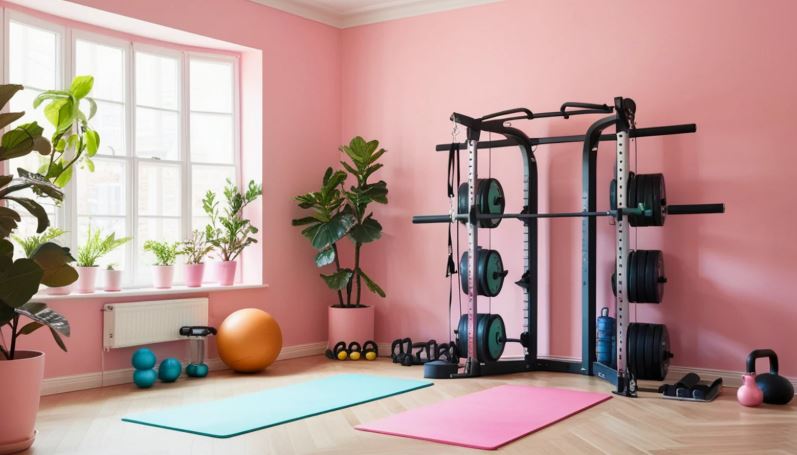
A thousand dollars builds a genuinely serious home gym if you spend it in the right order. You do not need a rack, a cable machine, and a full dumbbell set to train like an athlete. You need a barbell, plates, a pull-up structure, and a few targeted accessories. That combination covers the major movement patterns, supports progressive overload, and holds up for years. This guide tells you exactly what to buy, what to skip, and how to sequence your spending.
Why $1000 Is Enough to Train Seriously
The myth that home gyms require massive investment comes from looking at commercial gym setups and trying to replicate them at home. That is the wrong approach. Commercial gyms stock redundant equipment because they serve hundreds of members with different preferences. You only need to serve one athlete with specific training goals.
A barbell and plates alone can cover squats, deadlifts, Romanian deadlifts, rows, overhead press, and floor press. Add a pull-up bar and you have vertical pulling covered. Add a set of resistance bands and you have warm-up, mobility, and accessory work handled. That is a complete training program without a single machine, cable stack, or adjustable bench in sight.
The key is buying quality on the items that take abuse and saving money on items where budget options perform identically. A cheap barbell will flex, lose its knurling, and eventually fail under heavy load. A cheap resistance band does exactly the same job as an expensive one.
What to Buy First: The Non-Negotiables
A Quality Barbell
The barbell is the single most important purchase in this budget. Do not cut corners here. A good barbell will last decades. A bad one becomes dangerous under load and loses its spin and knurling within months of regular use.
For athletes, a standard 20kg Olympic barbell with rotating sleeves is the right choice. The rotating sleeves matter for any pulling movement because they reduce torque on the wrists and elbows under load. Look for a tensile strength rating of at least 190,000 PSI, which ensures the bar handles heavy deadlifts without permanent bend.
Reputable budget-friendly options exist from brands like Rogue’s entry-level lines, REP Fitness, and Titan Fitness. In the $200 to $300 range, you can find a barbell that performs close to bars costing twice as much. Avoid no-name barbells from Amazon or big-box sporting goods stores. The quality drop at that price point is significant.
Budget allocation: $200 to $280
Bumper Plates or Iron Plates
Your plate choice depends on your floor situation. If you are training on concrete in a garage, iron plates work perfectly and cost less per pound. If you are on a wood floor, in an apartment, or plan to do any Olympic lifting variations, bumper plates are worth the extra cost to protect both the floor and the bar.
For a $1000 budget, a practical starting set is 200 pounds of plates. That covers most athletes through at least one to two years of serious training before they need to add more. A common starting configuration is two 45-pound plates, two 25-pound plates, two 10-pound plates, and two 5-pound plates. This gives you enough range to progress across all major lifts without gaps between loading increments.
Iron plates from REP Fitness, Titan, or CAP Barbell offer solid quality at reasonable prices. Bumper plates cost more per pound, so budget-conscious buyers can mix: bumper plates in the 45-pound denomination and iron for smaller increments.
Budget allocation: $200 to $300
The Pull-Up Solution
A wall-mounted pull-up bar or a freestanding pull-up and dip station handles all vertical pulling. This covers pull-ups, chin-ups, hanging knee raises, and with a set of rings or bands, a range of bodyweight pressing and pulling variations.
Wall-mounted options are more stable and take up less space. They require drilling into studs, which is a five-minute job with the right drill. Freestanding options work for renters who cannot modify walls and typically cost slightly more for equivalent stability.
Doorframe pull-up bars are the cheapest option but have limitations. They cap out at lower weight limits, do not allow full hang with legs extended for taller athletes, and can damage door frames over time. For serious training, a proper wall mount or freestanding station is worth the extra investment.
Brands like Rogue, Titan Fitness, and REP Fitness all offer wall-mounted pull-up bars in the $80 to $150 range that handle heavy athletes without flex or wobble.
Budget allocation: $80 to $150
Flooring: Non-Negotiable for Any Serious Setup
Rubber flooring protects your floor, protects your joints, and makes training on hard surfaces genuinely safer. For a home gym, interlocking rubber tiles at 3/4 inch thickness are the standard. They handle dropped weights without cracking, provide enough cushion for jumping and landing movements, and clean easily.
A basic 10×10 foot training area requires approximately 100 square feet of coverage. Budget rubber tiles from suppliers like RubberFlooringInc or big-box home improvement stores cost between $1.50 and $2.50 per square foot in this thickness. That puts a 100-square-foot area at $150 to $250.
Athletes who are setting up in a garage often find that partial coverage is fine. Covering the deadlift and lifting area with rubber and leaving the surrounding space uncovered is a practical compromise when budget is tight.
Budget allocation: $150 to $200
Accessories That Earn Their Price
Resistance Bands
A set of loop resistance bands covers warm-up activation, mobility work, band-assisted pull-up progressions, and a wide range of accessory exercises. They also serve as emergency replacements for cable machine exercises like pull-aparts, face pulls, and tricep pushdowns.
A set covering light, medium, and heavy resistance runs $25 to $50 from brands like Rogue, Serious Steel, or WOD Nation. This is the category where brand matters less. Most resistance bands at a reasonable price point perform identically. Buy a set with multiple resistance levels rather than individual bands.
Budget allocation: $25 to $50
Fractional Plates
Fractional plates are small weight increments, typically 0.5kg to 1.25kg per plate, that allow smaller jumps between loading sessions. For overhead press and bench press in particular, jumping 10 pounds at a time quickly outpaces realistic strength progression. Fractional plates let athletes add 2 to 4 pounds per session instead, which keeps progress moving without stalling.
A set of fractional plates runs $30 to $60 and lasts indefinitely. For strength-focused athletes, this is one of the highest return purchases in the entire setup.
Budget allocation: $30 to $60
Gymnastics Rings or a Dip Bar
Gymnastics rings attach to any pull-up bar or beam and open up an enormous range of bodyweight exercises: ring rows, ring push-ups, ring dips, ring chin-ups, and eventually more advanced movements. The instability of rings increases muscle activation compared to fixed bar equivalents, making them a surprisingly high-value training tool for a small price.
A quality pair of wooden gymnastics rings with adjustable straps runs $25 to $50. This is another low-cost, high-return purchase that punches well above its price for athletes focused on upper body strength and stability.
Budget allocation: $25 to $50
What to Skip at This Budget
A Power Rack
A quality power rack costs $400 to $800 on its own, which would consume most of this budget for a single piece of equipment. At the $1000 total budget level, skip the rack and use safety alternatives instead.
For squatting, learning to safely bail a squat without a rack is a genuine skill worth developing. Training with a safety squat bar or front squat grip naturally limits how much load you can handle without a rack. Floor press eliminates the need for a rack for bench pressing. Romanian deadlifts and trap bar deadlifts cover the hinge pattern entirely from the floor.
When budget allows an upgrade, a rack becomes the first addition to this setup. Until then, rack-free programming is more achievable than most athletes assume. Our home gym under $300 guide covers rack-free programming in detail for athletes working with even tighter constraints.
Adjustable Dumbbells
Quality adjustable dumbbells cost $300 to $500 for a set that goes heavy enough to be useful. At this budget level, that is a poor allocation when a barbell and plates cover the same movements more effectively at lower cost. Fixed dumbbells in two or three key weights, around 25, 35, and 50 pounds, are a more affordable alternative if dumbbell work is a priority. However, most athletes can replace dumbbell exercises with barbell or band equivalents without losing meaningful training quality.
Cardio Equipment
Treadmills, rowing machines, and assault bikes are valuable tools but expensive relative to what they deliver at budget price points. A $300 treadmill performs significantly worse than a $2000 commercial equivalent. For cardiovascular conditioning at this budget, outdoor running, hill sprints, and jump rope deliver better results at minimal cost. A quality jump rope runs under $30 and produces conditioning outcomes that rival far more expensive equipment when used consistently.
Putting the Budget Together
Here is a realistic full breakdown at different spending levels within the $1000 ceiling:
Core setup ($650 to $750): Barbell ($250), 200 pounds of plates ($250), wall-mounted pull-up bar ($120), rubber flooring for a 10×8 area ($150)
Complete setup ($850 to $1000): Everything above plus resistance bands ($40), fractional plates ($50), gymnastics rings ($40), a foam roller ($30), and a jump rope ($25)
That complete setup handles every major movement pattern: squat, hinge, push, pull, carry, and conditioning. It supports progressive overload through at least two years of serious training before meaningful equipment additions become necessary. And it fits in a single car parking space.
How This Setup Trains Every Major Pattern
Squat: Barbell back squat, front squat, goblet squat with a single plate
Hinge: Conventional deadlift, Romanian deadlift, single leg RDL
Horizontal push: Floor press, push-up variations with band resistance or rings
Horizontal pull: Barbell row, ring row
Vertical pull: Pull-ups and chin-ups on the wall mount or rings
Vertical push: Overhead press, push press
Carry: Farmer carry with plates or barbell
Conditioning: Jump rope, hill sprints, barbell complexes
That is a complete athletic training program. No cables, no machines, no monthly membership required. The posterior chain training guide and upper body strength program on this site are both fully executable with this exact equipment list.
When to Upgrade and What to Add Next
Once the core setup is paid off and training is consistent, the next additions in order of priority are a power rack ($400 to $600), additional plates to extend loading capacity, and a set of kettlebells in two or three weights for swing and carry variations.
A pull-up bar and dip station upgrade, a GHD machine for posterior chain accessory work, or a weighted vest for bodyweight training intensification are all strong additions after the rack. None of these are urgent at the start. The core barbell setup handles serious training long enough to justify the investment in upgrades with confidence rather than guesswork.
A Serious Gym Does Not Require a Serious Space
The athletes who get the most out of home gyms are not the ones with the most equipment. They are the ones who buy the right equipment, program intelligently, and train consistently in the space they have. A barbell, plates, and a pull-up bar in a garage corner will produce better results than a poorly stocked commercial gym visited twice a week.
Spend the $1000 in the right order, skip the equipment that sounds useful but is not, and build a training space that removes every excuse between you and the work.