
Most athletes train hard. They show up. They push heavy weight. They follow a program. And yet they plateau. Their numbers stall. Their body stops responding the way it did in the first few months.
The problem is rarely effort. The problem is usually awareness.
Specifically, the awareness of what is actually happening inside a lift. Most athletes train movements. The best athletes train activations. That distinction is where Duaction lives.
Duaction is the simultaneous activation of both the primary and secondary muscle groups during a compound lift. Not one after the other. Not the primary doing the work while the secondary tags along passively. Both firing together, at full intentional output, from the first rep to the last.
It sounds simple. Almost every serious lifter is leaving significant strength on the table because they have never actually done it.
Why Most Lifters Only Use Half the System
Your body is efficient. It takes shortcuts wherever it can.
When you bench press, your chest is the primary mover. Your triceps and anterior deltoids are the secondary system. Both are supposed to contribute. But if your chest is strong enough to move the weight without demanding full tricep involvement, your nervous system will let the triceps cruise.
This is not laziness. It is energy conservation. Your brain is always looking for the minimum effort solution to any task.
The result is a lift that gets done but does not develop the full muscular system available to you. Over time, the secondary muscles fall further behind. Imbalances develop. Strength plateaus. Injury risk climbs.
Duaction fixes this by making the secondary activation a deliberate, coached intention rather than a passive side effect.
The Science Behind It
When you contract a muscle intentionally rather than letting it activate automatically, you recruit more motor units. More motor units means more muscle fibers involved. More fibers working means more force produced and more adaptation triggered after the session.
Strength exercises for athletes produce better results when the athlete understands which muscles are supposed to work and actively engages them. This is not a new idea in sports science. What Duaction adds is the specific focus on simultaneous dual activation rather than sequential.
Sequential activation means the primary fires, moves the weight, then the secondary assists at the end range. You see this in weak lockout on the bench press. Chest does the work off the bottom. Triceps kick in at the top. That is not Duaction. That is a gap.
True Duaction means both systems are fully engaged from the moment the bar leaves the rack. The chest and triceps are working together at 100% intention for the entire range of motion. The difference in total muscle tension is significant.
How It Changes Your Big Three Lifts
Squat
The primary mover is your quadriceps. The secondary system is your glutes and hamstrings. Most squatters are quad dominant by default. They drive through the front of their foot. Glutes and hamstrings are underused.
Duaction in the squat means actively squeezing the glutes at the bottom of the hole and driving the hamstrings into the floor through the entire ascent. Not just letting the quads push you up. Both systems firing together.
The ultimate glute training guide makes the case for posterior chain development as a speed and power foundation. Duaction in squatting is one of the most direct ways to build that posterior chain during a movement you are already doing.
Deadlift
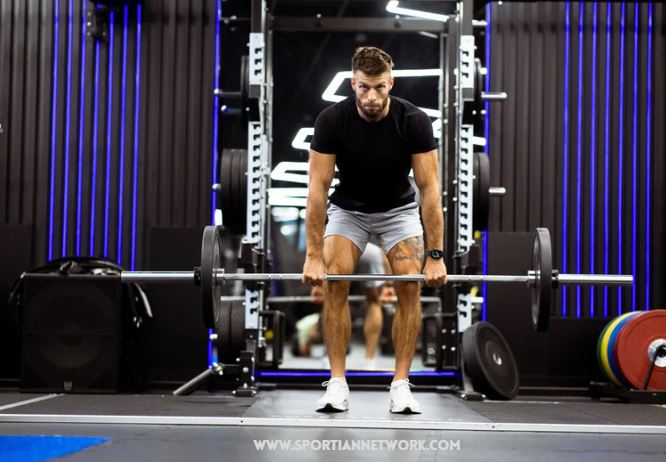
Primary movers are the posterior chain. Hamstrings, glutes, spinal erectors. Secondary system is the lats and upper back.
Most lifters let the bar drift forward off the floor because their lats are not actively engaged. The lat engagement in a deadlift is Duaction. You pull the bar back into your body while you drive the floor away. Two opposing intentions firing simultaneously. The result is a bar path that stays tight and a lift that is dramatically more efficient.
Deadlift form covers the mechanical cues in detail. Duaction is the activation principle underneath those cues. When coaches say “protect your armpits” or “bend the bar around your legs,” they are describing lat engagement. They are describing Duaction without naming it.
Bench Press
Primary is chest. Secondary is triceps and front deltoid.
Most lifters think about pushing the bar up. Duaction means simultaneously thinking about squeezing the chest together and driving the triceps to full lockout as a unified intention. Some elite powerlifters cue this as “push the bar apart” for tricep activation alongside “crush the chest” for pec activation. Both thoughts running at the same time. That is Duaction.
Why Athletes Need It More Than Gym Members
A gym member training for aesthetics can get away with passive secondary activation. The muscle still grows. The visual result is still there.
An athlete cannot afford that inefficiency.
Sport demands full-system output under fatigue, under pressure, at unpredictable moments. A rugby player making a tackle in the 75th minute needs every available motor unit firing in that movement. A basketball player jumping for a contested rebound needs the full hip extension system, not just the quads.
If secondary muscles have been trained passively, they will perform passively in competition. Sport has no warm-up period where you can consciously check your activations. You get what you trained.
Explosive speed training depends directly on full posterior chain activation. That activation is built in the weight room through Duaction. Every rep where the glutes and hamstrings are consciously co-firing with the quads is a rep that builds the athleticism that shows up on the field.
How to Start Training Duaction
The first step is slowing down.
You cannot learn Duaction under maximum load. Drop the weight to 60 to 70 percent of your maximum and focus entirely on activation quality. The goal is not to move heavy weight. The goal is to feel both systems working together.
Use verbal cues. Before each set, name both muscles out loud or in your head. “Chest and triceps.” “Glutes and quads.” “Lats and hamstrings.” This primes the nervous system for dual recruitment before the first rep begins.
Pause reps are useful here. At the bottom of a squat or the bottom of a bench press, hold for two seconds. While holding, consciously check that both the primary and secondary systems are engaged. Then drive up from that fully activated position.
The real reason most athletes plateau comes down to adaptation stagnation. The body stops growing because it has found an efficient pattern and stopped recruiting maximally. Duaction disrupts that pattern. It forces the nervous system to recruit more broadly and more completely.
Over four to six weeks of deliberate Duaction practice, most athletes report that their existing weights feel heavier in a good way. The load has not changed. The muscular demand has increased because more of the system is now genuinely working.
The Long-Term Payoff
Duaction is not a trick. It is a principle that compounds over time.
Every rep trained with full dual activation builds more complete muscular development. More complete development means fewer imbalances. Fewer imbalances means lower injury risk. Lower injury risk means longer, more consistent training careers.
How long you rest between sets matters too. Full recovery between sets is what allows you to maintain Duaction quality through every set of a session. When fatigue forces the secondary system offline, you are no longer training Duaction. You are back to the passive pattern. Rest long enough to do it right.
The athletes who build the most durable, functional strength over a career are almost always the ones who trained with full intentionality. Not just showing up and moving weight. Showing up, activating deliberately, and demanding the complete system every single time.
Duaction is that demand. It is the missing principle. And once you feel both systems firing together on a heavy set, you will never go back to training with half the engine.